
Pulp Fiction, 1922 · page 53 of 176
Argosy All-Story Weekly, December 2, 1922 — page 53: what you’re looking at
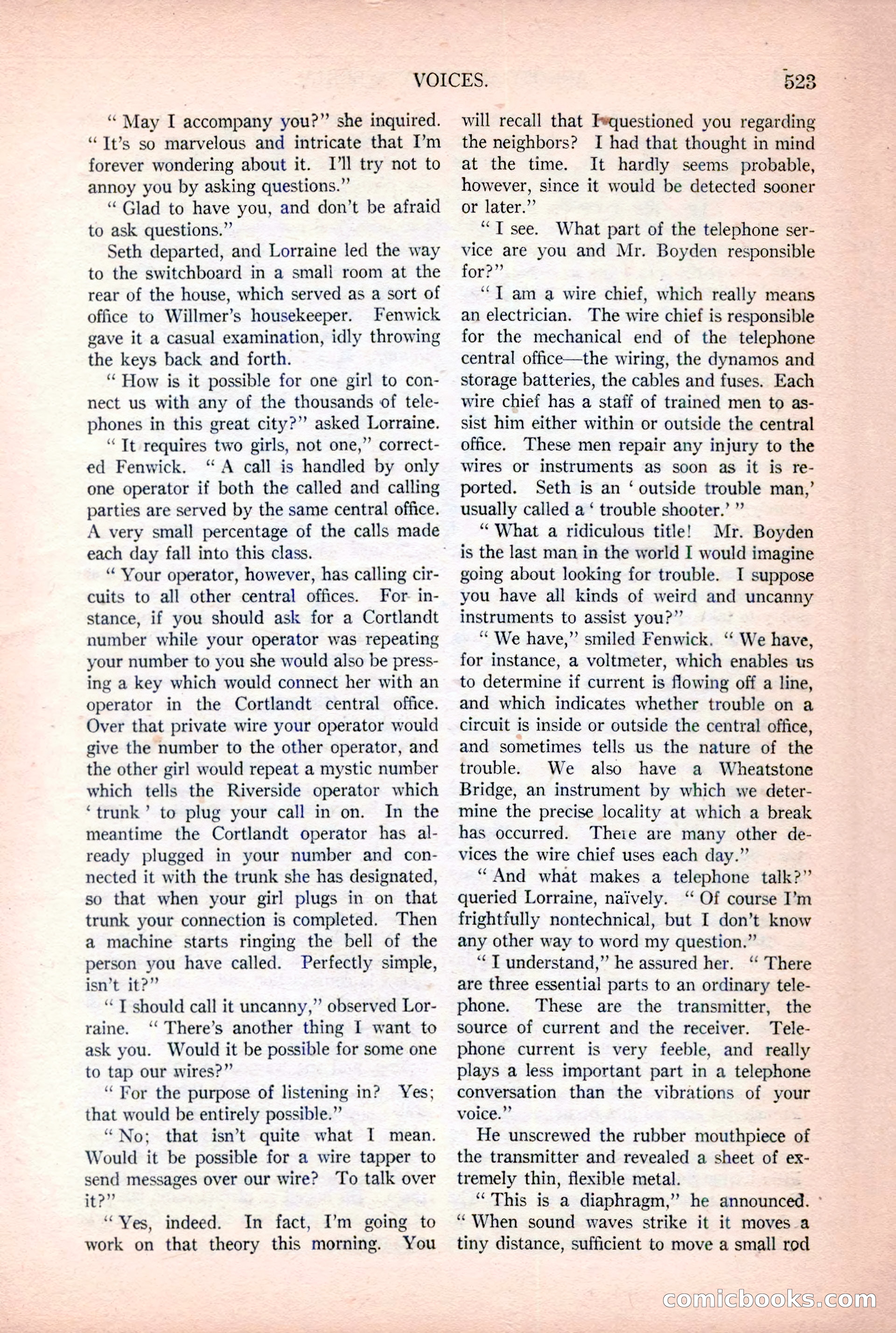
A restored page from Pulp Fiction, 1922. Page through the whole issue in the reader above.
📄 Transcribed text from this page (OCR, searchable)
Machine-transcribed from the original scan — historical spelling and the odd misread are preserved.
VOICES. “ May I accompany you?” she inquired. ‘“Tt’s so marvelous and intricate that I’m forever wondering about it. Ill try not to annoy you by asking questions.” “ Glad to have you, and don’t be afraid to ask questions.” Seth departed, and Lorraine led the way to the switchboard in a smali room at the rear of the house, which served as a sort of office to Willmer’s housekeeper. Fenwick gave it a casual examination, idly throwing the keys back and forth. ‘“ How is it possible for one girl to con- nect us with any of the thousands of tele- phones in this great city?” asked Lorraine. ‘Tt requires two girls, not one,” correct- ed Fenwick. “A call is handled by only one operator if both the called and calling parties are served by the same central office. A very small percentage of the calls made each day fall into this class. “Your operator, however, has calling cir- cuits to all other central offices. For. in- stance, if you should ask for a Cortlandt number while your operator was repeating your number to you she would also be press- ing a key which would connect her with an operator in the Cortlandt central office. Over that private wire your operator would give the number to the other operator, and the other girl would repeat a mystic number which tells the Riverside operator which ‘trunk’ to plug your call in on. In the meantime the Cortlandt operator has al- ready plugged in your number and con- nected it with the trunk she has designated, so that when your girl plugs in on that trunk your connection is completed. Then a machine starts ringing the bell of the person you have called. Perfectly simple, isn’t it?” ‘T should call it uncanny,” observed Lor- raine. ‘‘ There’s another thing I want to ask you. Would it be possible for some one to tap our wires?”’ “For the purpose of listening in? that would be entirely possible.” “No; that isn’t quite what I mean. Would it be possible for a wire tapper to send messages over our wire? To talk over it?” “Ves, indeed. work on that theory this morning. Yes: In fact, I’m going to You 523 will recall that Iwquestioned you regarding the neighbors? I had that thought in mind at the time. It hardly seems probable, however, since it would be detected sooner or later.” ‘“T see. What part of the telephone ser- vice are you and Mr. Boyden responsible for?” ‘““T am a wire chief, which really means an electrician. The wire chief is responsible for the mechanical end of the telephone central office—the wiring, the dynamos and storage batteries, the cables and fuses. Each wire chief has a staff of trained men to as- sist him either within or outside the central office. These men repair any injury to the wires or instruments as soon as it is re- ported. Seth is an ‘ outside trouble man,’ usually called a ‘ trouble shooter.’ ” “What a ridiculous title! Mr. Boyden is the last man in the world I would imagine going about looking for trouble. I suppose you have all kinds of weird and uncanny instruments to assist you?” ‘We have,” smiled Fenwick. “‘ We have, for instance, a voltmeter, which enables us to determine if current is flowing off a line, and which indicates whether trouble on a circuit is inside or outside the central office, and sometimes tells us the nature of the trouble. We also have a Wheatstone Bridge, an instrument by which we deter- mine the precise locality at which a break has occurred. Theie are many other de- vices the wire chief uses each day.” “And what makes a telephone talk?” queried Lorraine, naively. ‘ Of course I’m frightfully nontechnical, but I don’t know any other way to word my question.” ‘“‘T understand,” he assured her. ‘“ There are three essential parts to an ordinary tele- phone. These are the transmitter, the source of current and the receiver. Tele- phone current is very feeble, and really plays a less important part in a telephone conversation than the vibrations of your voice.” 7 He unscrewed the rubber mouthpiece of the transmitter and revealed a sheet of ex- tremely thin, flexible metal. “This is a diaphragm,” he announced. ° ‘When sound waves strike it it moves_a tiny distance, sufficient to move a small rod Gomichbooks;com