
Pulp Fiction, 1922 · page 92 of 176
Argosy All-Story Weekly, December 2, 1922 — page 92: what you’re looking at
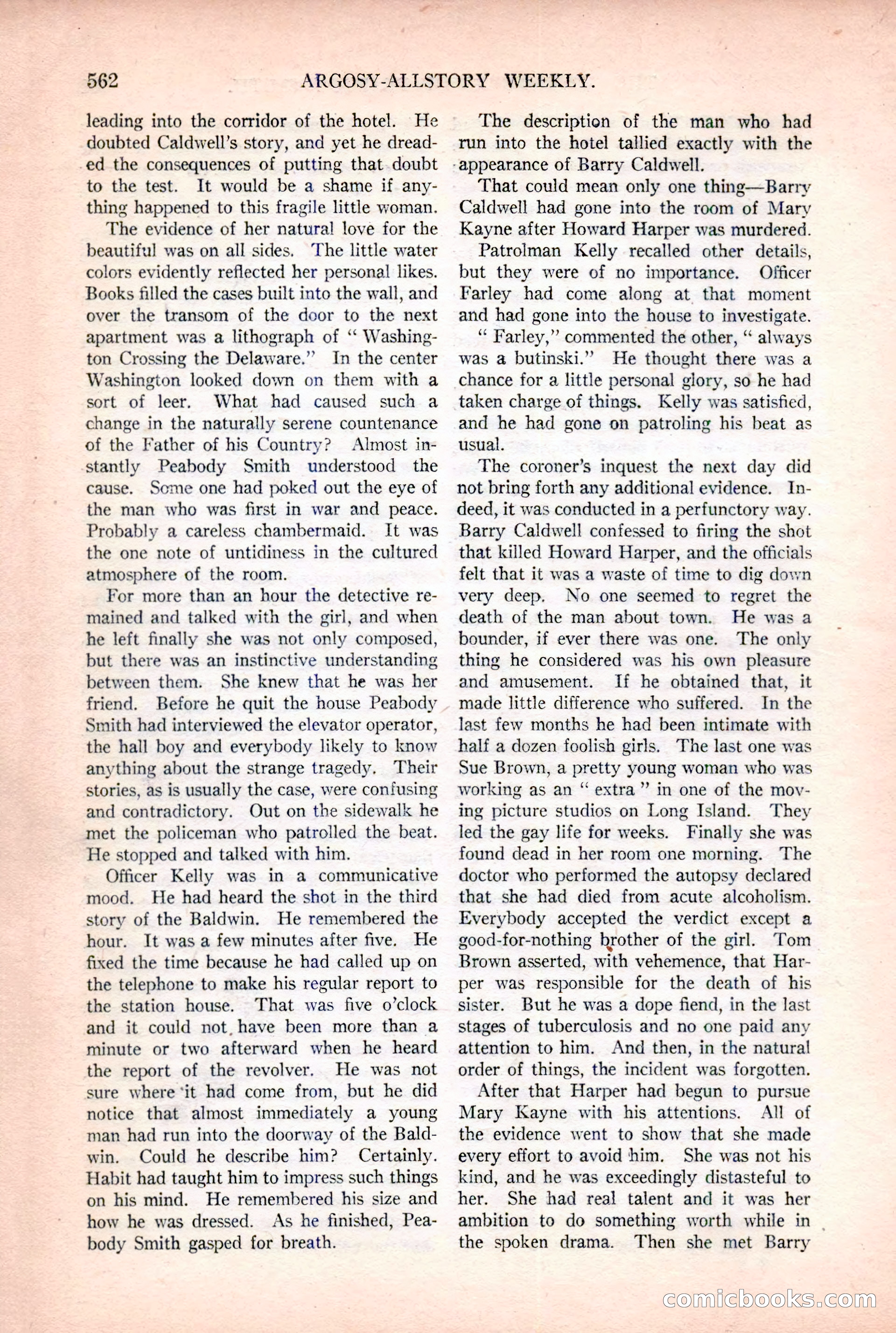
A restored page from Pulp Fiction, 1922. Page through the whole issue in the reader above.
📄 Transcribed text from this page (OCR, searchable)
Machine-transcribed from the original scan — historical spelling and the odd misread are preserved.
562 leading into the corridor of the hotel. He doubted Caldwell’s story, and yet he dread- -ed the consequences of putting that doubt to the test. It would be a shame if any- thing happened to this fragile little woman. The evidence of her natural love for the beautiful was on all sides, The little water colors evidently reflected her personal likes. Books filled the cases built into the wall, and over the transom of the door to the next apartment was a lithograph of ‘‘ Washing- ton Crossing the Delaware.”’ In the center Washington looked down on them with a sort of leer. What had caused such a change in the naturally serene countenance of the Father of his Country? Almost in- stantly Peabody Smith understood the cause. Some one had poked out the eye of the man who was first in war and peace. Probably a careless chambermaid. It was the one note of untidiness in the cultured atmosphere of the room. For more than an hour the detective re- mained and talked with the girl, and when he left finally she was not only composed, but there was an instinctive understanding between them. She knew that he was her friend. Before he quit the house Peabody Smith had interviewed the elevator operator, the hall boy and everybody likely to know anything about the strange tragedy. Their stories, as is usually the case, were confusing and contradictory. Out on the sidewalk he met the policeman who patrolled the beat. He stopped and talked with him. Officer Kelly was in a communicative mood. He had heard the shot in the third story of the Baldwin. He remembered the hour. It was a few minutes after five. He fixed the time because he had called up on the telephone to make his regular report to the station house. That was five o’clock and it could not, have been more than a minute or two afterward when he heard the report of the revolver. He was not sure where ‘it had come from, but he did notice that almost immediately a young man had run into the doorway of the Bald- win. Could he describe him? Certainly. Habit had taught him to impress such things on his mind. He remembered his size and how he was dressed. As he finished, Pea- body Smith gasped for breath. ARGOSY-ALLSTORY WEEKLY. The description of the man who had run into the hotel tallied exactly with the ‘appearance of Barry Caldwell. That could mean only one thing—Barry Caldwell had gone into the room of Mary Kayne after Howard Harper was murdered. Patrolman Kelly recalled other details, but they were of no importance. Officer Farley had come along at that moment and had gone into the house to investigate. ‘“ Farley,” commented the other, “ always was a butinski.”” He thought there was a chance for a little personal glory, so he had taken charge of things. Kelly was satisfied, and he had gone on patroling his beat as usual. The coroner’s inquest the next day did not bring forth any additional evidence. In- deed, it was conducted in a perfunctory way. Barry Caldwell confessed to firing the shot that killed Howard Harper, and the officials felt that it was a waste of time to dig down very deep. No one seemed to regret the death of the man about town. He was a bounder, if ever there was one. The only thing he considered was his own pleasure and amusement. If he obtained that, it made little difference who suffered. In the last few months he had been intimate with half a dozen foolish girls. The last one was Sue Brown, a pretty young woman who was working as an “ extra” in one of the mov- ing picture studios on Long Island. They led the gay life for weeks. Finally she was found dead in her room one morning. The doctor who performed the autopsy declared that she had died from acute alcoholism. Everybody accepted the verdict except a good-for-nothing hrother of the girl. Tom Brown asserted, with vehemence, that Har- per was responsible for the death of his sister. But he was a dope fiend, in the last stages of tuberculosis and no one paid any attention to him. And then, in the natural order of things, the incident was forgotten. After that Harper had begun to pursue Mary Kayne with his attentions. All of the evidence went to show that she made every effort to avoid him. She was not his kind, and he was exceedingly distasteful to her. She had real talent and it was her ambition to do something worth while in ~ the spoken drama. Then she met Barry COmicoookS . Conn