
Pulp Fiction, 1923 · page 134 of 184
Argosy All-Story Weekly, January 13, 1923 — page 134: what you’re looking at
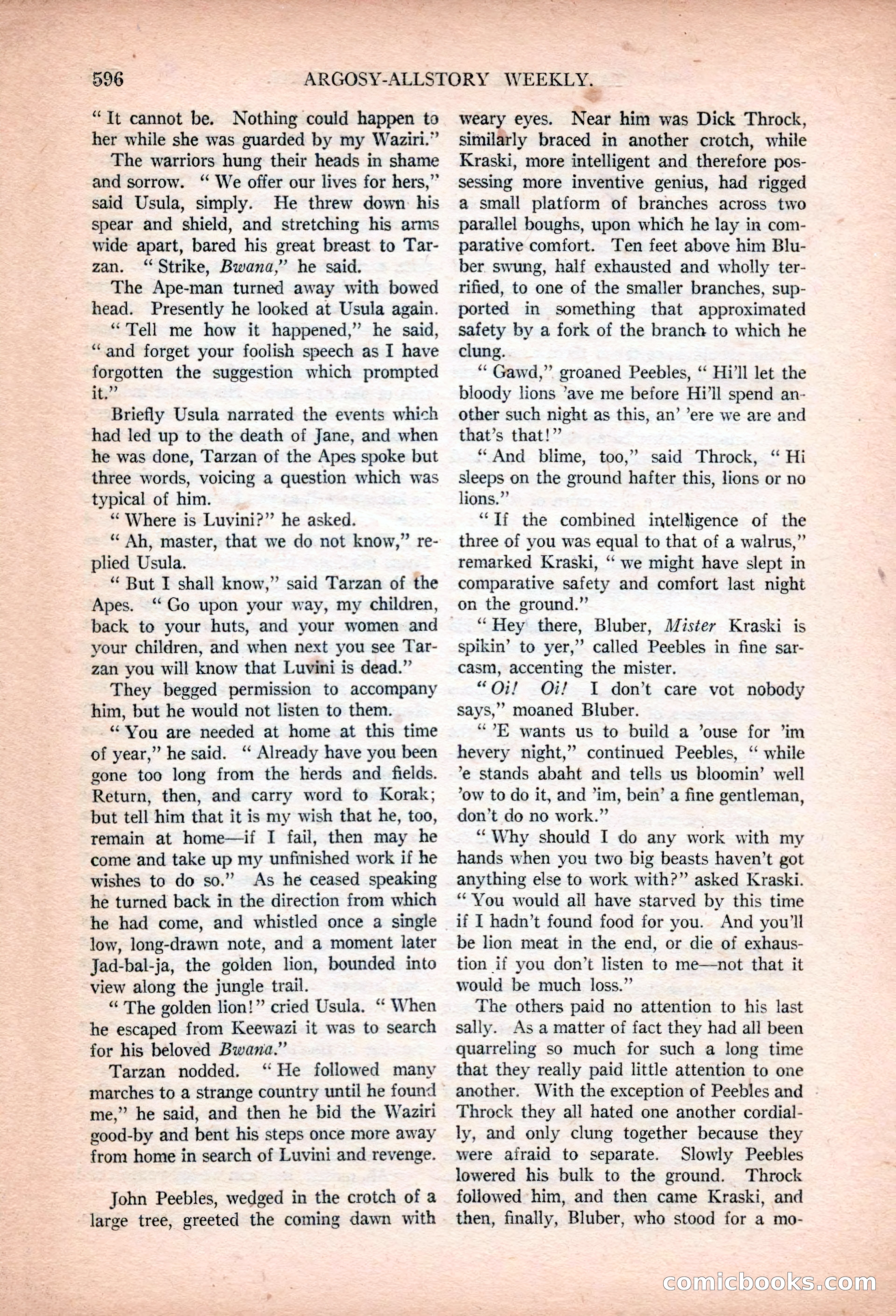
A restored page from Pulp Fiction, 1923. Page through the whole issue in the reader above.
📄 Transcribed text from this page (OCR, searchable)
Machine-transcribed from the original scan — historical spelling and the odd misread are preserved.
—- B96 “It cannot be. Nothing could happen to her while she was guarded by my Waziri.” The warriors hung their heads in shame and sorrow. ‘“ We offer our lives for hers,” said Usula, simply. He threw down. his spear and shield, and stretching his arms wide apart, bared his great breast to Tar- zan. “Strike, Bwana,” he said. The Ape-man turned away with bowed head. Presently he looked at Usula again. “Tell me how it happened,” he said, “and forget your foolish speech as I have forgotten the suggestion which prompted | ad Briefly Usula narrated the events which had led up to the death of Jane, and when he was done, Tarzan of the Apes spoke but three words, voicing a question which was typical of him. “Where is Luvini?” he asked. *‘ Ah, master, that we do not know,” re- plied Usula. “ But I shall know,” said Tarzan of the Apes. ‘‘Go upon your way, my children, back to your huts, and your women and your children, and when next you see Tar- zan you will know that Luvini is dead.” They begged permission to accompany him, but he would not listen to them. “You are needed at home at this time of year,” he said. ‘“ Already have you been gone too long from the herds and fields. Return, then, and carry word to Korak; but tell him that it is my wish that he, too, remain at home—if I fail, then may he come and take up my unfinished work if he wishes to do so.” As he ceased speaking he turned back in the direction from which he had come, and whistled once a single low, long-drawn note, and a moment later Jad-bal-ja, the golden lion, bounded into view along the jungle trail. “ The golden lion!” cried Usula. “ When he escaped from Keewazi it was to search for his beloved Bwana.” Tarzan nodded. “He followed many marches to a strange country until he found me,” he said, and then he bid the Waziri good-by and bent his steps once more away from home in search of Luvini and revenge. John Peebles, wedged in the crotch of a large tree, greeted the coming dawn with ARGOSY-ALLSTORY WEEKLY. weary eyes. Near him was Dick Throck, similarly braced in another crotch, while Kraski, more intelligent and therefore pos- sessing more inventive genius, had rigged a small platform of branches across two parallel boughs, upon which he lay in com- parative comfort. Ten feet above him Blu- ber swung, half exhausted and wholly ter- rified, to one of the smaller branches, sup- ported in something that approximated safety by a fork of the branch to which he clung. ““ Gawd,” groaned Peebles, “‘ Hi’ll let the bloody lions ’ave me before Hi’ll spend an- other such night as this, an’ ’ere we are and that’s that!” “And blime, too,” said Throck, “ Hi sleeps on the ground hafter this, lions or no lions.” “If the combined intelligence of the three of you was equal to that of a walrus,” remarked Kraski, “ we might have slept in comparative safety and comfort last night on the ground.” “Hey there, Bluber, Mister Kraski is spikin’ to yer,” called Peebles in fine sar- casm, accenting the mister. “Oi! Oi! I don’t care vot nobody says,’’ moaned Bluber. “’E wants us to build a ’ouse for ’im hevery night,” continued Peebles, ‘ while ’e stands abaht and tells us bloomin’ well ‘ow to do it, and ’im, bein’ a fine gentleman, don’t do no work.” : “Why should I do any work with my hands when you two big beasts haven’t got anything else to work with?” asked Kraski. “You would all have starved by this time if I hadn’t found food for you. And you'll be lion meat in the end, or die of exhaus- tion if you don’t listen to me—not that it would be much loss.” The others paid no attention to his last sally. As a matter of fact they had all been quarreling so much for such a long time that they really paid little attention to one another. With the exception of Peebles and Throck they all hated one another cordial- ly, and only clung together because they were airaid to separate. Slowly Peebles lowered his bulk to the ground. Throck followed him, and then came Kraski, and then, finally, Bluber, who stood for a mo- ECORMICLO© <S) (E@