
Pulp Fiction, 1923 · page 145 of 184
Argosy All-Story Weekly, January 13, 1923 — page 145: what you’re looking at
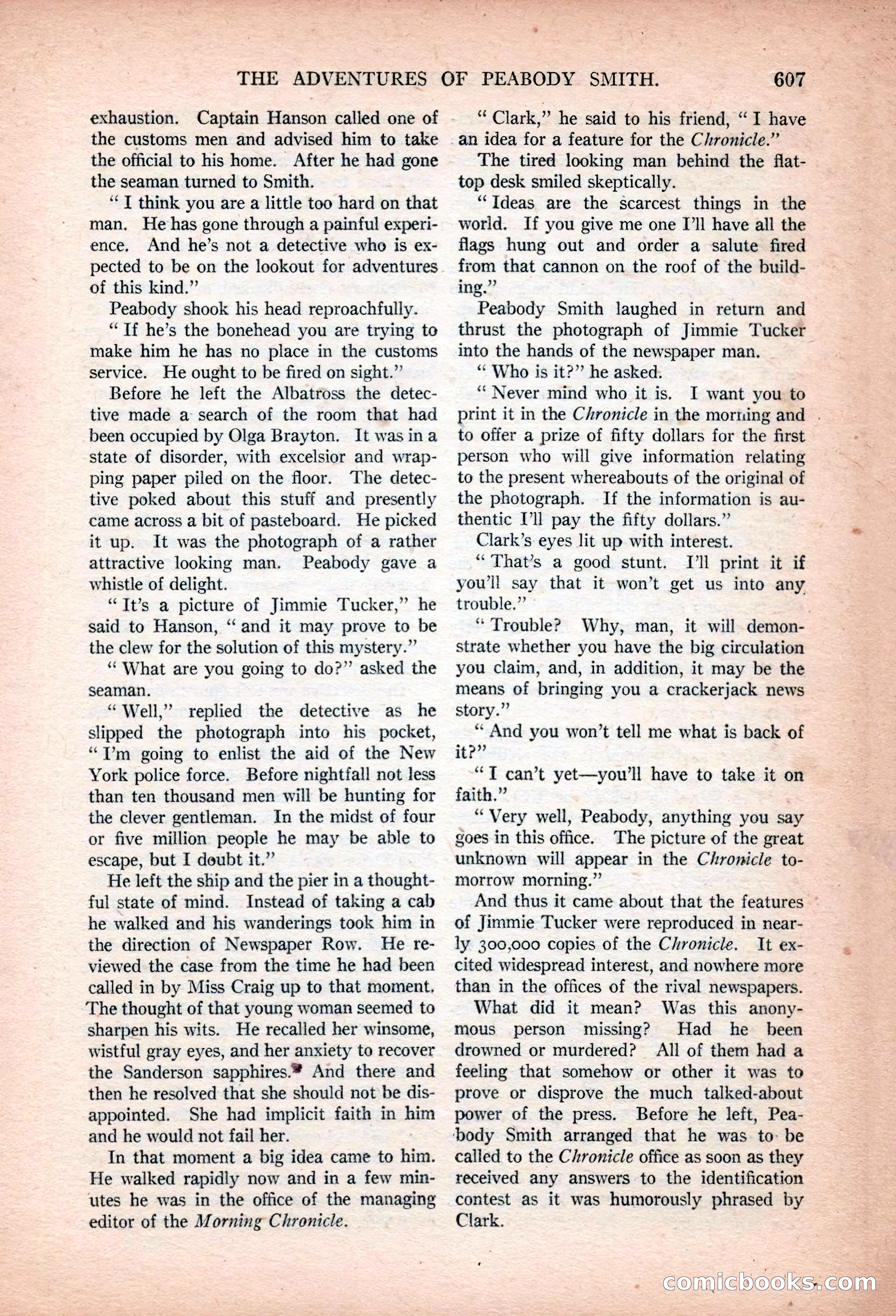
A restored page from Pulp Fiction, 1923. Page through the whole issue in the reader above.
📄 Transcribed text from this page (OCR, searchable)
Machine-transcribed from the original scan — historical spelling and the odd misread are preserved.
THE ADVENTURES OF PEABODY SMITH. exhaustion. Captain Hanson called one of the customs men and advised him to take the official to his home. After he had gone the seaman turned to Smith. ‘*T think you are a little too hard on that man. He has gone through a painful experi- ence. And he’s not a detective who is ex- pected to be on the lookout for adventures of this kind.” Peabody shook his head reproachfully. “Tf he’s the bonehead you are trying to make him he has no place in the customs service. He ought to be fired on sight.” Before he left the Albatross the detec- tive made a search of the room that had been occupied by Olga Brayton. It wasina state of disorder, with excelsior and wrap- ping paper piled on the floor. The detec- tive poked about this stuff and presently came across a bit of pasteboard. He picked it up. It was the photograph of a rather attractive looking man. Peabody gave a whistle of delight. “It’s a picture of Jimmie Tucker,” he said to Hanson, ‘“ and it may prove to be the clew for the solution of this mystery.” ‘What are you going to do?” asked the seaman. “Well,” replied the detective as he slipped the photograph into his pocket, “T’m going to enlist the aid of the New York police force. Before nightfall not less than ten thousand men will be hunting for the clever gentleman. In the midst of four or five million people he may be able to escape, but I doubt it.” He left the ship and the pier in a thought- ful state of mind. Instead of taking a cab he walked and his wanderings took him in the direction of Newspaper Row. He re- viewed the case from the time he had been called in by Miss Craig up to that moment, The thought of that young woman seemed to sharpen his wits. He recalled her winsome, wistful gray eyes, and her anxiety to recover the Sanderson sapphires.¥ And there and then he resolved that she should not be dis- appointed. She had implicit faith in him and he would not fail her. In that moment a big idea came to him. He walked rapidly now and in a few min- utes he was in the office of the managing editor of the Morning Chronicle. 607 “ Clark,” he said to his friend, “I have an idea for a feature for the Chronicle.” The tired looking man behind the flat- top desk smiled skeptically. “Ideas are the scarcest things in the world. If you give me one I’ll have all the flags hung out and order a salute fired from that cannon on the roof of the build- ing.” Peabody Smith laughed in return and thrust the photograph of Jimmie Tucker into the hands of the newspaper man. “Who is it?” he asked. ‘“‘ Never mind who it is. I want you to print it in the Chronicle in the morning and . to offer a prize of fifty dollars for the first person who will give information relating to the present whereabouts of the original of the photograph. If the information is au- thentic Ill pay the fifty dollars.” Clark’s eyes lit up with interest. “That’s a good stunt. I'll print it if you'll say that it won’t get us into any trouble.” “ Trouble? Why, man, it will demon- strate whether you have the big circulation you claim, and, in addition, it may be the means of bringing you a crackerjack news story.” “And you won’t tell me what is back of ite” “T can’t yet—you’ll have to take it on faith.” “Very well, Peabody, anything you say goes in this office. The picture of the great unknown will appear in the Chronicle to- morrow morning.” And thus it came about that the features ~ of Jimmie Tucker were reproduced in near- ly 300,000 copies of the Chronicle. It ex- cited widespread interest, and nowhere more than in the offices of the rival newspapers. What did it mean? Was this anony- mous person missing? Had he been drowned or murdered? All of them had a feeling that somehow or other it was to prove or disprove the much talked-about power of the press. Before he left, Pea- ‘body Smith arranged that he was to: be called to the Chronicle office as soon as they received any answers to the identification contest as it was humorously phrased by Clark. OOK COLANUCE (EO)