
Pulp Fiction, 1923 · page 167 of 184
Argosy All-Story Weekly, January 13, 1923 — page 167: what you’re looking at
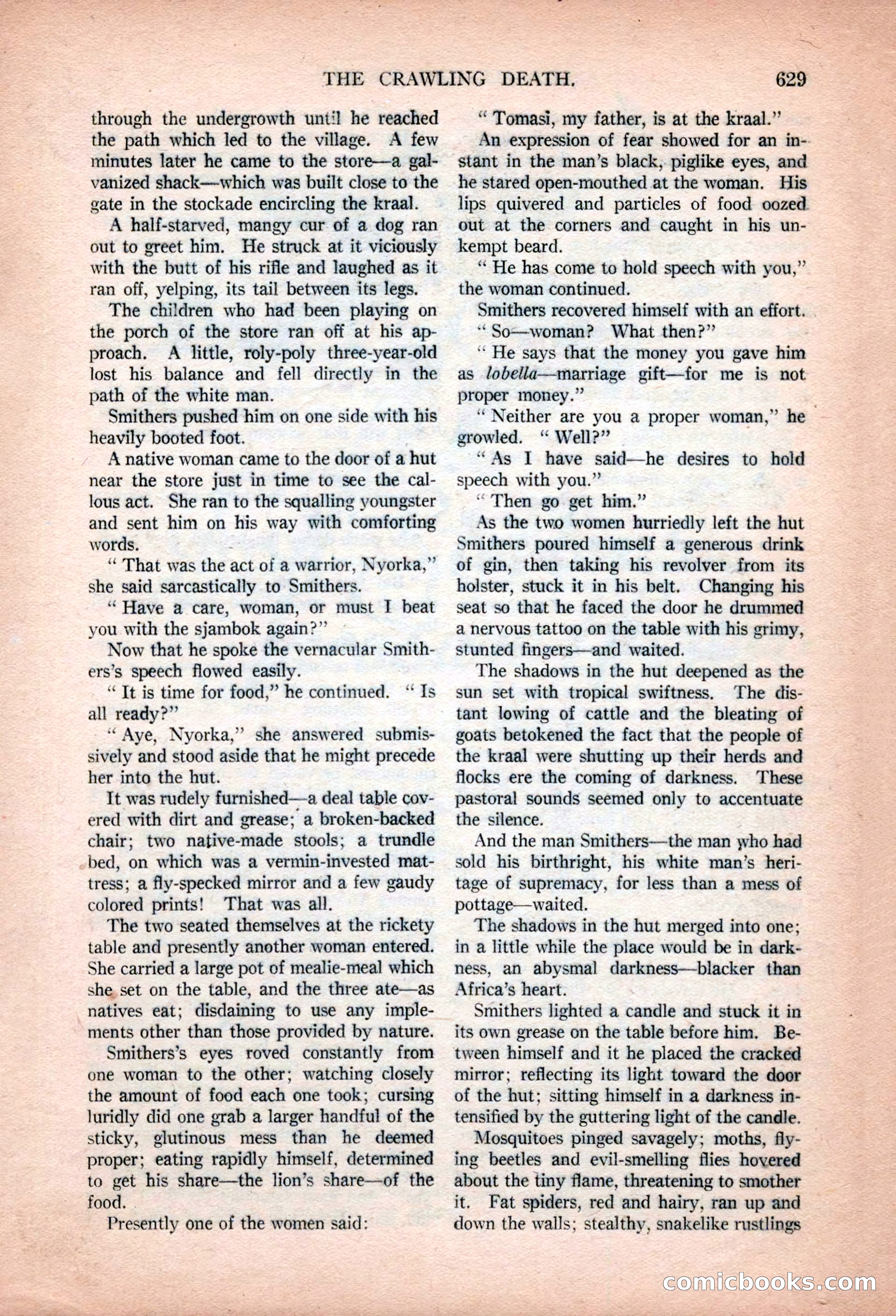
A restored page from Pulp Fiction, 1923. Page through the whole issue in the reader above.
📄 Transcribed text from this page (OCR, searchable)
Machine-transcribed from the original scan — historical spelling and the odd misread are preserved.
THE CRAWLING DEATH. through the undergrowth until he reached the path which led to the village. A few minutes later he came to the store—a gal- vanized shack——which was built close to the gate in the stockade encircling the kraal. A half-starved, mangy cur of a dog ran out to greet him. He struck at it viciously with the butt of his rifle and laughed as it ran off, yelping, its tail between its legs. The children who had been playing on the porch of the store ran off at his ap- proach. A little, roly-poly three-year-old lost his balance and fell directly in the path of the white man. Smithers pushed him on one side with his heavily booted foot. A native woman came to the door of a hut near the store just in time to see the cal- lous act. She ran to the squalling youngster and sent him on his way with comforting words. “That was the act of a warrior, Nyorka,”’ she said sarcastically to Smithers. “ Have a care, woman, or must I beat you with the sjambok again?” Now that he spoke the vernacular Smith- ers’s speech flowed easily. “Tt is time for food,” he continued. ‘“ Is all ready?” ‘“ Aye, Nyorka,” she answered submis- sively and stood aside that he might precede her into the hut. It was rudely furnished—a deal table cov- ered with dirt and grease; a broken-backed chair; two native-made stools; a trundle bed, on which was a vermin-invested mat- tress; a fly-specked mirror and a few gaudy colored prints! That was all. The two seated themselves at the rickety table and presently another woman entered. She carried a large pot of mealie-meal which she set on the table, and the three ate—as natives eat; disdaininge to use any imple- ments other than those provided by nature. Smithers’s eyes roved constantly from one woman to the other; watching closely the amount of food each one took; cursing luridly did one grab a larger handful of the sticky, glutinous mess than he deemed proper; eating rapidly himself, determined to get his share—the lion’s share—of the food. | Presently one of the women said: Ser," “Tomasi, my father, is at the kraal.’’ An expression of fear showed for an in- stant in the man’s black, piglike eyes, and he stared open-mouthed at the woman. His lips quivered and particles of food oozed out at the corners and caught in his un- kempt beard. ‘“ He has come to hold speech with you,” the woman continued. Smithers recovered himself with an effort. ‘““So—woman? What then?” ‘ He says that the money you gave him as lobella—marriage gift—for me is not proper money.” ‘Neither are you a proper woman,” he growled. ‘“ Well?” “As I have said—he desires to hold speech with you.” “Then go get him.” As the two women hurriedly left the hut Smithers poured himself a generous drink of gin, then taking his revolver from its holster, stuck it in his belt. Changing his seat so that he faced the door he drummed a nervous tattoo on the table with his grimy, stunted fingers—and waited. The shadows in the hut deepened as the sun set with tropical swiftness. The dis- tant lowing of cattle and the bleating of goats betokened the fact that the people of the kraal were shutting up their herds and flocks ere the coming of darkness. These pastoral sounds seemed only to accentuate the silence. And the man Smithers—the man who had sold his birthright, his white man’s heri- tage of supremacy, for less than a mess of pottage—waited. The shadows in the hut merged into one; in a little while the place would be in dark- ness, an abysmal darkness—blacker than Africa’s heart. Smithers lighted a candle and stuck it in its own grease on the table before him. Be- tween himself and it he placed the cracked mirror; reflecting its light toward the door of the hut; sitting himself in a darkness in- tensified by the guttering light of the candle. Mosquitoes pinged savagely; moths, fly- ing beetles and evil-smelling flies hovered about the tiny flame, threatening to smother it. Fat spiders, red and hairy, ran up and down the walls; stealthy, snakelike rustlings EOPNICGLOO KS 629 com