
Pulp Fiction, 1923 · page 20 of 184
Argosy All-Story Weekly, January 13, 1923 — page 20: what you’re looking at
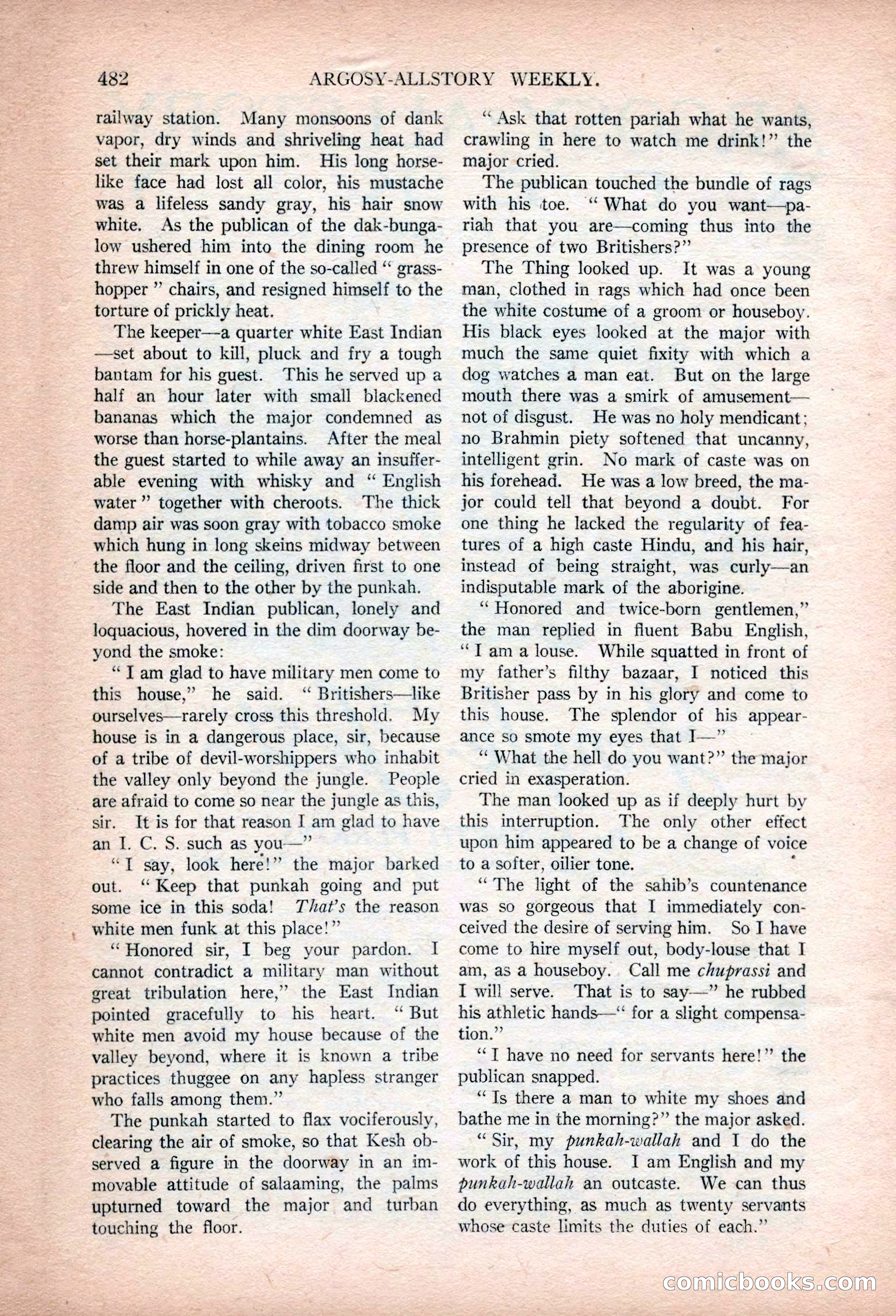
A restored page from Pulp Fiction, 1923. Page through the whole issue in the reader above.
📄 Transcribed text from this page (OCR, searchable)
Machine-transcribed from the original scan — historical spelling and the odd misread are preserved.
482 railway station. Many monsoons of dank vapor, dry winds and shriveling heat had set their mark upon him. His long horse- like face had lost all color, his mustache was a lifeless sandy gray, his hair snow white. As the publican of the dak-bunga- low ushered him into the dining room he threw himself in one of the so-called “‘ grass- hopper ” chairs, and resigned himself to the torture of prickly heat. The keeper—a quarter white East Indian —set about to kill, pluck and fry a tough bantam for his guest. This he served up a half an hour later with small blackened bananas which the major condemned as worse than horse-plantains. After the meal the guest started to while away an insuffer- able evening with whisky and “ English water ” together with cheroots. The thick damp air was soon gray with tobacco smoke which hung in long skeins midway between the floor and the ceiling, driven first to one side and then to the other by the punkah. The East Indian publican, lonely and loquacious, hovered in the dim doorway be- yond the smoke: “I am glad to have military men come to this house,” he said. ‘“ Britishers—like ourselves—rarely cross this threshold. My house is in a dangerous place, sir, because of a tribe of devil-worshippers who inhabit the valley only beyond the jungle. People - are afraid to come so near the jungle as this, sir. It is for that reason I am glad to have an I. C, S. such as you—”’ “T say, look here!” the major barked out. ‘ Keep that punkah going and put some ice in this soda! TJva?’s the reason white men funk at this place!” “Honored sir, I beg your pardon. I cannot contradict a military man without great tribulation here,’ the East Indian pointed gracefully to his heart. “ But white men avoid my house because of the valley beyond, where it is known a tribe practices thuggee on any hapless stranger who falls among them.” The punkah started to flax vociferously, clearing the air of smoke, so that Kesh ob- served a figure in the doorway in an im- movable attitude of salaaming, the palms upturned toward the major and turban touching the floor. ARGOSY-ALLSTORY WEEKLY. “ Ask that rotten pariah what he wants, crawling in here to watch me drink!” the major cried. The publican touched the bundle of rags with his toe. ‘“ What do you want—pa- riah that you are—coming thus into the presence of two Britishers?” The Thing looked up. It was a young man, clothed in rags which had once been the white costume of a groom or houseboy. His black eyes looked at the major with much the same quiet fixity with which a dog watches a man eat. But on the large mouth there was a smirk of amusement— not of disgust. He was no holy mendicant; no Brahmin piety softened that uncanny, intelligent grin. No mark of caste was on his forehead. He was a low breed, the ma- jor could tell that beyond a doubt. For one thing he lacked the regularity of fea- tures of a high caste Hindu, and his hair, instead of being straight, was curly—an indisputable mark of the aborigine. ‘““Honored and twice-born gentlemen,” the man replied in fluent Babu English, “Tama louse. While squatted in front of my father’s filthy bazaar, I noticed this Britisher pass by in his glory and come to this house. The splendor of his appear- ance so smote my eyes that I—” ‘What the hell do you want?” the major cried in exasperation. The man looked up as if deeply hurt by this interruption. The only other effect upon him appeared to be a change of voice to a softer, oilier tone. : “The light of the sahib’s countenance was so gorgeous that I immediately con- ceived the desire of serving him. So I have come to hire myself out, body-louse that I am, as a houseboy. Call me chuprassi and I will serve. That is to say—” he rubbed his athletic hands—‘ for a slight compensa- tion.” ‘“‘T have no need for servants here!”’ the publican snapped. “Ts there a man to white my shoes and bathe me in the morning?” the major asked. “Sir, my punkah-wallah and I do the work of this house. I am English and my punkah-wallah an outcaste. We can thus do everything, as much as twenty servants whose caste limits the duties of each.” CORNICLOOOLK< (C@)