
Pulp Fiction, 1923 · page 39 of 184
Argosy All-Story Weekly, January 13, 1923 — page 39: what you’re looking at
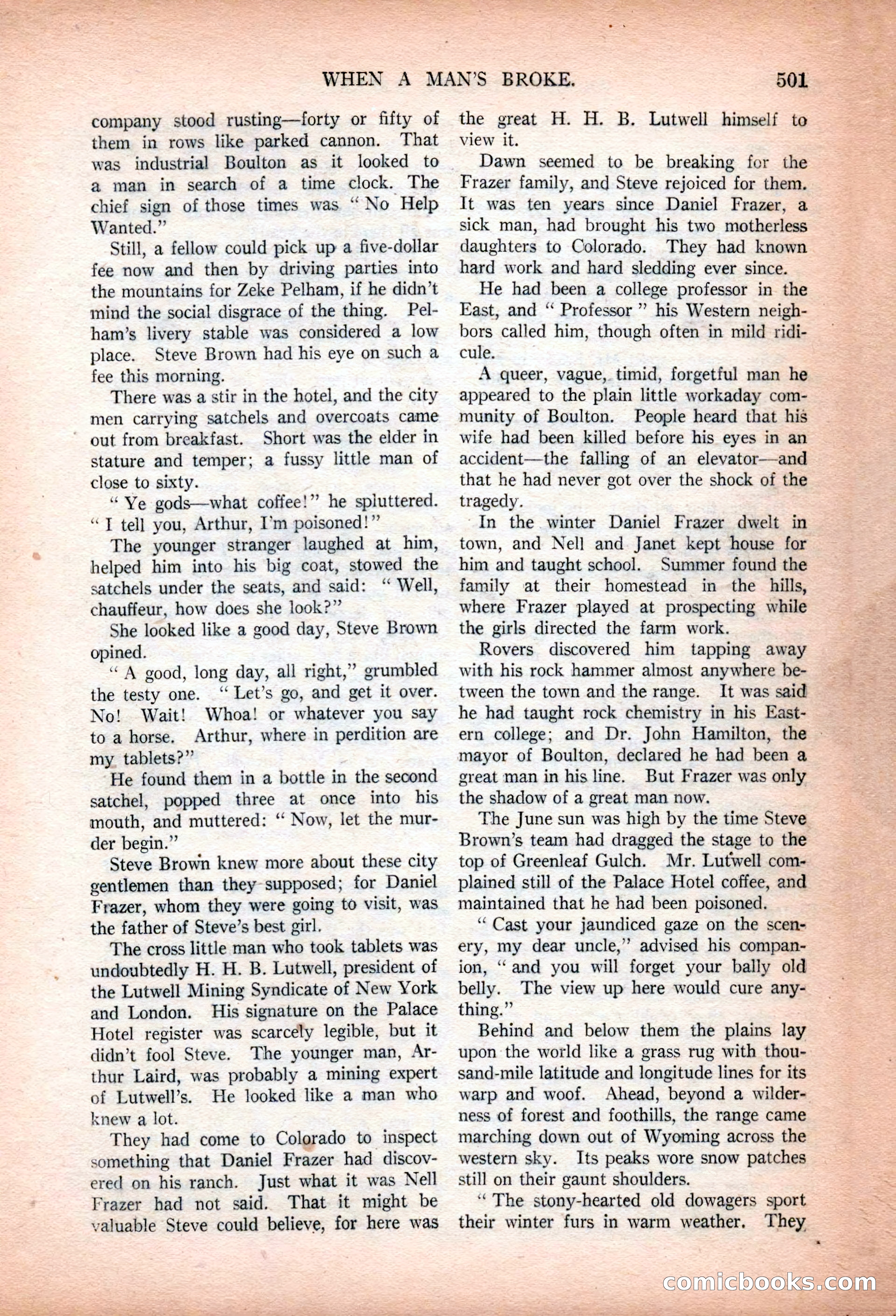
A restored page from Pulp Fiction, 1923. Page through the whole issue in the reader above.
📄 Transcribed text from this page (OCR, searchable)
Machine-transcribed from the original scan — historical spelling and the odd misread are preserved.
- out from breakfast. WHEN A MAN’S BROKE. company stood rusting—forty or fifty of them in rows like parked cannon. That was industrial Boulton as it looked to a man in search of a time clock. The chief sign of those times was “No Help Wanted.” Still, a fellow could pick up a five-dollar fee now and then by driving parties into the mountains for Zeke Pelham, if he didn’t mind the social disgrace of the thing. Pel- ham’s livery stable was considered a low place. Steve Brown had his eye on such a fee this morning. There was a stir in the hotel, and the city men carrying satchels and overcoats came Short was the elder in stature and temper; a fussy little man of close to sixty. “Ye gods—what coffee!” he spluttered. “T tell you, Arthur, I’m poisoned!” The younger stranger laughed at him, helped him into his big coat, stowed the satchels under the seats, and said: “ Well, chauffeur, how does she look?” She looked like a good day, Steve Brown opined. “A good, long day, all right,” grumbled the testy one. “ Let’s go, and get it over. No! Wait! Whoa! or whatever you say to a horse. Arthur, where in perdition are my. tablets?” He found them in a bottle in the second satchel, popped three at once into his mouth, and muttered: ‘‘ Now, let the mur- der begin.” Steve Brown knew more about these city gentlemen than they supposed; for Daniel Frazer, whom they were going to visit, was the father of Steve’s best girl. The cross little man who took tablets was undoubtedly H. H. B. Lutwell, president of the Lutwell Mining Syndicate of New York and London. His signature on the Palace Hotel register was scarcely legible, but it didn’t fool Steve. The younger man, Ar- thur Laird, was probably a mining expert of Lutwell’s. He looked like a man who knew a lot. They had come to Colorado to inspect something that Daniel Frazer had discov- ered on his ranch. Just what it was Nell Frazer had not said. That it might be valuable Steve could believe, for here was the great H. H. B. Lutwell himself to view it. Dawn seemed to be breaking for the Frazer family, and Steve rejoiced for them. It was ten years since Daniel Frazer, a sick man, had brought his two motherless daughters to Colorado. They had known hard work and hard sledding ever since. He had been a college professor in the East, and “ Professor” his Western neigh- — bors called him, though often in mild ridi- cule. A queer, vague, timid, forgetful man he appeared to the plain little workaday com- munity of Boulton. People heard that his wife had been killed before his eyes in an accident—the falling of an elevator—and that he had never got over the shock of the tragedy. In the winter Daniel Frazer dwelt in town, and Nell and Janet kept house for him and taught school. Summer found the family at their homestead in the hills, where Frazer played at prospecting while the girls directed the farm work. Rovers discovered him tapping away with his rock hammer almost anywhere be- tween the town and the range. It was said he had taught rock chemistry in his East- ern college; and Dr. John Hamilton, the ~ mayor of Boulton, declared he had been a great man in his line. But Frazer was only the shadow of a great man now. The June sun was high by the time Steve Brown’s team had dragged the stage to the top of Greenleaf Gulch. Mr. Lutwell com- plained still of the Palace Hotel coffee, and maintained that he had been poisoned. “Cast your jaundiced gaze on the scen- ery, my dear uncle,” advised his compan- ion, ‘and you will forget your bally old belly. The view up here would cure any- thing.” Behind and below them the plains lay upon the world like a grass rug with thou- sand-mile latitude and longitude lines for its warp and woof. ness of forest and foothills, the range came marching down out of Wyoming across the western sky. Its peaks wore snow patches still on their gaunt shoulders. ‘“The stony-hearted old dowagers sport their winter furs in warm weather. They Eomirebook: 501 Ahead, beyond a wilder-