
Pulp Fiction, 1923 · page 44 of 184
Argosy All-Story Weekly, January 13, 1923 — page 44: what you’re looking at
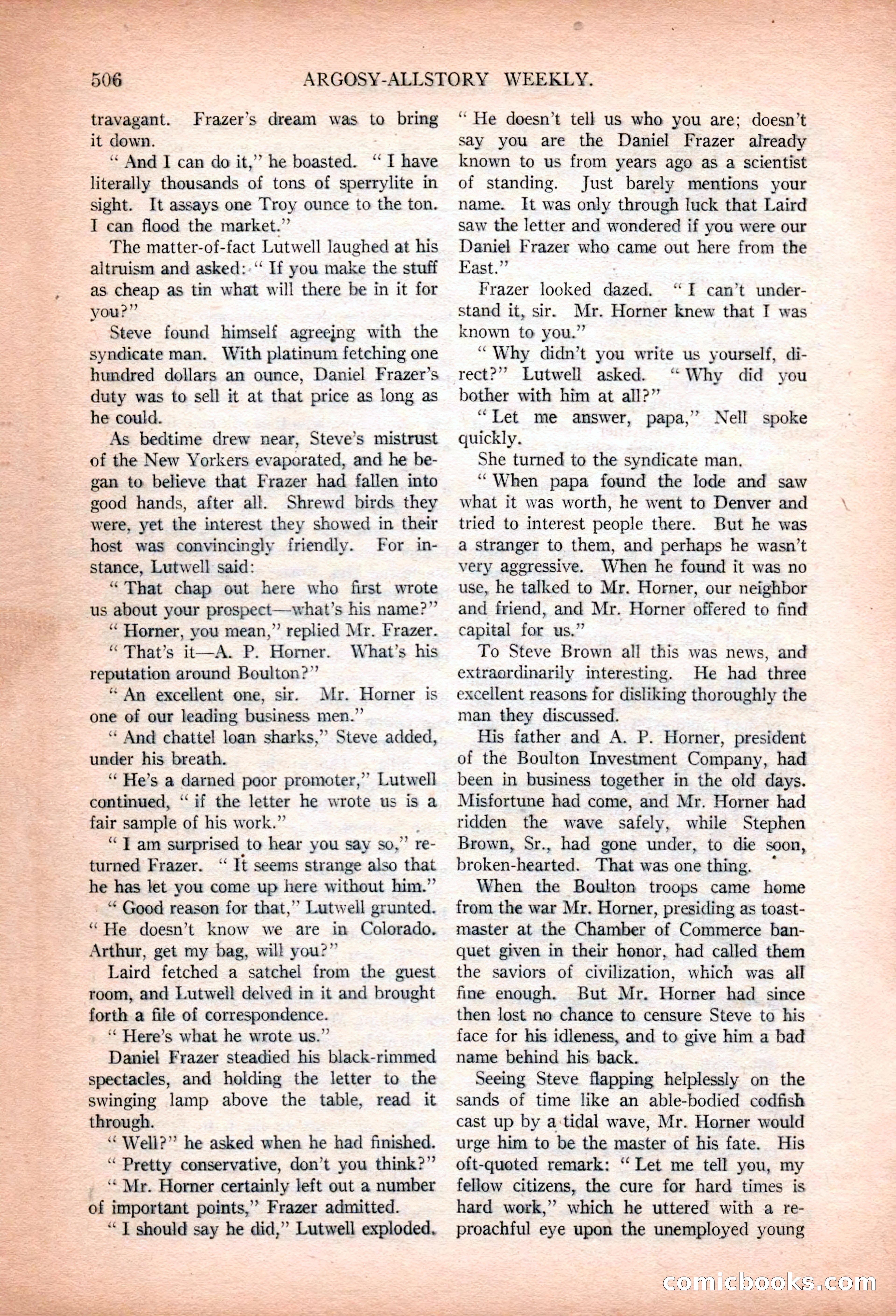
A restored page from Pulp Fiction, 1923. Page through the whole issue in the reader above.
📄 Transcribed text from this page (OCR, searchable)
Machine-transcribed from the original scan — historical spelling and the odd misread are preserved.
ag ee a >. ew be a a i aa travagant. Frazer’s dream was to bring it down. ‘‘ And I can do it,’”’ he boasted. ‘“ I have literally thousands of tons of sperrylite in sight. It assays one Troy ounce to the ton. I can flood the market.” The matter-of-fact Lutwell laughed at his altruism and asked:.‘‘ If you make the stuff as. cheap as tin what will there be in it for you?” Steve found himself agreejng with the syndicate man. With platinum fetching one hundred dollars an ounce, Daniel Frazer’s duty was to sell it at that price as long as he could. As bedtime drew near, Steve’s mistrust of the New Yorkers evaporated, and he be- gan to believe that Frazer had fallen into good hands, after all. Shrewd birds they were, yet the interest they showed in their host was convincingly friendly. For in- stance, Lutwell said: “That chap out here who first wrote us about your prospect—what’s his name?”’ “Horner, you mean,” replied Mr. Frazer. “That’s it—A. P. Horner. What’s his reputation around Boulton?” “ An excellent one, sir. Mr. Horner is one of our leading business men.” “ And chattel loan sharks,” Steve added, under his breath. ‘“ He’s a darned poor promoter,” Lutwell continued, ‘‘ if the letter he wrote us is a fair sample of his work.” “T am surprised to hear you say so,” re- turned Frazer. “ It seems strange also that he has let you come up here without him.” _“ Good reason for that,’’ Lutwell grunted. “ He doesn’t know we are in Colorado. Arthur, get my bag, will you?” Laird fetched a satchel from the guest room, and Lutwell delved in it and brought forth a file of correspondence. ‘““ Here’s what he wrote us.” Daniel Frazer steadied his black-rimmed spectacles, and holding the letter to the swinging lamp above the table, read it through. “Well?” he asked when he had finished. ‘“ Pretty conservative, don’t you think?” _ “ Mr. Horner certainly left out a number of important points,’ Frazer admitted. “J should say he did,” Lutwell exploded. setter ween Mar — ~~ os a a | as el a eee ee” a a ee. = rn ae Se — a ee eg ~ 4 See ~ a ——, ~~," a ~~ — = yg = wee - = i - — r- ~ ARGOSY-ALLSTORY WEEKLY. ‘“ He doesn’t tell us who you are; doesn’t say you are the Daniel Frazer already known to us from years ago as a scientist of standing. Just barely mentions your name. I[t was only through luck that Laird saw the letter and wondered if you were our Daniel Frazer who came out here from the Fast.” . Frazer looked dazed. “I can’t under- stand it, sir. Mr. Horner knew that I was known to you.” “Why didn’t you write us yourself, di- rect?” Lutwell asked. “Why did you bother with him at all?” “Let me answer, papa,’ Nell spoke quickly. She turned to the syndicate man, “When papa found the lode and saw what it was worth, he went to Denver and tried to interest people there. But he was a stranger to them, and perhaps he wasn’t very aggressive. When he found it was no use, he talked to Mr. Horner, our neighbor and friend, and Mr. Horner offered to find capital for us.” To Steve Brown all this was news, and extraordinarily interesting. He had three excellent reasons for disliking thoroughly the man they discussed. His father and A. P. Horner, president of the Boulton Investment Company, had been in business together in the old days. Misfortune had come, and Mr. Horner had ridden the wave safely, while Stephen Brown, Sr., had gone under, to die soon, broken-hearted. That was one thing. ~ When the Boulton troops came home from the war Mr. Horner, presiding as toast- master at the Chamber of Commerce ban- quet given in their honor, had called them the saviors of civilization, which was all fine enough. But Mr. Horner had since then lost no chance to censure Steve to his face for his idleness, and to give him a bad name behind his back. Seeing Steve flapping helplessly on the sands of time like an able-bodied codfish cast up by a:tidal wave, Mr. Horner would urge him to be the master of his fate. His oft-quoted remark: “ Let me tell you, my fellow citizens, the cure for hard times is hard work,” which he uttered with a re- proachful eye upon the unemployed young COPMIC LOOKS a“ Te mal a es ~, . (E@) im — ; © ae ee ~~ vr s —— ee