
Pulp Fiction, 1923 · page 74 of 184
Argosy All-Story Weekly, January 13, 1923 — page 74: what you’re looking at
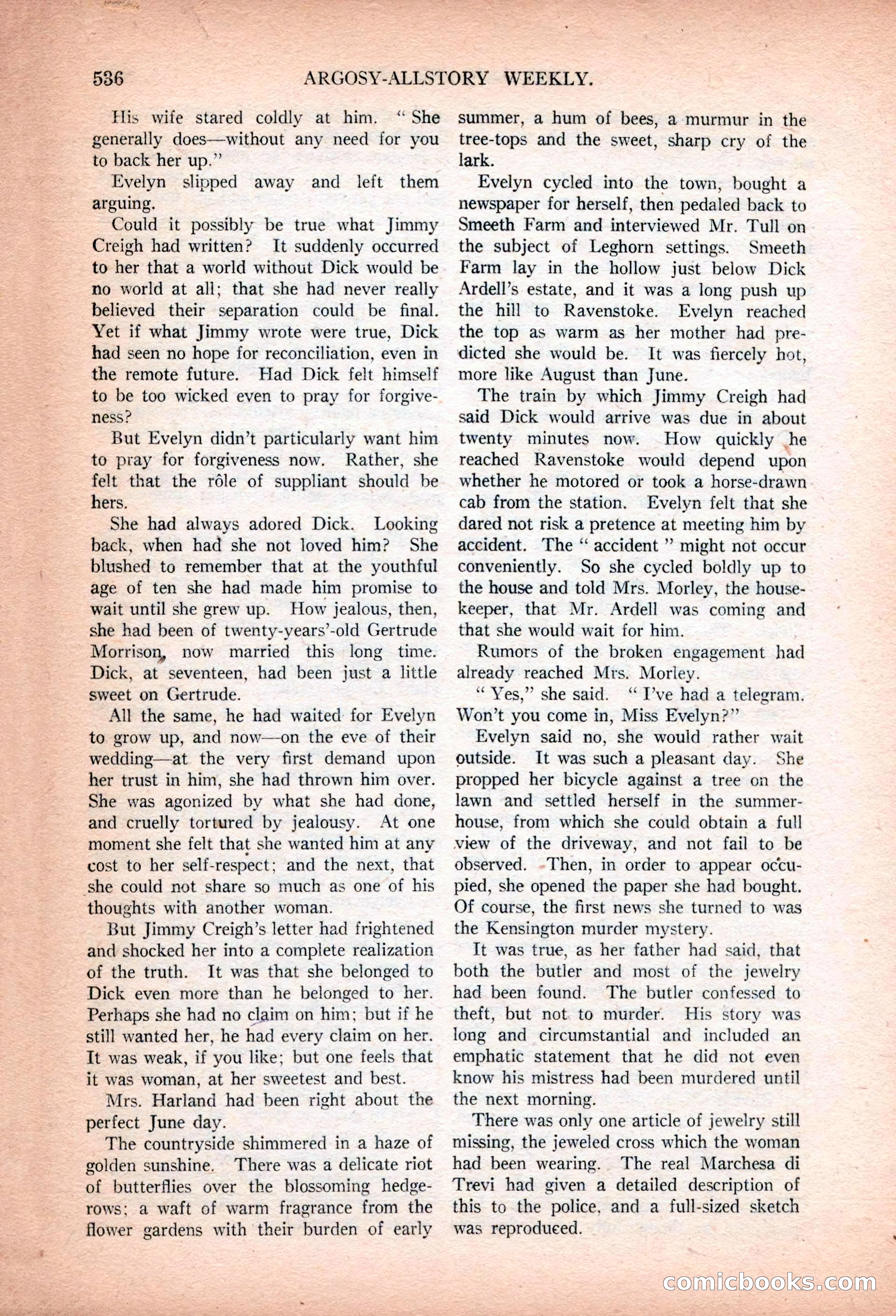
A restored page from Pulp Fiction, 1923. Page through the whole issue in the reader above.
📄 Transcribed text from this page (OCR, searchable)
Machine-transcribed from the original scan — historical spelling and the odd misread are preserved.
536° His wife stared coldly at him. “ She generally does—without any need for you to back her up.” Evelyn slipped away and left them arguing. Could it possibly be true what Jimmy Creigh had written? It suddenly occurred to her that a world without Dick would be no world at all; that she had never really believed their separation could be final. Yet if what Jimmy wrote were true, Dick had seen no hope for reconciliation, even in the remote future. Had Dick felt himself to be too wicked even to pray for forgive- ness? But Evelyn didn’t particularly want him to pray for forgiveness now. Rather, she felt that the role of suppliant should be hers. She had always adored Dick. Looking back, when had she not loved him? She blushed to remember that at the youthful age of ten she had made him promise to wait until she grew up. How jealous, then, she had been of twenty-years’-old Gertrude Morrison, now married this long time. Dick, at seventeen, had been just a little sweet on Gertrude. All the same, he had waited for Evelyn to grow up, and now—on the eve of their weddinge—at the very first demand upon her trust in him, she had thrown him over. She was agonized by what she had done, and cruelly tortured by jealousy. At one moment she felt that she wanted him at any cost to her self-respect; and the next, that she could not share so much as one of his thoughts with another woman. But Jimmy Creigh’s letter had frightened and shocked her into a complete realization of the truth. It was that she belonged to Dick even more than he belonged to her. Perhaps she had no claim on him; but if he still wanted her, he had every claim on her. It was weak, if you like; but one feels that it was woman, at her sweetest and best. Mrs. Harland had been right about the perfect June day. The countryside shimmered in a haze of golden sunshine. There was a delicate riot of butterflies over the blossoming hedge- rows; a waft of warm fragrance from the flower gardens with their burden of early ARGOSY-ALLSTORY WEEKLY. summer, a hum of bees, a murmur in the tree-tops and the sweet, sharp cry of the lark. Evelyn cycled into the town, bought a newspaper for herself, then pedaled back to Smeeth Farm and interviewed Mr. Tull on the subject of Leghorn settings. Smeeth Farm lay in the hollow just below Dick Ardell’s estate, and it was a long push up the hill to Ravenstoke. Evelyn reached the top as warm as her mother had pre- dicted she would be. It was fiercely hot, more like August than June. The train by which Jimmy Creigh had said Dick would arrive was due in about twenty minutes now. How quickly he reached Ravenstoke would depend upon whether he motored or took a horse-drawn cab from the station. Evelyn felt that she dared not risk a pretence at meeting him by accident. The ‘“ accident ” might not occur conveniently. So she cycled boldly up to the house and told Mrs. Morley, the house- keeper, that Mr. Ardell was coming and that she would wait for him. Rumors of the broken engagement had already reached Mrs. Morley. “Yes,” she said. ‘“ I’ve had a telegram. Won’t you come in, Miss Evelyn?” Evelyn said no, she would rather wait outside. It was such a pleasant day. She propped her bicycle against a tree on the lawn and settled herself in the summer- house, from which she could obtain a full view of the driveway, and not fail to be observed. -Then, in order to appear occu- pied, she opened the paper she had bought. Of course, the first news she turned to was the Kensington murder mystery. It was true, as her father had said, that both the butler and most of the jewelry had been found. The butler confessed to theft, but not. to murder. His story was long and circumstantial and included an emphatic statement that he did not even know his mistress had been murdered until the next morning. There was only one article of jewelry still missing, the jeweled cross which the woman had been wearing. The real Marchesa di Trevi had given a detailed description of this to the police, and a full-sized sketch was reprodueed. EOPMICLOOOKS (E@)