
Pulp Fiction, 1923 · page 34 of 196
Argosy All-Story Weekly, October 6, 1923 — page 34: what you’re looking at
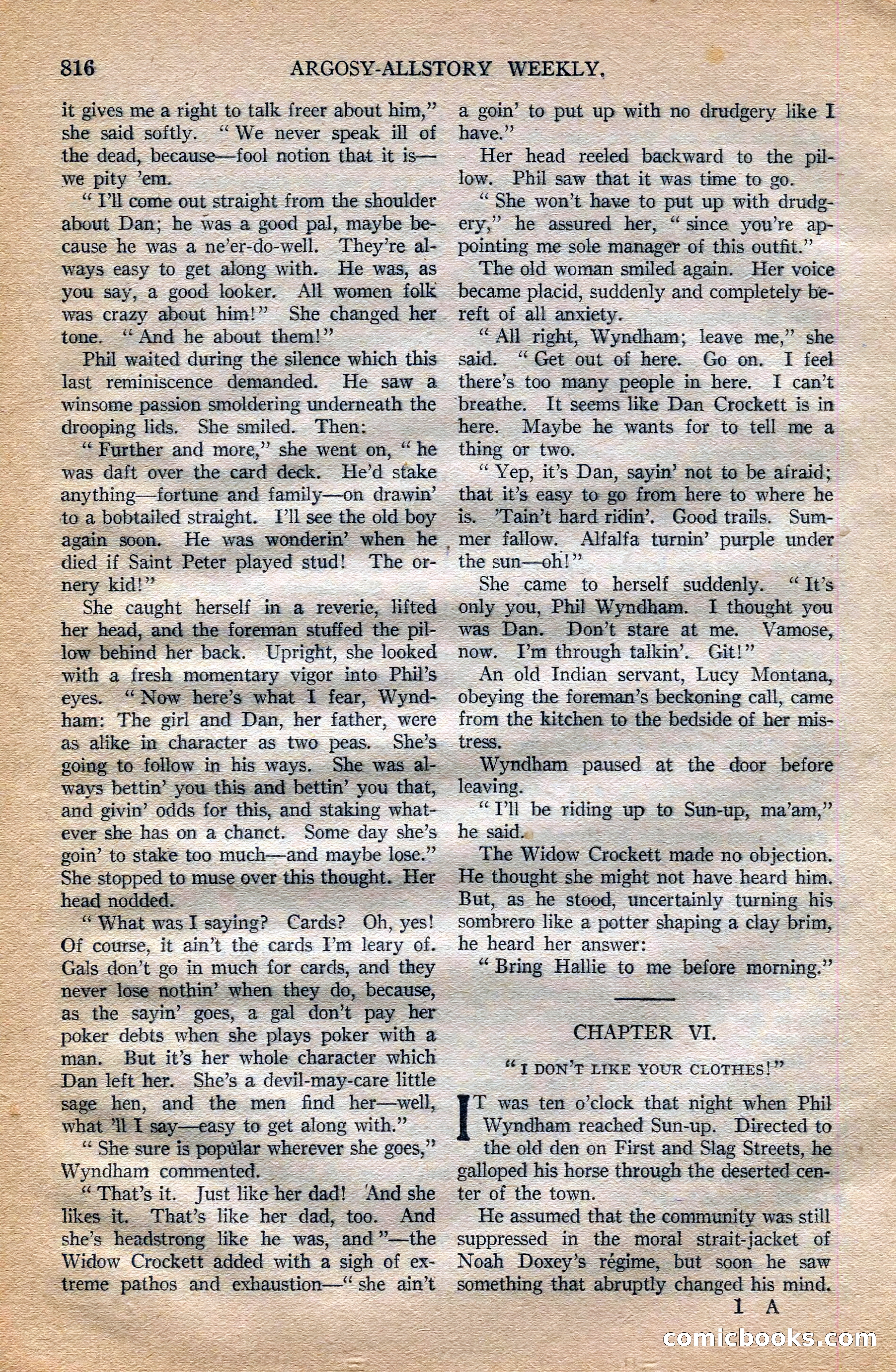
A restored page from Pulp Fiction, 1923. Page through the whole issue in the reader above.
📄 Transcribed text from this page (OCR, searchable)
Machine-transcribed from the original scan — historical spelling and the odd misread are preserved.
me -__it gives me a right to talk freer about him,” __ She said softly. “ We never speak ill of == ae dead, because—fool notion that it is— = we pity em. Vil come out straight from the Soccer _ Cause he was a ne’er-do-well. They’re al- ‘Ways easy to get along with. He was, as you say, a good looker. All women folk ‘Was crazy shout him!” She changed her = tone. _* And he about them!” = Phil waited during the silence which this = last reminiscence demanded. He saw a -—— ‘winsome-passion smoldering underneath the == seep lids. She smiled. Then: Further and more,” she went on, “ he : = was daft over. the card deck. He'd stake - anything—fortune and family—on drawin’ toa bobtailed straight. Tl see the old boy = again soon. He was wonderin’ when he | died if Saint Peter played stud! The or- __nery kid!” low behind her back. Upright she looked with a_fresh_ momentary vigor into. Phil’s — eyes. ham: The girl and Dan, her father, were -_as alike in “character as two peas. She’s S going: to follow in his ways. ~~. and givin’ odds for this, and staking what- = ever she has on a chanct. Some day she’s -- goin’ to stake too much—and maybe lose.” = She sores to muse over. this thou = =a ‘What. was 1 aie Cards? “Oh, yes! Se Of course, it ain’t the cards I’m leary of. Gals don’t go in much for cards, and they _ thin’ when they do, because, — as the sayin’ goes, a gal don’t pay her never lose = poker debts when she plays poker with a man. But it’s her whole character which Dan left her. She’s a devil-may-care little _ sage hen, and the men find her—well, ee what LT say—easy to get along with.” - _ “ She sure is popular wherever she goes,” Wyndham commented. as as it. Just like “hee dad! ot _ That’s like her dad, too. ‘And she -ARGOSY-ALLSTORY WEEKLY, about Dan; he was a good pal, maybe be- She caught herself in a reverie, lifted = = head, and the foreman stuffed the pil- “Now here’s what I fear, Wynd- | She was al-. Se 32 ‘bettin’ you. this. and bettin’ you that, : pits ae And ~ z ee that at abruptly changed his mind. — | =.= a goin’ to pal up ai no eS like : have.” — Her head ase backward to the pil- ion Phil saw that it was time to go. = “She won’t have to put up with drudg- ery,’ he assured her, “since you’re ap- pointing me sole manager of this outfit.” The old woman smiled again. Her voice became placid, suddenly and completely be- refit of all anxiety. “All right, Wyndham; leave me,” she said. “Get out of here. Go on. I feet there’s too many people in here. I can’t ‘breathe. It seems like Dan Crockett is in there. Maybe he wants for to tell me a thing or two. == ‘Yep, it’s Dan, sayin’ not to be aia na it’s easy to go from here to where he is. *Tain’t hard ridin’. Good trails. Sum- mer fallow. Alfalfa turnin’ purple under the sun—oh!” She came to herself suddenly. “ Tp . only you, Phil Wyndham. {f thought you was Dan. Don’t stare at me. Vamaose, now. I’m through talkin’. Git!” An old Indian servant, Lucy Montana, obeying the foreman’s beckoning call, came from the kitchen te the bedside of her mis- tres Wyndham paused at the door before leaving. = rg be nding up te Sun-up, ma’am,” he said. _ The Widow Crockett made no objection. He thought she might not have heard him. But, as he stood, uncertainly turning his sombrero like a potter shaping a Ses brim, he heard her answer: | aa fee Hallie to me moe morning, = Say VI. “Tt DON’T LIKE YOUR CLOTHES!” T was ten o’clock that night when Phil Wyndham reached Sun-up. Directed to_ == ter of the town. He assumed that the coment was s still suppressed in the Moral strait- jacket of Noah Doxey’s régim , but soon he saw =a) __ comicboo #e eS the old den on First and Slag Streets,he galloped his horse throug the desertee: cen= =