
Pulp Fiction, 1924 · page 11 of 166
Argosy All-Story Weekly, February 23, 1924 — page 11: what you’re looking at
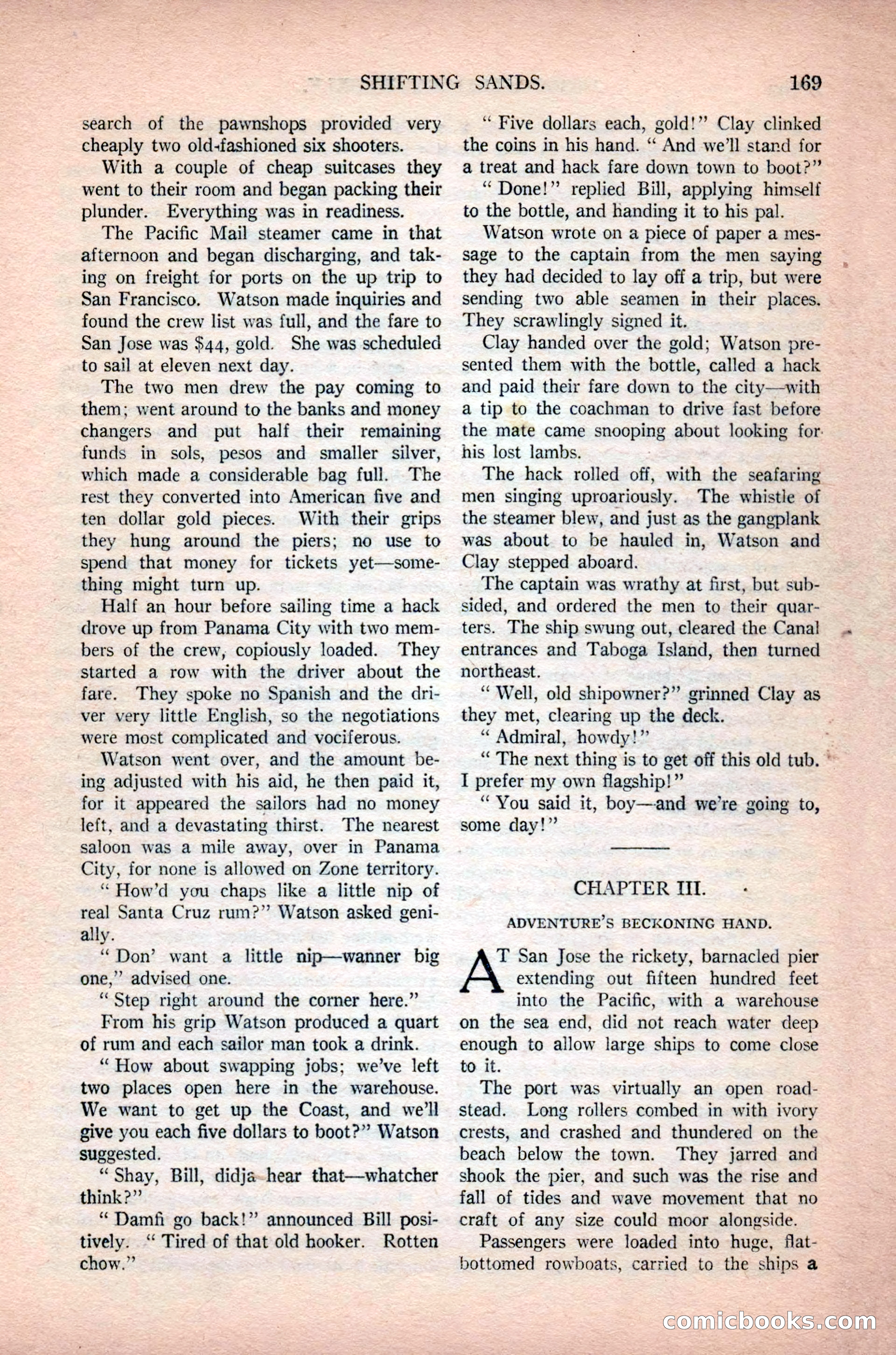
A restored page from Pulp Fiction, 1924. Page through the whole issue in the reader above.
📄 Transcribed text from this page (OCR, searchable)
Machine-transcribed from the original scan — historical spelling and the odd misread are preserved.
SHIFTING SANDS. search of the pawnshops provided very cheaply two old-fashioned six shooters. With a couple of cheap suitcases they went to their room and began packing their plunder. Everything was in readiness. The Pacific Mail steamer came in that afternoon and began discharging, and tak- ing on freight for ports on the up trip to San Francisco. Watson made inquiries and found the crew list was full, and the fare to San Jose was $44, gold. She was scheduled to sail at eleven next day. The two men drew the pay coming to them; went around to the banks and money changers and put half their remaining funds in sols, pesos and smaller silver, which made a considerable bag full. The rest they converted into American five and ten dollar gold pieces. With their grips they hung around the piers; no use to spend that money for tickets yet—some- thing might turn up. Half an hour before sailing time a hack drove up from Panama City with two mem- bers of the crew, copiously loaded. They started a row with the driver about the fare. They spoke no Spanish and the dri- ver very little English, so the negotiations were most complicated and vociferous. Watson went over, and the amount be- ing adjusted with his aid, he then paid it, for it appeared the sailors had no money left, and a devastating thirst. The nearest saloon was a mile away, over in Panama City, for none is allowed on Zone territory. ‘“ How’d you chaps like a little nip of real Santa Cruz rum?” Watson asked geni- ally. ‘Don’ want a little nip—wanner big one,” advised one. “Step right around the corner here.” From his grip Watson produced a quart of rum and each sailor man took a drink. “How about swapping jobs; we’ve left two places open here in the warehouse. We want to get up the Coast, and we’ll give you each five dollars to boot?” Watson suggested. “Shay, Bill, didja~hear that—whatcher think?” “Damfi go back!” announced Bill posi- tively. “ Tired of that old hooker. Rotten chow.” 169 ‘Five dollars each, gold!” Clay clinked the coins in his hand. “ And we’ll stand for a treat and hack fare down town to boot?” ‘“ Done!”’ replied Bill, applying himself to the bottle, and handing it to his pal. Watson wrote on a piece of paper a mes- sage to the captain from the men saying they had decided to lay off a trip, but were sending two able seamen in their places. They scrawlingly signed it. Clay handed over the gold; Watson pre- sented them with the bottle, called a hack and paid their fare down to the city—with a tip to the coachman to drive fast before the mate came snooping about looking for. his lost lambs. The hack rolled off, with the seafaring men singing uproariously. The whistle of the steamer blew, and just as the gangplank was about to be hauled in, Watson and Clay stepped aboard. The captain was wrathy at first, but sub- sided, and ordered the men to their quar- ters. The ship swung out, cleared the Canal entrances and Taboga Island, then turned northeast. “Well, old shipowner?” grinned Clay as they met, clearing up the deck. “ Admiral, howdy!” “The next thing is to get off this old tub. I prefer my own flagship!” “You said it, boy—and we’re going to, some day!” CHAPTER Ii. ADVENTURE’S BECKONING HAND. T San Jose the rickety, barnacled pier extending out fifteen hundred feet into the Pacific, with a warehouse on the sea end, did not reach water deep enough to allow large ships to come close to it. The port was virtually an open road- stead. Long rollers combed in with ivory crests, and crashed and thundered on the beach below the town. They jarred and shook the pier, and such was the rise and fall of tides and wave movement that no craft of any size could moor alongside. Passengers were loaded into huge, flat- bottomed rowboats, carried to the ships a (e(0) .OOKS AMUCE ° , (EO)