
Pulp Fiction, 1924 · page 13 of 166
Argosy All-Story Weekly, February 23, 1924 — page 13: what you’re looking at
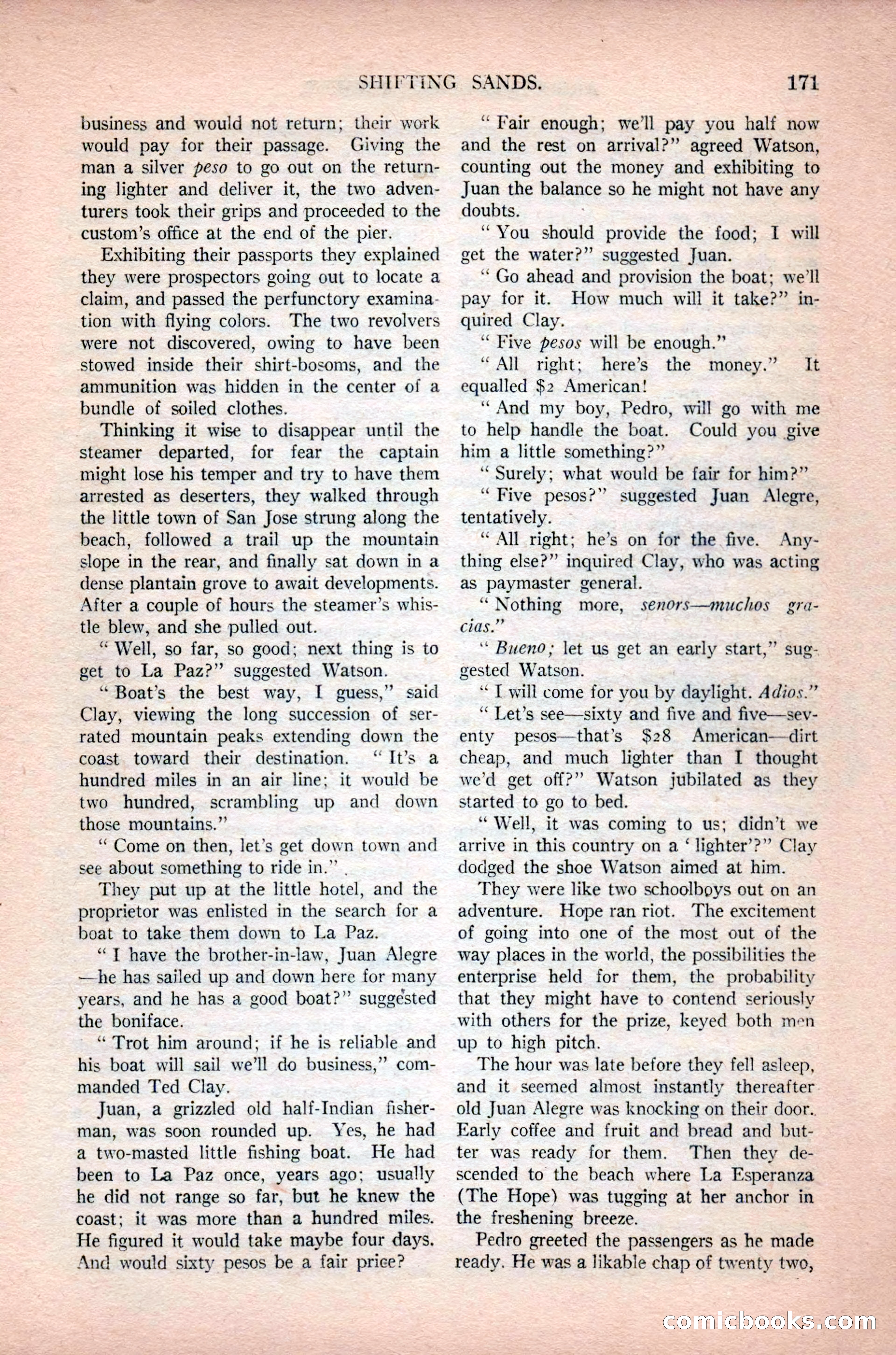
A restored page from Pulp Fiction, 1924. Page through the whole issue in the reader above.
📄 Transcribed text from this page (OCR, searchable)
Machine-transcribed from the original scan — historical spelling and the odd misread are preserved.
SHIFTING business and would not return; their work would pay for their passage. Giving the man a silver peso to go out on the return- ing lighter and deliver it, the two adven- turers took their grips and proceeded to the custom’s office at the end of the pier. Exhibiting their passports they explained they were prospectors going out to locate a claim, and passed the perfunctory examina- tion with flying colors. The two revolvers were not discovered, owing to have been stowed inside their shirt-bosoms, and the ammunition was hidden in the center of a bundle of soiled clothes. Thinking it wise to disappear until the steamer departed, for fear the captain might lose his temper and try to have them arrested as deserters, they walked through the little town of San Jose strung along the beach, followed a trail up the mountain slope in the rear, and finally sat down in a dense plantain grove to await developments. After a couple of hours the steamer’s whis- tle blew, and she pulled out. “Well, so far, so good; next thing is to get to La Paz?” suggested Watson. “ Boat’s the best way, I guess,” said Clay, viewing the long succession of ser- rated mountain peaks extending down the coast toward their destination. “It’s a hundred miles in an air line; it would be two hundred, scrambling up and down those mountains.” ‘““Come on then, let’s get down town and see about something to ride in.”’ . They put up at the little hotel, and the proprietor was enlisted in the search for a boat to take them down to La Paz. “T have the brother-in-law, Juan Alegre —he has sailed up and down here for many years, and he has a good boat?” suggested the boniface. “ Trot him around; if he is reliable and his boat will sail we’ll do business,’’ com- manded Ted Clay. Juan, a grizzled old half-Indian fisher- man, was soon rounded up. Yes, he had a two-masted little fishing boat. He had been to La Paz once, years ago; usually he did not range so far, but he knew the coast; it was more than a hundred miles. He figured it would take maybe four days. And would sixty pesos be a fair price? SANDS. 171 ‘“ Fair enough; we'll pay you half now and the rest on arrival?” agreed Watson, counting out the money and exhibiting to Juan the balance so he might not have any doubts. ‘You should provide the food; I will get the water?” suggested Juan. ‘Go ahead and provision the boat; we’ll pay for it. How much will it take?” in- quired Clay. “Five pesos will be enough.” “All right; here’s the money.” equalled $2 American! ‘“And my boy, Pedro, will go with me to help handle the boat. Could you give him a little something?” ‘Surely; what would be fair for him?” “Five pesos?” suggested Juan Alegre, tentatively. “All right; he’s on for the five. Any- thing else?” inquired Clay, who was acting as paymaster general. “Nothing more, senors—muchos gra- cias.”” ‘“ Bueno; let us get an early start,” sug- gested Watson. ‘‘ T will come for you by daylight. Adios.” ‘“ Let’s see—sixty and five and five—sev- enty pesos—that’s $28 American—dirt cheap, and much lighter than I thought we'd get off?” Watson jubilated as they started to go to bed. ‘Well, it was coming to us; didn’t we arrive in this country on a ‘ lighter’?” Clay dodged the shoe Watson aimed at him. They were like two schoolboys out on an adventure. Hope ran riot. The excitement of going into one of the most out of the way places in the world, the possibilities the enterprise held for them, the probability that they might have to contend seriously with others for the prize, keyed both men up to high pitch. The hour was late before they fell asleep, and it seemed almost instantly thereafter old Juan Alegre was knocking on their door.. Early coffee and fruit and bread and but- ter was ready for them. Then they de- scended to the beach where La Esperanza (The Hope) was tugging at her anchor in the freshening breeze. Pedro greeted the passengers as he made ready. He was a likable chap of twenty two, It Gomichbooks (E()