
Pulp Fiction, 1924 · page 143 of 166
Argosy All-Story Weekly, February 23, 1924 — page 143: what you’re looking at
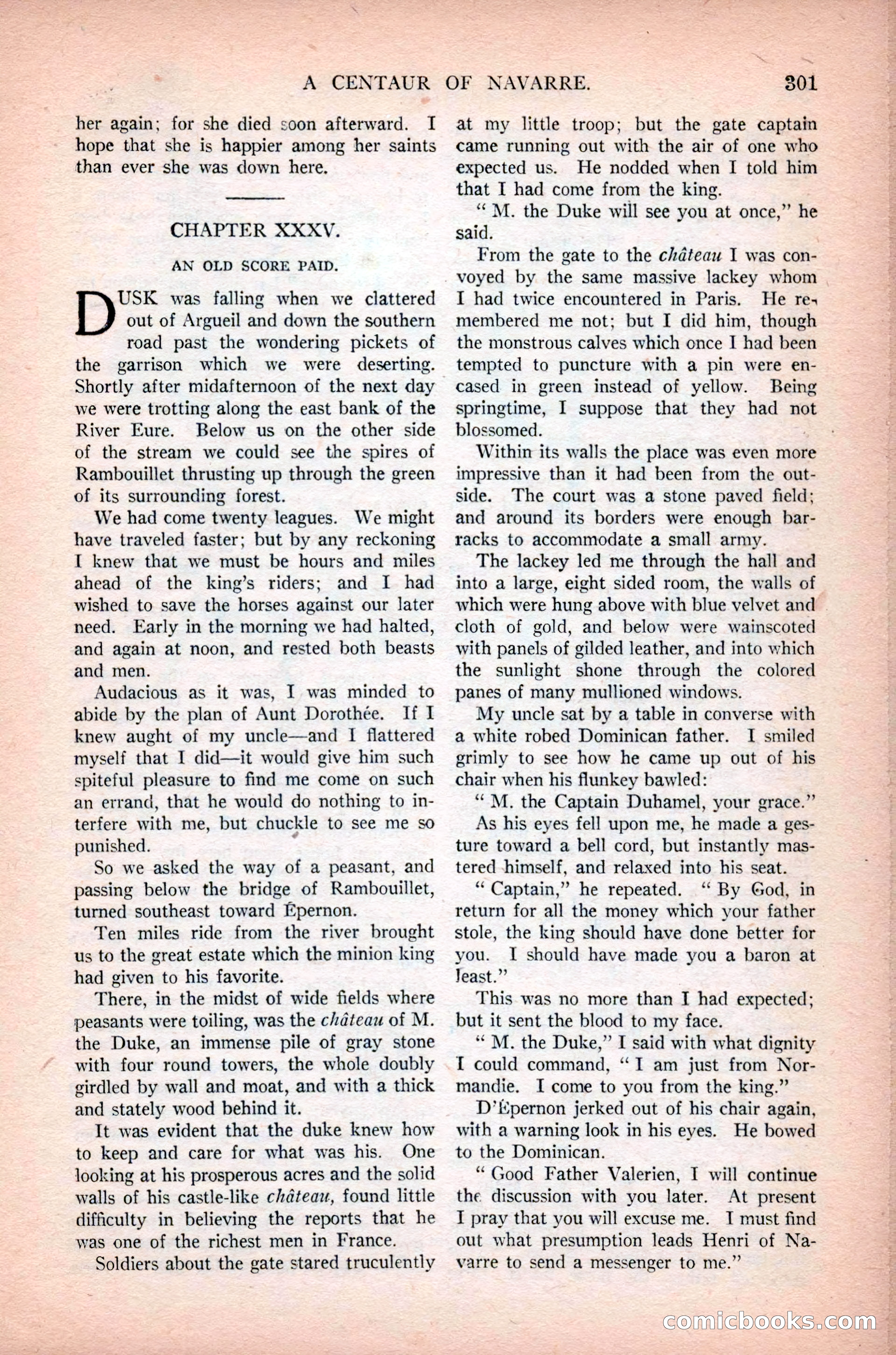
A restored page from Pulp Fiction, 1924. Page through the whole issue in the reader above.
📄 Transcribed text from this page (OCR, searchable)
Machine-transcribed from the original scan — historical spelling and the odd misread are preserved.
A CENTAUR OF NAVARRE. her again; for she died soon afterward. I hope that she is happier among her saints than ever she was down here. CHAPTER XXXV. AN OLD SCORE PAID. USK was falling when we clattered out of Argueil and down the southern road past the wondering pickets of the garrison which we were deserting. Shortly after midafternoon of the next day we were trotting along the east bank of the River Eure. Below us on the other side of the stream we could see the spires of Rambouillet thrusting up through the green of its surrounding forest. We had come twenty leagues. We might have traveled faster; but by any reckoning I knew that we must be hours and miles ahead of the king’s riders; and I had wished to save the horses against our later need. Early in the morning we had halted, and again at noon, and rested both beasts and men. Audacious as it was, I was minded to abide by the plan of Aunt Dorothée. If I knew aught of my uncle—and I flattered myself that I did—it would give him such spiteful pleasure to find me come on such an errand, that he would do nothing to in- terfere with me, but chuckle to see me so punished. : So we asked the way of a peasant, and passing below the bridge of Rambouillet, turned southeast toward Epernon. Ten miles ride from the river brought us to the great estate which the minion king had given to his favorite. There, in the midst of wide fields where peasants were toiling, was the cidteau of M. the Duke, an immense pile of gray stone with four round towers, the whole doubly girdled by wall and moat, and with a thick and stately wood behind it. It was evident that the duke knew how to keep and care for what was his. One looking at his prosperous acres and the solid walls of his castle-like chateau, found little difficulty in believing the reports that he was one of the richest men in France. Soldiers about the gate stared truculently ~, 501 at my little troop; but the gate captain came running out with the air of one who expected us. He nodded when I told him that I had come from the king. ‘““M. the Duke will see you at once,” he said. From the gate to the chdteau I was con- voyed by the same massive lackey whom I had twice encountered in Paris. He re. membered me not; but I did him, though the monstrous calves which once I had been tempted to puncture with a pin were en- cased in green instead of yellow. Being springtime, I suppose that they had no blossomed. : Within its walls the place was even more impressive than it had been from the out- side. The court was a stone paved field; and around its borders were enough bar- racks to accommodate a small army. The lackey led me through the hall and into a large, eight sided room, the walls of which were hung above with blue velvet and cloth of gold, and below were wainscoted with panels of gilded leather, and into which the sunlight shone through the colored panes of many mullioned windows. My uncle sat by a table in converse with a white robed Dominican father. I smiled grimly to see how he came up out of his chair when his flunkey bawled: “'M. the Captain Duhamel, your grace.” As his eyes fell upon me, he made a ges- ture toward a bell cord, but instantly mas- tered -himself, and relaxed into his seat. “ Captain,” he repeated. ‘“‘ By God, in return for all the money which your father stole, the king should have done better for you. I should have made you a baron at least.” This was no more than I had expected; but it sent the blood to my face. *M. the Duke,” I said with what dignity I could command, “I am just from Nor- mandie. I come to you from the king.” D’ipernon jerked out of his chair again, with a warning look in his eyes. He bowed to the Dominican. “Good Father Valerien, I will continue the discussion with you later. At present I pray that you will excuse me. I must find out what presumption leads Henri of Na- varre to send a messenger to me.” COPMICLOOKS (E@) ~ i AS NPIS TS SD s | “ i wiry, 2