
Pulp Fiction, 1924 · page 151 of 166
Argosy All-Story Weekly, February 23, 1924 — page 151: what you’re looking at
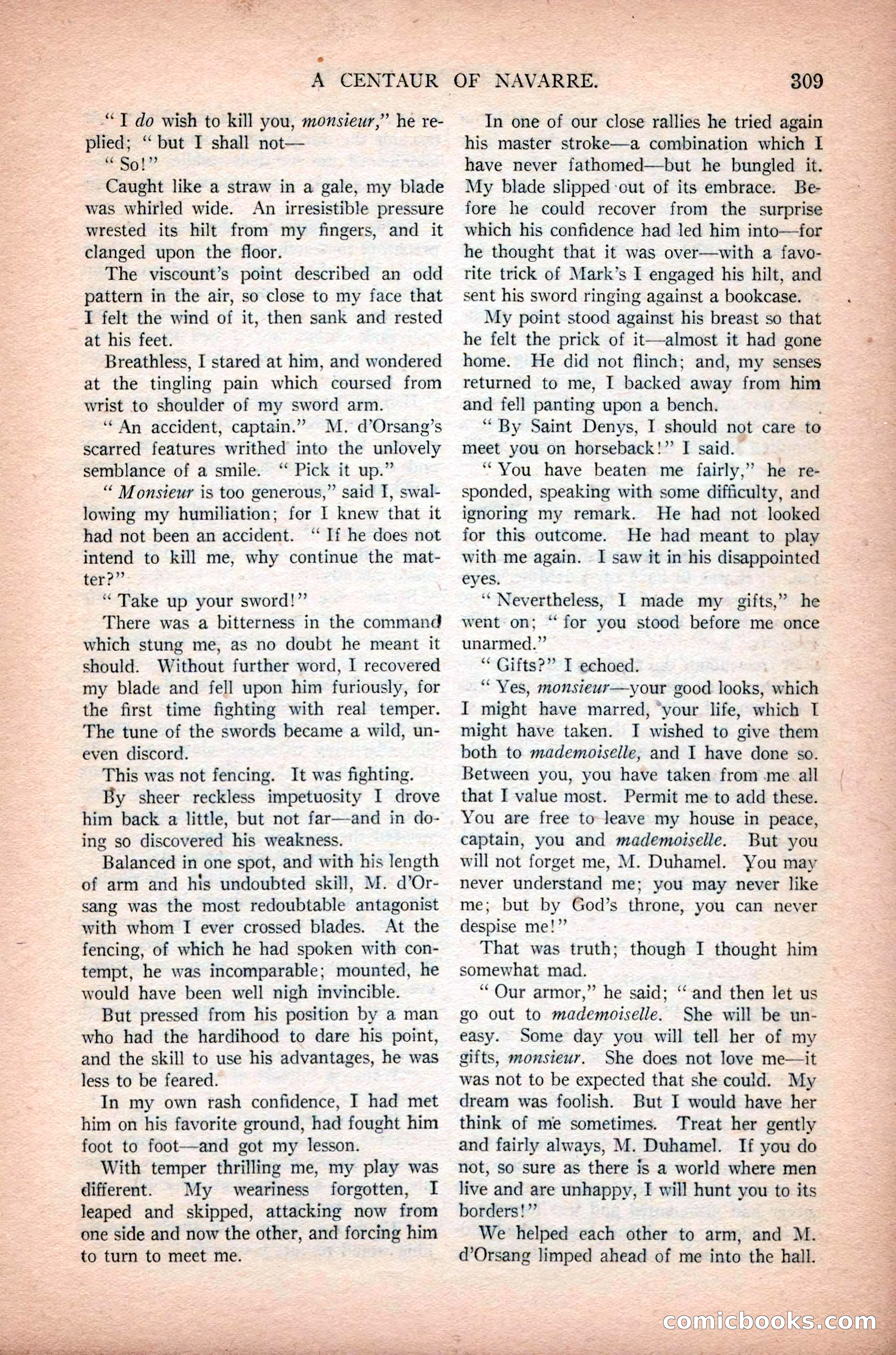
A restored page from Pulp Fiction, 1924. Page through the whole issue in the reader above.
📄 Transcribed text from this page (OCR, searchable)
Machine-transcribed from the original scan — historical spelling and the odd misread are preserved.
Bs te’ A CENTAUR OF NAVARRE. “J do wish to kill you, monsieur,” he re- plied; “ but I shall not— ic So! > Caught like a straw in a gale, my blade was whirled wide. An irresistible pressure wrested its hilt from my fingers, and it clanged upon the floor. The viscount’s point described an odd pattern in the air, so close to my face that I felt the wind of it, then sank and rested at his feet. Breathless, I stared at him, and wondered at the tingling pain which coursed from wrist to shoulder of my sword arm. ‘““ An accident, captain.” M. d’Orsang’s scarred features writhed into the unlovely semblance of a smile. “ Pick it up.” “ Monsieur is too generous,” said I, swal- lowing my humiliation; for 1 knew that it had not been an accident. ‘ If he does not intend to kill me, why continue the mat- ter?” “Take up your sword!” There was a bitterness in the command which stung me, as no doubt he meant it should. Without further word, I recovered my blade and fell upon him furiously, for the first time fighting with real temper. The tune of the swords became a wild, un- even discord. This was not fencing. It was fighting. By sheer reckless impetuosity I drove him back a little, but not far—and in do- ing so discovered his weakness. Balanced in one spot, and with his length of arm and his undoubted skill, M. d’Or- sang was the most redoubtable antagonist with whom I ever crossed blades. At the fencing, of which he had spoken with con- tempt, he was incomparable; mounted, he would have been well nigh invincible. But pressed from his position by a man who had the hardihood to dare his point, and the skill to use his advantages, he was less to be feared. In my own rash confidence, I had met him on his favorite ground, had fought him foot to foot—and got my lesson. With temper thrilling me, my play was different. My weariness forgotten, I leaped and skipped, attacking now from one side and now the other, and forcing him to turn to meet me. 309 In one of our close rallies he tried again his master stroke—a combination which I have never fathomed—but he bungled it. My blade slipped out of its embrace. Be- fore he could recover from the surprise which his confidence had led him into—for he thought that it was over—with a favo- rite trick of Mark’s I engaged his hilt, and sent his sword ringing against a bookcase. My point stood against his breast so that he felt the prick of it—almost it had gone home. He did not flinch; and, my senses returned to me, I backed away from him and fell panting upon a bench. “By Saint Denys, I should not care to meet you on horseback!” I said. “You have beaten me fairly,” he re- sponded, speaking with some difficulty, and ignoring my remark. He had not looked for this outcome. He had meant to play with me again. I saw it in his disappointed eyes. ‘* Nevertheless, I made my gifts,” he went on; “for you stood before me once unarmed.” “ Gifts?” I echoed. “Yes, monsieur—your good looks, which I might have marred, “your life, which I might have taken. I wished to give them both to mademoiselle, and I have done so. Between you, you have taken from me all that I value most. Permit me to add these. You are free to leave my house in peace, captain, you and mademoiselle. But you will not forget me, M. Duhamel. You may never understand me; you may never like me; but by God’s throne, you can never despise me!” That was truth; though I thought him somewhat mad. “Our armor,” he said; “and then let us go out to mademoiselle. She will be un- easy. Some day you will tell her of my gifts, monsieur. She does not love me—it was not to be expected that she could. My dream was foolish. But I would have her think of me sometimes. Treat her gently and fairly always, M. Duhamel. If you do not, so sure as there is a world where men live and are unhappy, I will hunt you to its borders!” We helped each other to arm, and M. d’Orsang limped ahead of me into the hall. EOMEIE JOOKS 2 S - = ~— ome ~. ~ : Td a ba ~ ee Oe —— ee ee _ a , 4 - ee ea i, io se a | SS, . ny: PA iy) i " 7) } hid) 4) \ b)) , AY eat V1 i Py ad eae