
Pulp Fiction, 1924 · page 38 of 166
Argosy All-Story Weekly, February 23, 1924 — page 38: what you’re looking at
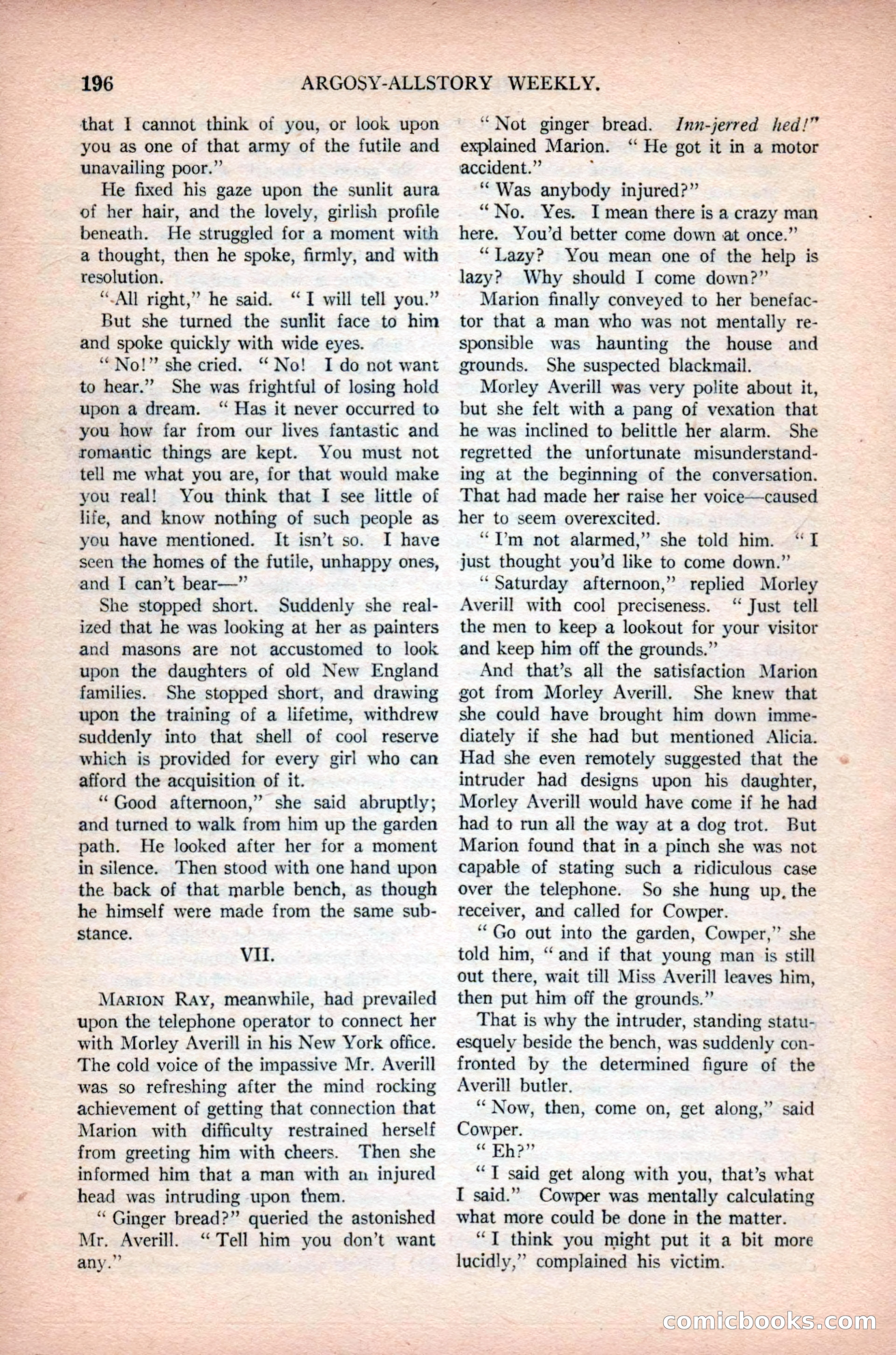
A restored page from Pulp Fiction, 1924. Page through the whole issue in the reader above.
📄 Transcribed text from this page (OCR, searchable)
Machine-transcribed from the original scan — historical spelling and the odd misread are preserved.
196 that I cannot think of you, or look upon you as one of that army of the futile and unavailing poor.” He fixed his gaze upon the sunlit aura of her hair, and the lovely, girlish profile beneath. He struggled for a moment with a thought, then he spoke, firmly, and with resolution. “<All right,” he said. “I will tell you.” But she turned the sunlit face to him and spoke quickly with wide eyes. “No!” she cried. “No! Ido not want to hear.” She was frightful of losing hold upon a dream. ‘“ Has it never occurred to you how far from our lives fantastic and romantic things are kept. You must not tell me what you are, for that would make you real! You think that I see little of life, and know nothing of such people as you have mentioned. It isn’t so. I have seen the homes of the futile, unhappy ones, and I can’t bear—’’ She stopped short. Suddenly she real- ized that he was looking at her as painters and masons are not accustomed to look upon the daughters of old New England families. She stopped short, and drawing upon the training of a lifetime, withdrew suddenly into that shell of cool reserve which is provided for every girl who can afford the acquisition of it. “Good afternoon,” she said abruptly; and turned to walk from him up the garden path. He looked after her for a moment in silence. Then stood with one hand upon the back of that marble bench, as though he himself were made from the same sub- stance. Vil. Marion Ray, meanwhile, had prevailed upon the telephone operator to connect her with Morley Averill in his New York office. The cold voice of the impassive Mr. Averill was so refreshing after the mind rocking achievement of getting that connection that Marion with difficulty restrained herself from greeting him with cheers. Then she informed him that a man with an injured head was intruding upon them. “ Ginger bread?” queried the astonished Mr. Averill. ‘ Tell him you don’t want any.”’ ARGOSY-ALLSTORY WEEKLY. ‘Not ginger bread. Jnn-jerred hed!” explained Marion. ‘“ He got it in a motor accident.” : “Was anybody injured?” “No. Yes. I mean there is a crazy man here. You’d better come down at once.” “Lazy? You mean one of the help is lazy? Why should I come down?” Marion finally conveyed to her benefac- tor that a man who was not mentally re- sponsible was haunting the house and grounds. She suspected blackmail. Morley Averill was very polite about it, but she felt with a pang of vexation that he was inclined to belittle her alarm. She regretted the unfortunate misunderstand- ing at the beginning of the conversation. That had made her raise her voice—caused her to seem overexcited. “1m not alarmed,” she told him. “I just thought you’d like to come down.” ‘Saturday afternoon,” replied Morley Averill with cool preciseness. ‘“ Just tell the men to keep a lookout for your visitor and keep him off the grounds.” And that’s all the satisfaction Marion got from Morley Averill. She knew that she could have brought him down imme- diately if she had but mentioned Alicia. Had she even remotely suggested that the intruder had designs upon his daughter, Morley Averill would have come if he had had to run all the way at a dog trot. But Marion found that in a pinch she was not capable of stating such a ridiculous case over the telephone. So she hung up, the receiver, and called for Cowper. ‘Go out into the garden, Cowper,” she told him, “ and if that young man is still out there, wait till Miss Averill leaves him, then put him off the grounds.” That is why the intruder, standing statu- esquely beside the bench, was suddenly con- fronted by the determined figure of the Averill butler. ‘““ Now, then, come on, get along,” said Cowper. <4 Eh?” “I said get along with you, that’s what I said.”” Cowper was mentally calculating what more could be done in the matter. “T think you might put it a bit more lucidly,” complained his victim. EORNICLOOOKS ~ (E@