
Pulp Fiction, 1924 · page 4 of 166
Argosy All-Story Weekly, February 23, 1924 — page 4: what you’re looking at
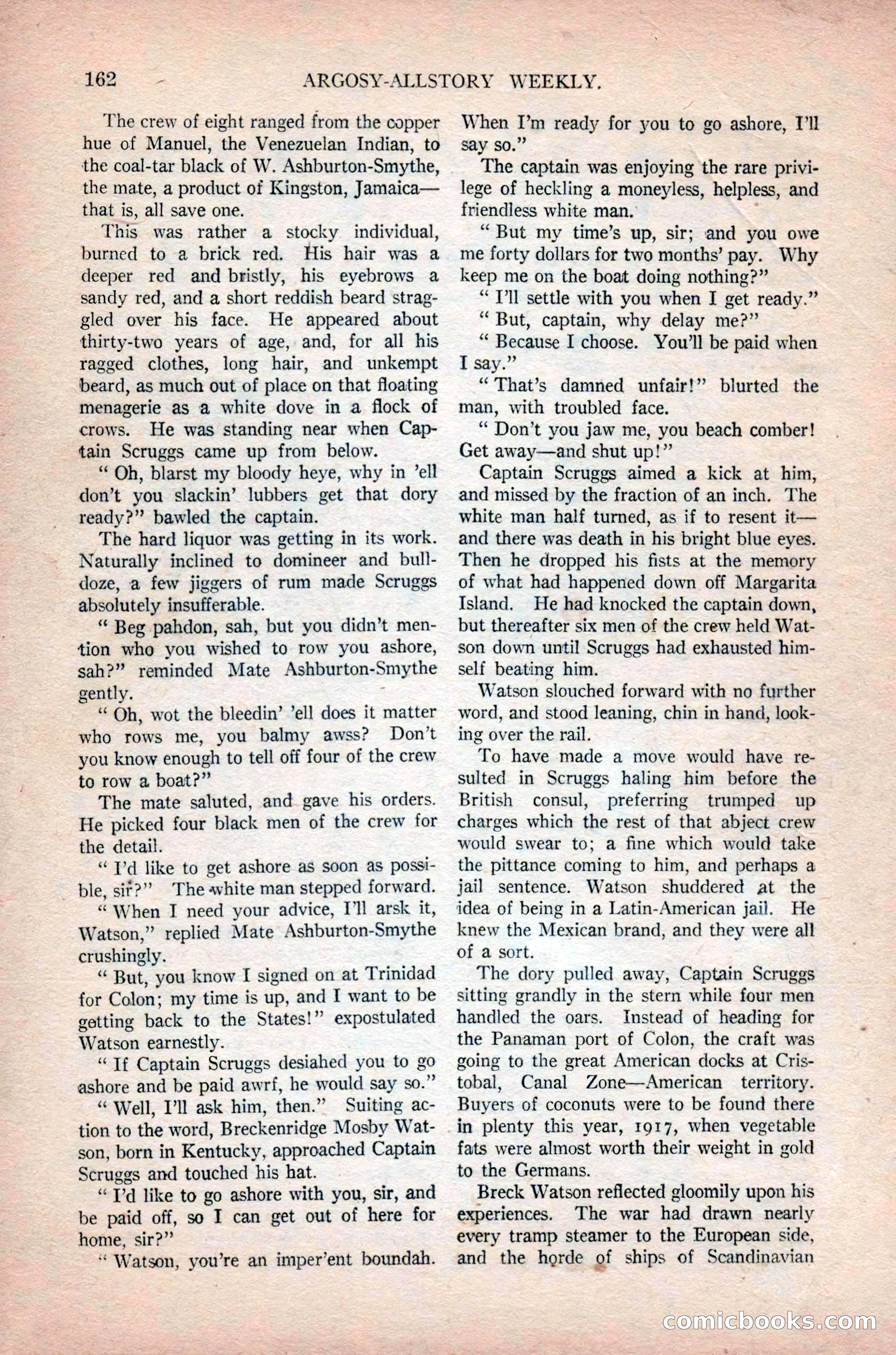
A restored page from Pulp Fiction, 1924. Page through the whole issue in the reader above.
📄 Transcribed text from this page (OCR, searchable)
Machine-transcribed from the original scan — historical spelling and the odd misread are preserved.
162 The crew of eight ranged from the copper hue of Manuel, the Venezuelan Indian, to the coal-tar black of W. Ashburton-Smythe, the mate, a product of Kingston, Jamaica— that is, all save one. This was rather a stocky individual, burned to a brick red. His hair was a deeper red and bristly, his eyebrows a sandy red, and a short reddish beard strag- gled over his face. He appeared about thirty-two years of age, and, for all his ragged clothes, long hair, and unkempt beard, as much out of place on that floating menagerie as a white dove in a flock of crows. He was standing near when Cap- tain Scruggs came up from below. “Oh, blarst my bloody heye, why in ’ell don’t you slackin’ lubbers get that dory ready?” bawled the captain. The hard liquor was getting in its work. Naturally inclined to domineer and _bull- doze, a few jiggers of rum made Scruggs absolutely insufferable. Beg pahdon, sah, but you didn’t men- tion who you wished to row you ashore, sah?” reminded Mate Ashburton-Smythe gently. : “Oh, wot the bleedin’ ’ell does it matter who rows me, you balmy awss? Don’t you know enough to tell off four of the crew to row a boat?” The mate saluted, and gave his orders. He picked four black men of the crew for the detail. “ Td like to get ashore as soon as possi- ble, sit?” The avhite man stepped forward. When I need your advice, I'll arsk it, Watson,” replied Mate Ashburton-Smythe crushingly. “ But, you know I signed on at Trinidad for Colon; my time is up, and I want to be getting back to the States!” expostulated Watson earnestly. “Tf Captain Scruggs desiahed you to go ashore and be paid awrf, he would say so.” “ Well, I’ll ask him, then.” Suiting ac- tion to the word, Breckenridge Mosby Wat- son, born in Kentucky, approached Captain Scruggs and touched his hat. “I'd like to go ashore with you, sir, and be paid off, so I can get out of here for home, sir?” ‘Watson, you’re an imper’ent boundah. ARGOSY-ALLSTORY WEEKLY, When I’m ready for you to go ashore, Ill say so.” The captain was enjoying the rare privi- lege of heckling a moneyless, helpless, and friendless white man. “But my time’s up, sir; and you owe me forty dollars for two months’ pay. Why keep me on the boat doing nothing?” “T’ll settle with you when I get ready.” “ But, captain, why delay me?” ““ Because I choose. You'll be paid when I say.” “That’s damned unfair!” blurted the man, with troubled face. “Don’t you jaw me, you beach comber! Get away—and shut up!” Captain Scruggs aimed a kick at him, and missed by the fraction of an inch. The white man half turned, as if to resent it— and there was death in his bright blue eyes. Then he dropped his fists at the memory of what had happened down off Margarita Island. He had knocked the captain down, but thereafter six men of the crew held Wat- son down until Scruggs had exhausted him- self beating him. Watson slouched forward with no further word, and stood leaning, chin in hand, look- ing over the rail. To have made a move would have re- sulted in Scruggs haling him before the British consul, preferring trumped up charges which the rest of that abject crew would swear to; a fine which would take the pittance coming to him, and perhaps a jail sentence. Watson shuddered at the idea of being in a Latin-American jail. He knew the Mexican brand, and they were all of a sort. The dory pulled away, Captain Scruggs sitting grandly in the stern while four men handled the oars. Instead of heading for the Panaman port of Colon, the craft was going to the great American docks at Cris- tobal, Canal Zone—American territory. Buyers of coconuts were to be found there in plenty this year, 1917, when vegetable fats were almost worth their weight in gold to the Germans. Breck Watson reflected gloomily upon his experiences. The war had drawn nearly every tramp steamer to the European side, and the horde of ships of Scandinavian COMIC OOO KS (E)