
Pulp Fiction, 1924 · page 47 of 166
Argosy All-Story Weekly, February 23, 1924 — page 47: what you’re looking at
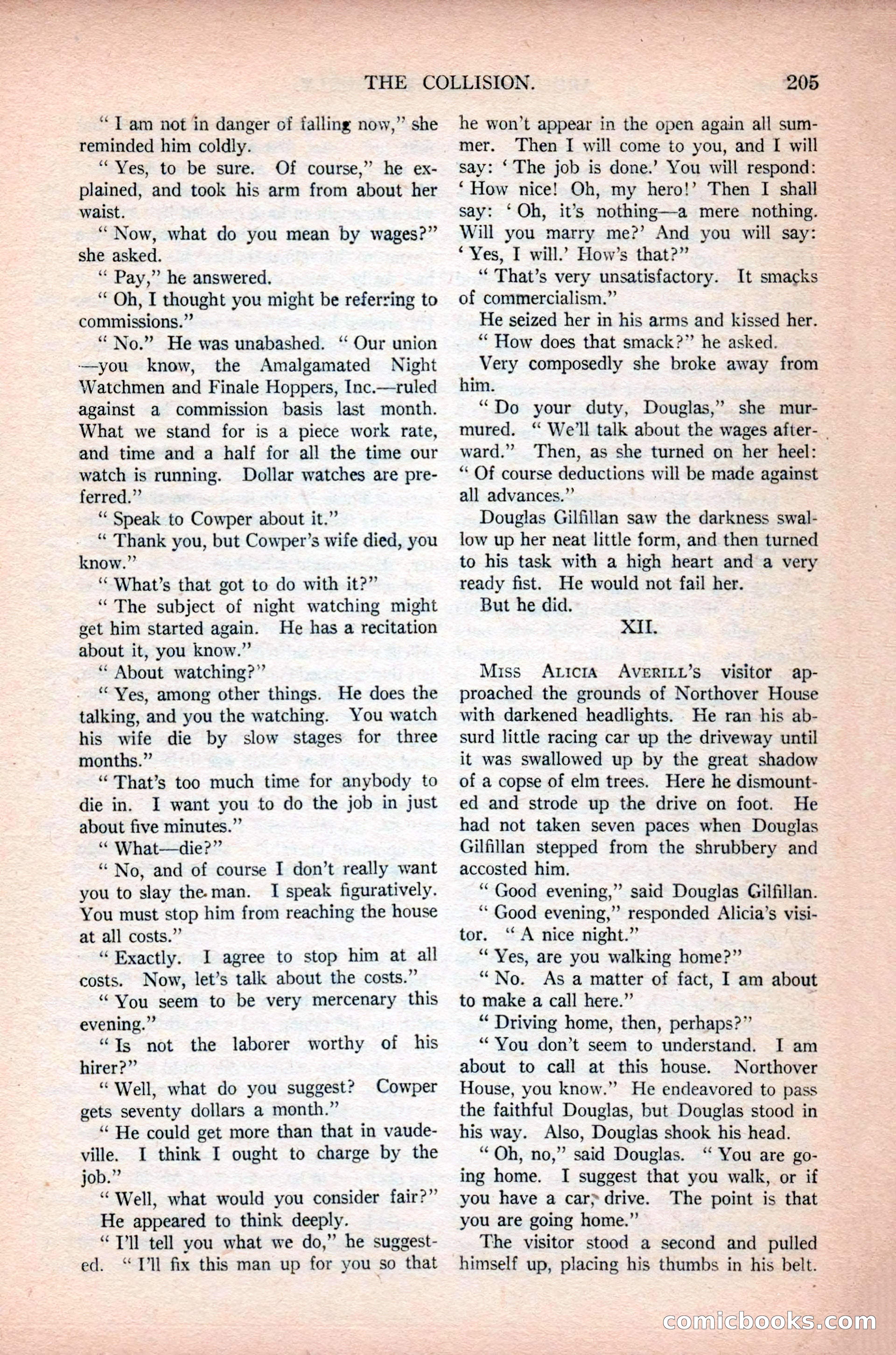
A restored page from Pulp Fiction, 1924. Page through the whole issue in the reader above.
📄 Transcribed text from this page (OCR, searchable)
Machine-transcribed from the original scan — historical spelling and the odd misread are preserved.
THE COLLISION. ‘““T am not in danger of falling now,” she reminded him coldly. “Yes, to be sure. Of course,” he ex- plained, and took his arm from about her waist. ‘“ Now, what do you mean by wages?” she asked. ‘“ Pay,” he answered. “Oh, I thought you might be referring to commissions.” “No.” He was unabashed. “ Our union —you know, the Amalgamated Night Watchmen and Finale Hoppers, Inc.—ruled against a commission basis last month. What we stand for is a piece work rate, and time and a half for all the time our watch is running. Dollar watches are pre- ferred.” ‘“‘ Speak to Cowper about it.” “ Thank you, but Cowper’s wife died, you know.” ‘‘What’s that got to do with it?” “The subject of night watching might get him started again. He has a recitation about it, you know.” “ About watching?” ‘Yes, among other things. He does the talking, and you the watching. You watch his wife die by slow stages for three months.” “ That’s too much time for anybody to die in. I want you to do the job in just about five minutes.”’ ‘““ What—die?”’ “No, and of course I don’t really want you to slay the.man. I speak figuratively. You must stop him from reaching the house at all costs.” “Exactly. I agree to stop him at all costs. Now, let’s talk about the costs.” “Vou seem to be very mercenary this evening.” “Ts not the laborer worthy of his hirer?” “ Well, what do you suggest? gets seventy dollars a month.” “He could get more than that in vaude- ville. I think I ought to charge by the job.” “Well, what would you consider fair?” He appeared to think deeply. “ T’ll tell you what we do,” he suggest- ed. “I'll fix this man up for you so that Cowper — a. 205 he won’t appear in the open again all sum- mer. Then I will come to you, and I will say: ‘ The job is done.’ You will respond: ‘How nice! Oh, my hero!’ Then I shall say: ‘Oh, it’s nothing—a mere nothing. Will you marry me?’ And you will say: ‘Yes, I will.’ How’s that?” ‘““That’s very unsatisfactory. It smacks of commercialism.” He seized her in his arms and kissed her. ““ How does that smack?” he asked. Very composedly she broke away from him. “Do your duty, Douglas,’ she mur- ) es mured. ‘“ We'll talk about the wages after- ward.” Then, as she turned on her heel: “‘ Of course deductions will be made against all advances.”’ Douglas Gilfillan saw the darkness swal- low up her neat little form, and then turned to his task with a high heart and a very ready fist. He would not fail her. But he did. XIT, Miss ALicia AVERILL’s visitor ap- proached the grounds of Northover House with darkened headlights. He ran his ab- surd little racing car up the driveway until it was swallowed up by the great shadow of a copse of elm trees. Here he dismount- ed and strode up the drive on foot. He had not taken seven paces when Douglas Gilfillan stepped from the shrubbery and accosted him. “Good evening,” said Douglas Gilfillan. ‘“‘ Good evening,” responded Alicia’s visi- tor. “A nice night.” “Yes, are you walking home?” “No. As a matter of fact, I am about to make a call here.” : “‘ Driving home, then, perhaps?” “You don’t seem to understand. about to call at this house. Northover House, you know.” He endeavored to pass the faithful Douglas, but Douglas stood in his way. Also, Douglas shook his head. “Oh, no,” said Douglas. “ You are go- ing home. I suggest that you walk, or if you have a car>drive. The point is that you are going home.” The visitor stood a second and pulled himself up, placing his thumbs in his belt. I am (C@) AMUC DOOKS Eom