
Pulp Fiction, 1924 · page 86 of 166
Argosy All-Story Weekly, February 23, 1924 — page 86: what you’re looking at
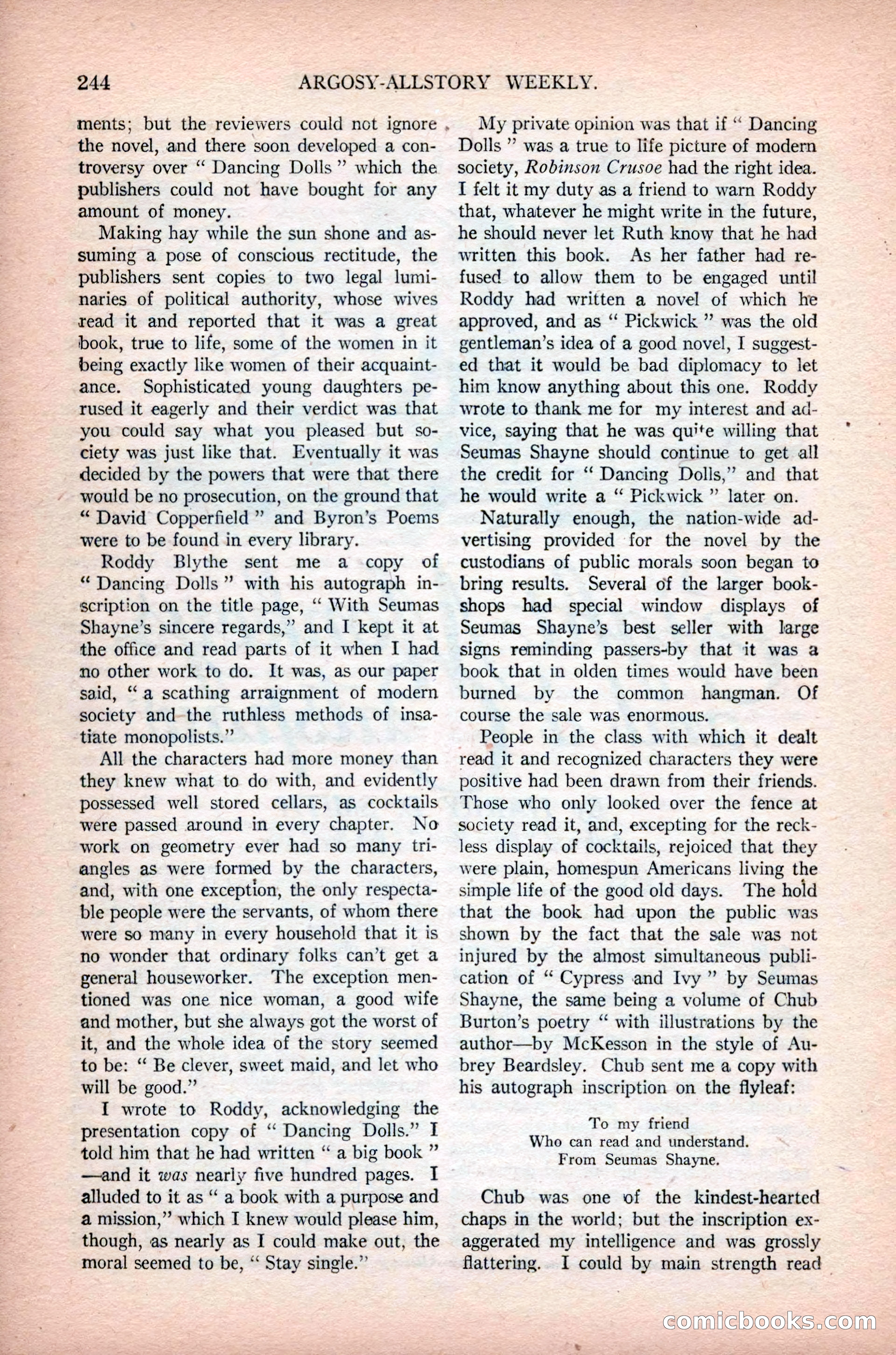
A restored page from Pulp Fiction, 1924. Page through the whole issue in the reader above.
📄 Transcribed text from this page (OCR, searchable)
Machine-transcribed from the original scan — historical spelling and the odd misread are preserved.
244 ments; but the reviewers could not ignore , the novel, and there soon developed a con- troversy over “ Dancing Dolls” which the publishers could not have bought for any amount of money. Making hay while the sun shone and as- suming a pose of conscious rectitude, the publishers sent copies to two legal lumi- naries of political authority, whose wives read it and reported that it was a great book, true to life, some of the women in it being exactly like women of their acquaint- ance. Sophisticated young daughters pe- rused it eagerly and their verdict was that you could say what you pleased but so- ciety was just like that. Eventually it was decided by the powers that were that there would be no prosecution, on the ground that “ David Copperfield” and Byron’s Poems were to be found in every library. Roddy Blythe sent me a copy of Dancing Dolls” with his autograph in- scription on the title page, ““ With Seumas Shayne’s sincere regards,” and I kept it at the office and read parts of it when I had no other work to do. It was, as our paper said, ‘‘a scathing arraignment of modern society and-the ruthless methods of insa- tiate monopolists.”’ All the characters had more money than they knew what to do with, and evidently possessed well stored cellars, as cocktails were passed around in every chapter. No work on geometry ever had so many tri- angles as were formed by the characters, and, with one exception, the only respecta- ble people were the servants, of whom there were so many in every household that it is no wonder that ordinary folks can’t get a general houseworker. The exception men- tioned was one nice woman, a good wife and mother, but she always got the worst of it, and the whole idea of the story seemed to be: “ Be clever, sweet maid, and let who will be good.” {I wrote to Roddy, acknowledging the presentation copy of “ Dancing Dolls.” I told him that he had written “ a big book ” —and it was nearly five hundred pages. I alluded to it as “ a book with a purpose and a mission,” which I knew would please him, though, as nearly as I could make out, the moral seemed to be, “‘ Stay single.”’ ARGOSY-ALLSTORY WEEKLY. My private opinion was that if “ Dancing Dolls ” was a true to life picture of modern society, Robinson Crusoe had the right idea. [ felt it my duty as a friend to warn Roddy that, whatever he might write in the future, he should never let Ruth know that he had written this book. As her father had re- fused to allow them to be engaged until Roddy had written a novel of which he approved, and as ‘‘ Pickwick ” was the old gentleman’s idea of a good novel, I suggest- ed that it would be bad diplomacy to let him know anything about this one. Roddy wrote to thank me for my interest and ad- vice, saying that he was quite willing that Seumas Shayne should continue to get all the credit for “‘ Dancing Dolls,” and that he would write a “ Pickwick ” later on. Naturally enough, the nation-wide ad- vertising provided for the novel by the custodians of public morals soon began to bring results. Several of the larger book- shops had special window displays of Seumas Shayne’s best seller with large signs reminding passers-by that it was a book that in olden times would have been burned by the common hangman. Of course the sale was enormous. People in the class with which it dealt read it and recognized characters they were positive had been drawn from their friends. Those who only looked over the fence at society read it, and, excepting for the reck- less display of cocktails, rejoiced that they were plain, homespun Americans living the simple life of the good old days. The hold that the book had upon the public was shown by the fact that the sale was not injured by the almost simultaneous publi- cation of “ Cypress and Ivy ” by Seumas Shayne, the same being a volume of Chub Burton’s poetry “ with illustrations by the author—by McKesson in the style of Au- brey Beardsley. Chub sent me a copy with his autograph inscription on the flyleaf: To my friend Who can read and understand. From Seumas Shayne. Chub was one of the kindest-hearted chaps in the world; but the inscription ex- aggerated my intelligence and was grossly flattering. I could by main strength read — Comichboo (c cS) (E@)