
Pulp Fiction, 1924 · page 89 of 166
Argosy All-Story Weekly, February 23, 1924 — page 89: what you’re looking at
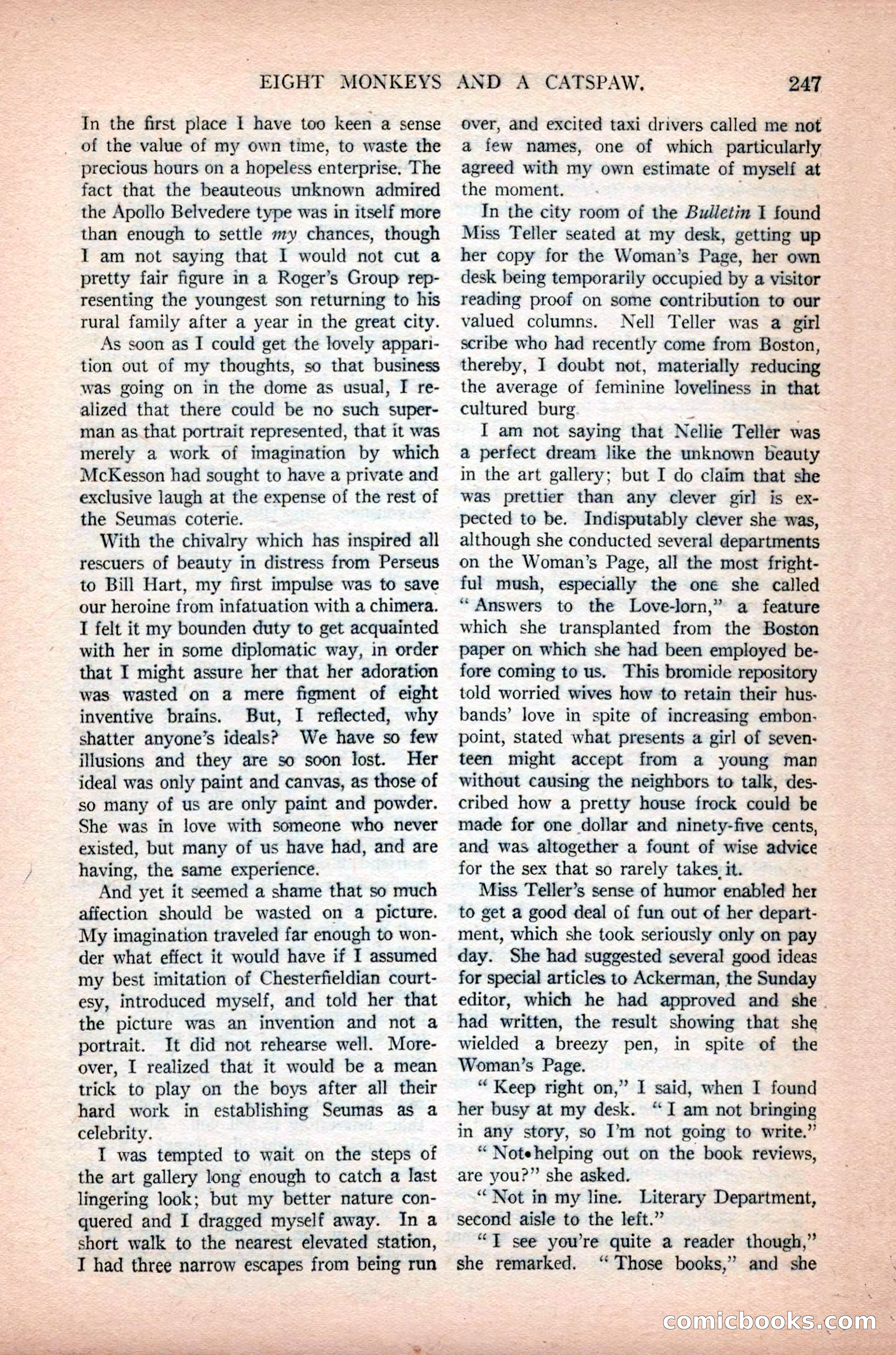
A restored page from Pulp Fiction, 1924. Page through the whole issue in the reader above.
📄 Transcribed text from this page (OCR, searchable)
Machine-transcribed from the original scan — historical spelling and the odd misread are preserved.
EIGHT MONKEYS In the first place 1 have too keen a sense _ of the value of my own time, to waste the precious hours on a hopeless enterprise, The fact that the beauteous unknown admired the Apollo Belvedere type was in itself more than enough to settle my chances, though I am not saying that I would not cut a pretty fair figure in a Roger’s Group rep- resenting the youngest son returning to his rural family after a year in the great city. As soon as I could get the lovely appari- tion out of my thoughts, so that business was going on in the dome as usual, I re- alized that there could be no such super- man as that portrait represented, that it was merely a work of imagination by which McKesson had sought to have a private and exclusive laugh at the expense of the rest of the Seumas coterie. With the chivalry which has inspired all rescuers of beauty in distress from Perseus to Bill Hart, my first impulse was to save our heroine from infatuation with a chimera. I felt it my bounden duty to get acquainted with her in some diplomatic way, in order that I might assure her that her adoration was wasted on a mere figment of eight inventive brains. But, I reflected, why shatter anyone’s ideals? We have so few illusions and they are so soon lost. Her ideal was only paint and canvas, as those of so many of us are only paint and powder. She was in love with someone who never existed, but many of us have had, and are having, the same experience. And yet it seemed a shame that so much affection should be wasted on a picture. My imagination traveled far enough to won- der what effect it would have if I assumed my best imitation of Chesterfieldian court- esy, introduced myself, and told her that the picture was an invention and not a portrait. It did not rehearse well. More- over, I realized that it would be a mean trick to play on the boys after all their hard work in establishing Seumas as a celebrity. I was tempted to wait on the steps of the art gallery long enough to catch a Iast lingering look; but my better nature con- quered and I dragged myself away. In a short walk to the nearest elevated station, I had three narrow escapes from being run AND A CATSPAW, 247 over, and excited taxi drivers called me not a few names, one of which particularly agreed with my own estimate of myself at the moment. In the city room of the Bulletin I found Miss Teller seated at my desk, getting up her copy for the Woman’s Page, her own desk being temporarily occupied by a visitor reading proof on some contribution to our valued columns. Nell Teller was a girl scribe who had recently come from Boston, thereby, I doubt not, materially reducing the average of feminine loveliness in that cultured burg. ; I am not saying that Nellie Teller was a perfect dream like the unknown beauty in the art gallery; but I do claim that she was prettier than any clever girl is ex- pected to be. Indisputably clever she was, although she conducted several departments on the Woman’s Page, all the most fright- ful mush, especially the one she called “Answers to the Love-lorn,” a feature which she transplanted from the Boston paper on which she had been employed be- fore coming to us. This bromide repository told worried wives how to retain their hus- bands’ love in spite of increasing embon- point, stated what presents a girl of seven- teen might accept from a young man without causing the neighbors to talk, des- cribed how a pretty house frock could be made for one dollar and ninety-five cents, and was altogether a fount of wise advice for the sex that so rarely takes. it. Miss Teller’s sense of humor enabled her to get a good deal of fun out of her depart- ment, which she took seriously only on pay day. She had suggested several good ideas for special articles to Ackerman, the Sunday editor, which he had approved and she. had written, the result showing that she wielded a breezy pen, in spite of the Woman’s Page. “ Keep right on,” I said, when I found her busy at my desk. “I am not bringing in any story, so I’m not going to write.” “ Notehelping out on the book reviews, are you?” she asked. ‘““Not in my line. Literary Department, second aisle to the left.” “T see you're quite a reader though,” she remarked. ‘ Those books,’ and she Gomicboo (E Sol ~ - . -—%; > ~ - - » * ee >So = = - - - . eT ae a ee ie a ey Pn ee ee ore ee ae —y mg ee =e - S- al