
Pulp Fiction, 1924 · page 110 of 177
Argosy All-Story Weekly, March 15, 1924 — page 110: what you’re looking at
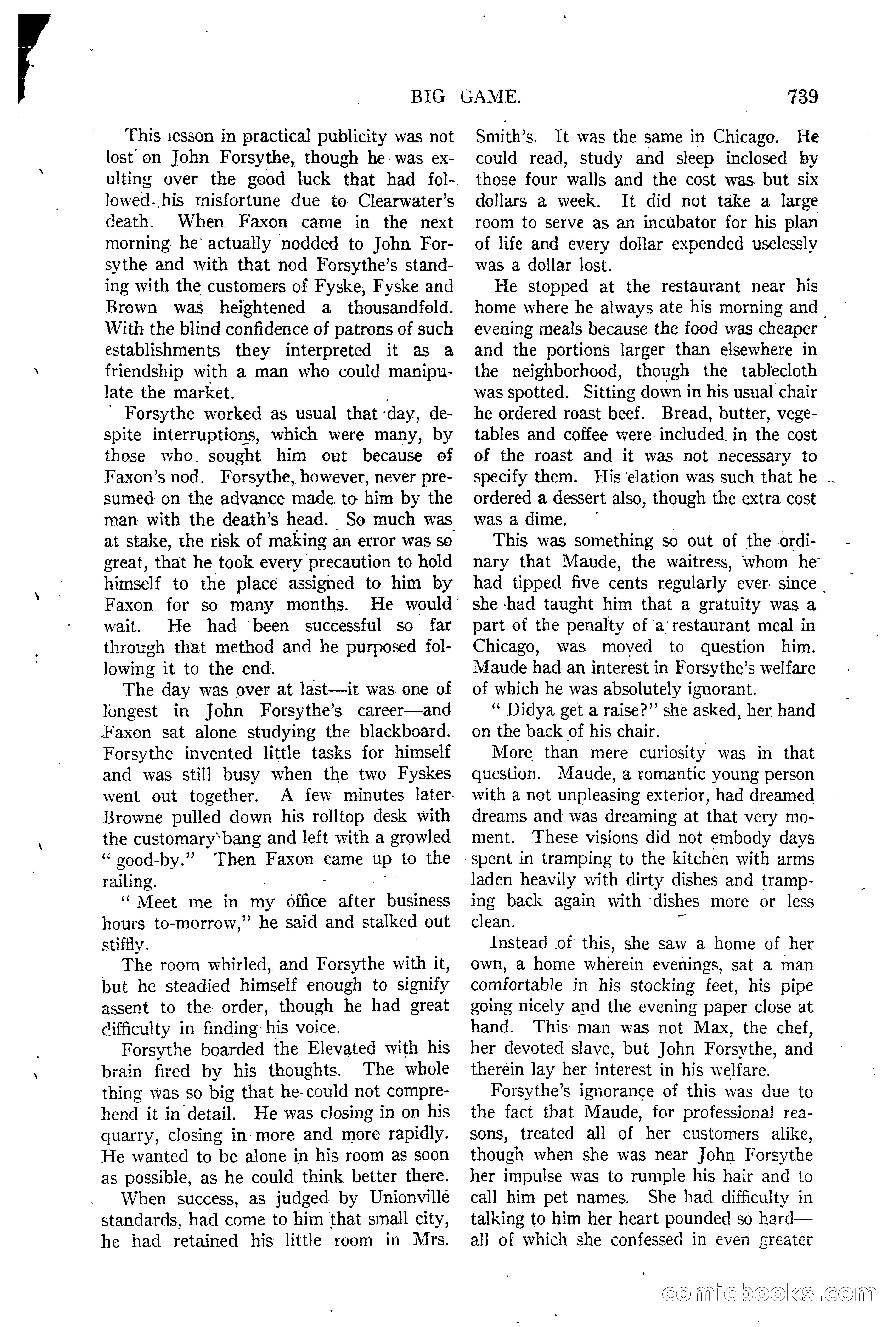
A restored page from Pulp Fiction, 1924. Page through the whole issue in the reader above.
📄 Transcribed text from this page (OCR, searchable)
Machine-transcribed from the original scan — historical spelling and the odd misread are preserved.
BIG GAME. This :esson in practical publicity was not lost on John Forsythe, though he. was ex- ulting over the good luck that had fol-. lowed. his misfortune due to Clearwater’s death. When Faxon came in the next morning. he’ actually nodded to John For- sythe and with that nod Forsythe’s stand- ing with the customers of Fyske, Fyske and Brown was heightened a_ thousandfold. With the blind confidence of patrons of such establishments they interpreted it as a friendship with a man who could manipu- late the market. | ' Forsythe worked as usual that ‘day, de- spite interruptions, which were many, by those who. sought him out because of Faxon’s nod. Forsythe, however, never pre- sumed on the advance made to him by the man: with the death’s head. So much was at stake, the risk of making an error was so great, that he took every precaution to hold himself to the place assigned to him by Faxon for so many months. wait. He had ‘been successful so far through that method and he purposed fol- lowing it to the end. The day was over at last—it was one of longest in John Forsythe’s career—and Faxon sat alone studying the blackboard. Forsythe invented little tasks for himself and was still busy when the two Fyskes went out together. Browne pulled down his rolltop desk with the customary*bang and left with a growled “ ogod-by.” Then Faxon came up to the railing. ‘Meet me In my office after business hours to-morrow,” he said and stalked out stiffly. The room whirled, and Forsythe with it, but he steadied himself enough to signify assent to the order, though he had great cifficulty in finding: his voice. Forsythe boarded the Elevated with his brain fired by his thoughts. The whole thing was so big that he-could not compre- hend it in detail. He was closing in on his quarry, closing in-more and more rapidly. He wanted to be alone in his room as soon as possible, as he could think better there. When success, as judged by Unionville standards, had come to him that small city, he had retained his little room in Mrs. He would’ A few minutes later. 739 Smith’s. It was the same in Chicago. He could read, study and sleep inclosed by those four walls and the cost was but six dollars a week. It did not take a large room to serve as an incubator for his plan of life and every dollar expended uselessly was a dollar lost. He stopped at the restaurant near his home where he always ate his morning and > evening meals because the food was cheaper and the portions larger than elsewhere in the neighborhood, though the tablecloth was spotted. Sitting down in his usual chair he ordered roast beef. Bread, butter, vege- tables and coffee were included. in the cost of the roast and it was not necessary to specify them. His elation was such that he .. ordered a dessert also, though the extra cost was adime. — a | This was something so out of the ordi- nary that Maude, the waitress, whom he had tipped five cents regularly ever. since _ she -had taught him that a gratuity was a part of the penalty of a restaurant meal in Chicago, was moved to question him. Maude had an interest in Forsythe’s welfare of which he was absolutely ignorant. ‘ Didya get a raise?” she asked, her hand on the back of his chair. More than mere curiosity was in that question. Maude, a romantic young person with a not unpleasing exterior, had dreamed dreams and was dreaming at that very mo- ment. These visions did not embody days -spent in tramping to the kitchen with arms laden heavily with dirty dishes and tramp- ing back again with ‘dishes more or less clean. Instead of this, she saw a home of her own, a home wherein evenings, sat a man comfortable in his stocking feet, his pipe going nicely and the evening paper close at hand. This man was not Max, the chef, her devoted slave, but John Forsythe, and therein lay her interest in his welfare. Forsythe’s ignorance of this was due to the fact that Maude, for professional rea- sons, treated all of her customers alike, though when she was near John Forsythe her impulse was to rumple his hair and to call him pet names. She had difficulty in talking to him her heart pounded so hard— all of which she confessed in even greater S COMICLO©O CO