
Pulp Fiction, 1924 · page 169 of 177
Argosy All-Story Weekly, March 15, 1924 — page 169: what you’re looking at
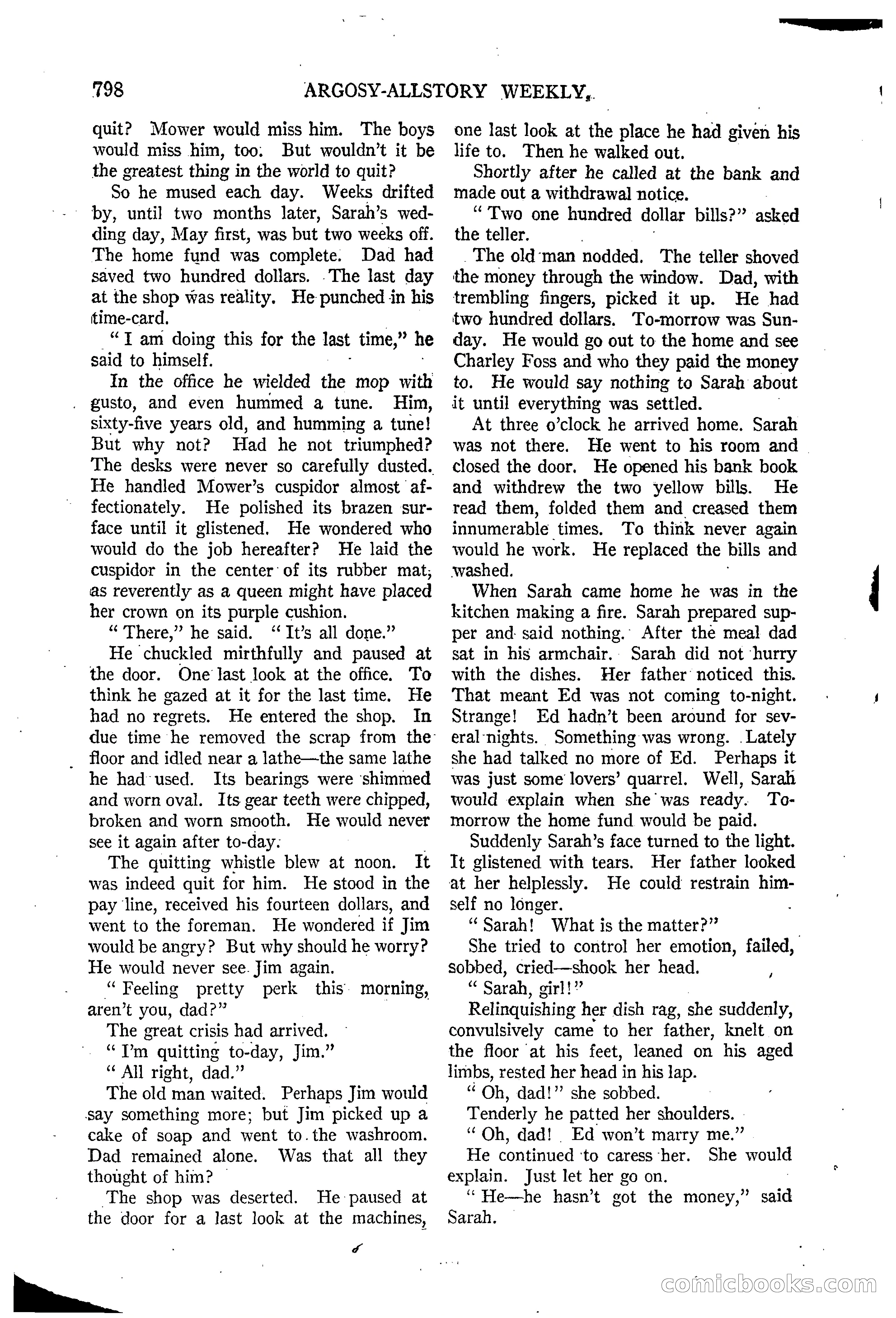
A restored page from Pulp Fiction, 1924. Page through the whole issue in the reader above.
📄 Transcribed text from this page (OCR, searchable)
Machine-transcribed from the original scan — historical spelling and the odd misread are preserved.
798 quit? Mower would miss him. The boys would miss him, too. But wouldn’t it be the greatest thing in the world to quit? So he mused each day. Weeks drifted _ by, until two months later, Sarah’s wed- ding day, May first, was but two weeks off. The home fund was complete. Dad had saved two hundred dollars. .The last day at the shop was reality. He punched jin his time-card. | “Tam doing this for the last time,” he said to himself. In the office he wielded the mop with _ gusto, and even hummed a tune. Him, sixty-five years old, and humming a tune! But why not? Had he not triumphed? The desks were never so carefully dusted. He handled Mower’s cuspidor almost af- fectionately. He polished its brazen sur- face until it glistened. He wondered who would do the job hereafter? He laid the cuspidor in the center of its rubber mat; as reverently as a queen might have placed her crown on its purple cushion. “There,” he said. ‘It’s all done.” He chuckled mirthfully and paused at the door. One last look at the office. To think he gazed at it for the last time. He had no regrets. He entered the shop. In due time he removed the scrap from the’ _ floor and idled near a lathe—the same lathe he had used. Its bearings were shimmed and worn oval. Its gear teeth were chipped, broken and worn smooth. He woute never see it again after to- -day: The quitting whistle blew at noon. It was indeed quit for him. He stood in the pay line, received his fourteen dollars, and went to the foreman. He wondered if Jim would be angry? But why should he worry? He would never see. Jim again. “Feeling pretty perk this. morning, aren’t you, dad?” | The great crisis had arrived, “Tm quitting to-day, Jim.” ‘All right, dad.” The old man waited. Perhaps Jim would say something more; but Jim picked up a cake of soap and went to.the washroom. Dad remained alone. Was that all they thought of him? © The shop was deserted. He paused at the door for a last look at the machines, rf ARGOSY-ALLSTORY WEEKLY,,. one last look at the place he had given his life to. Then he walked out. Shortly after he called at the bank and made out a withdrawal notice. ‘Two one hundred dollar bills?” asked the teller. . _ The oldman nodded. The teller shoved the money through the window. Dad, with trembling fingers, picked it up. He had two hundred dollars. To-morrow was Sun- day. He would go out to the home and see Charley Foss and who they paid the money to. He would say nothing to Sarah about it until everything was settled. At three o’clock he arrived home. Sarah was not there. closed the door. He opened his bank book and withdrew the two yellow bills. He read them, folded them and creased them innumerable times. To think never again would he work. He replaced the hills and washed. When Sarah came home he was in the kitchen making a fire. Sarah prepared sup- per and: said nothing. After the meal dad sat in his armchair.. Sarah did not ‘hurry with the dishes. Her father noticed this. That meant Ed was not coming to-night. Strange! Ed hadn’t been around for sev- eral nights. Something was wrong. . Lately she had talked no more of Ed. Perhaps it was just some lovers’ quarrel. Well, Sarah would explain when she was ready. To- morrow the home fund would be paid. Suddenly Sarah’s face turned to the light. It glistened with tears. Her father looked at her helplessly. He could restrain him- self no longer. ‘Sarah! What is the matter?” He went to his room and — She tried to control her emotion, failed, sobbed, cried—shook her head. , “¢ Sarah, girl!” Relinquishing her dish rag, she suddenly, convulsively came to her father, knelt on the floor at his feet, leaned on his aged limbs, rested her head in his lap. “Oh, dad!” she sobbed. Tenderly he patted her shoulders. - ‘Oh, dad! . Ed won’t marry me.” © He continued ‘to caress her. She would explain. Just let her go on. : ‘“He—he hasn’t got the money,” said Sarah, — EO 1IOO S C@