
Pulp Fiction, 1924 · page 27 of 177
Argosy All-Story Weekly, March 15, 1924 — page 27: what you’re looking at
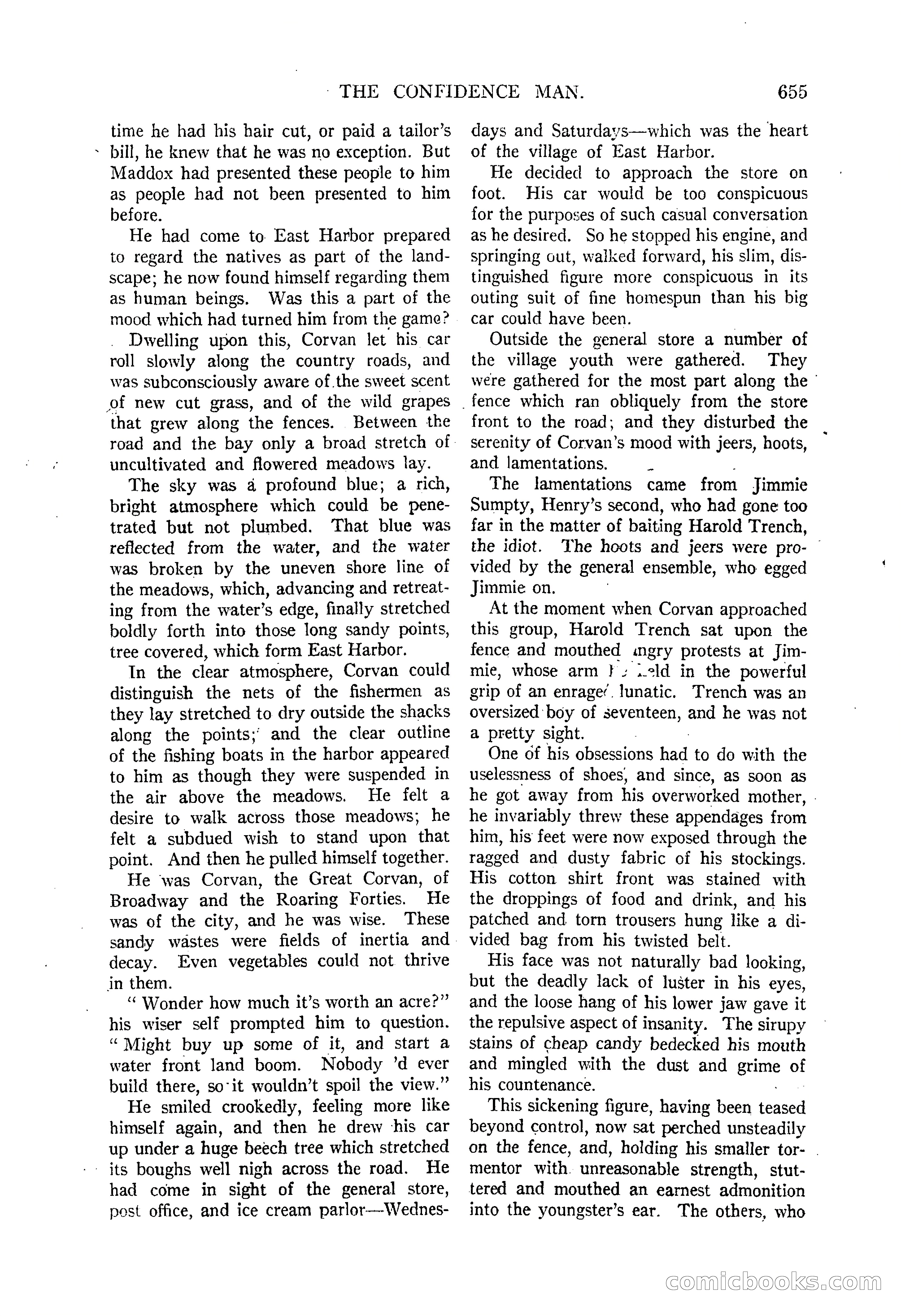
A restored page from Pulp Fiction, 1924. Page through the whole issue in the reader above.
📄 Transcribed text from this page (OCR, searchable)
Machine-transcribed from the original scan — historical spelling and the odd misread are preserved.
THE CONTIDENCE time he had his hair cut, or paid a tailor’s ~ bill, he knew that he was no exception. But Maddox had presented these people to him as people had not been presented to him before. He had come to. East Harbor prepared to regard the natives as part of the land- scape; he now found himself regarding them as human beings. Was this a part of the mood which had turned him from the game? » Dwelling upon this, Corvan let his car roll slowly along the country roads, and was subconsciously aware of the sweet scent of new cut grass, and of the wild grapes that grew along the fences. Between the road and the bay only a broad stretch of uncultivated and flowered meadows lay. The sky was a profound blue; a rich, bright atmosphere which could be pene- trated but not plumbed. That blue was reflected from the water, and the water was broken by the uneven shore line of the meadows, which, advancing and retreat- ing from the water’s edge, finally stretched boldly forth into those long sandy points, tree covered, which form East Harbor. In the clear atmosphere, Corvan could distinguish the nets of the fishermen as they lay stretched to dry outside the shacks along the points;’ and the clear outline of the fishing boats in the harbor appeared to him as though they were suspended in the air above the meadows. He ielt a desire to walk across those meadows; he felt a subdued wish to stand upon that point. And then he pulled himself together. He was Corvan, the Great Corvan, of Broadway and the Roaring Forties. He was of the city, and he was wise. These sandy wastes were fields of inertia and. decay. Even vegetables could not. thrive in them. “ Wonder how much it’s worth an acre?” his wiser self prompted him to question. “Might buy up some of if, and start a water front land boom. Nobody 'd ever build there, soit wouldn’t spoil the view.’ He smiled crookedly, feeling more like himself again, and then he drew ‘his car up under a huge beech tree which stretched - its boughs well nigh across the road. He had come in sight of the general store, post office, and ice cream parlor—-Wednes- MAN. 655 days and Saturdays—which was the heart of the village of East Harbor. He decided to approach the store on foot. His car would be too conspicuous for the purposes of such casual conversation as he desired. So he stopped his engine, and Springing out, walked forward, his slim, dis- tinguished figure more conspicuous in its outing suit of fine homespun than his big car could have been. | Outside the general store a number of the village youth were gathered. They were gathered for the most part along the | _fence which ran obliquely from the store front to the road; and they disturbed the serenity of Corvan’s mood with jeers, hoots, and lamentations. - The lamentations came from Jimmie Sumpty, Henry’s second, who had gone too far in the matter of baiting Harold Trench, the idiot. vided by the general ensemble, who egged Jimmie on. At the moment when Corvan approached this group, Harold Trench sat upon the fence and mouthed ingry protests at Jim- mie, whose arm }- ield in the powerful grip of an enrage’. lunatic. Trench was an oversized boy of seventeen, and he was not a pretty sight. One of his obsessions had to do with the uselessness of shoes, and since, as soon as he got away from his overworked mother, - he invariably threw these appendages from him, his feet were now exposed through the ragged and dusty fabric of his stockings. His cotton shirt front was stained with the droppings of food and drink, and his patched and torn trousers hung like a di- vided bag from his twisted belt. His face was not naturally bad looking, but the deadly lack of luster in his eyes, and the loose hang of his lower jaw gave it the repulsive aspect of insanity. The sirupy stains of cheap candy bedecked his mouth and mingled with the dust and grime of his countenance. This sickening figure, having been teased beyond control, now sat perched unsteadily on the fence, and, holding his smaller tor- . mentor with. unreasonable strength, stut- tered and mouthed an earnest admonition into the youngster’s ear. The others, who CoOnnicloool The hoots and jeers were pro- © CO