
Pulp Fiction, 1924 · page 29 of 177
Argosy All-Story Weekly, March 15, 1924 — page 29: what you’re looking at
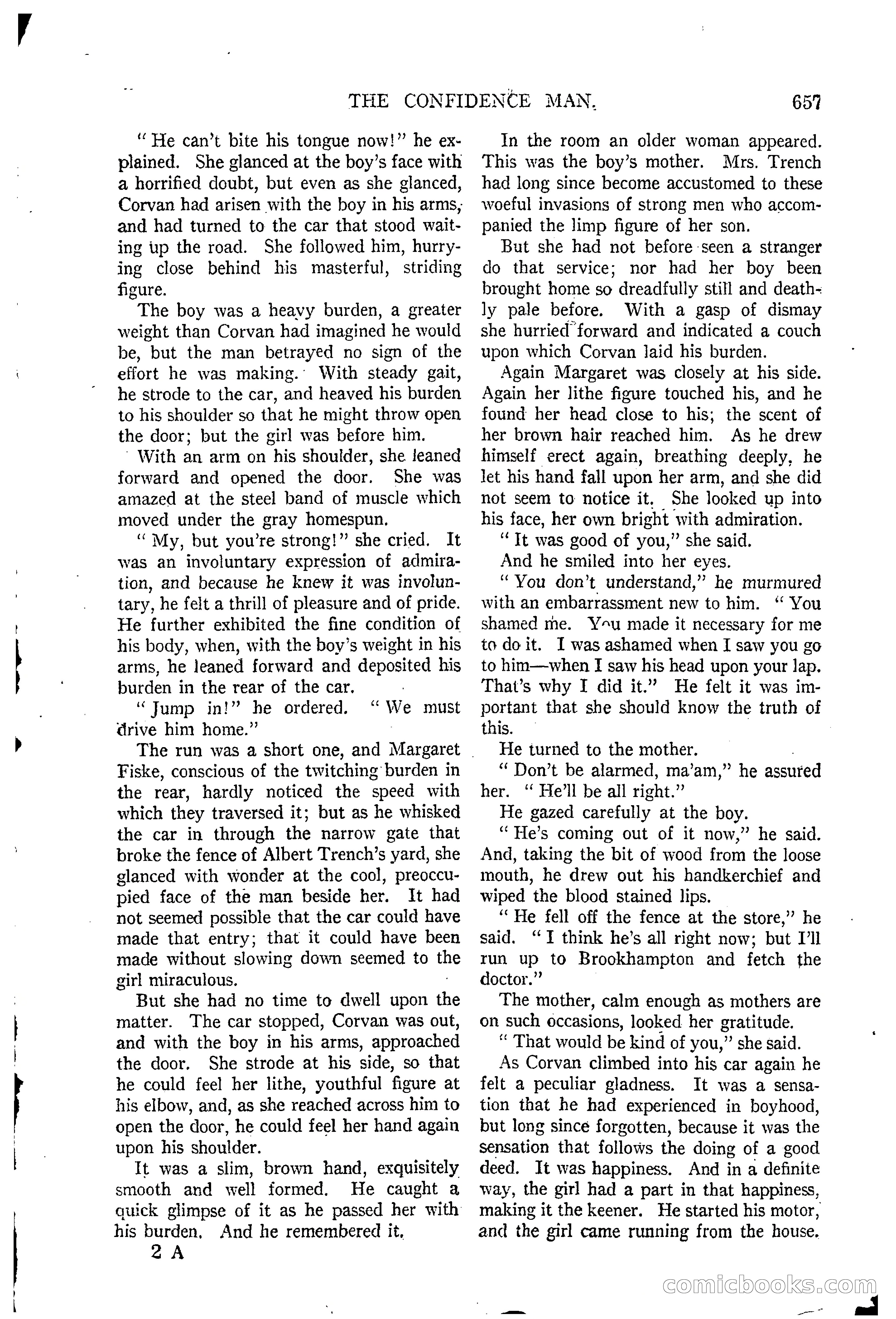
A restored page from Pulp Fiction, 1924. Page through the whole issue in the reader above.
📄 Transcribed text from this page (OCR, searchable)
Machine-transcribed from the original scan — historical spelling and the odd misread are preserved.
- — er =~: THE CONFIDENCE MAN. 657 “ He can’t bite his tongue now!” he ex- plained. She glanced at the boy’s face with a horrified doubt, but even as she glanced, Corvan had arisen with the boy in his arms, and had turned to the car that stood wait- ing up the road. She followed him, hurry- ing close behind his masterful, striding figure. The boy was a heavy burden, a greater weight than Corvan had imagined he would be, but the man betrayed no sign of the effort he was making.’ With steady gait, he strode to the car, and heaved his burden to his shoulder so that he might throw open the door; but the girl was before him. ' With an arm on his shoulder, she leaned forward and opened the door. She was amazed at the steel band of muscle which moved under the gray homespun. “My, but you’re strong!” she cried. It was an involuntary expression of admira- tion, and because he knew it was involun- tary, he felt a thrill of pleasure and of pride. He further exhibited the fine condition of his body, when, with the boy’s weight in his arms, he leaned forward and deposited his burden in the rear of the car. “Jump in!” he ordered. “We must drive him home.” : The run was a short one, and Margaret | Fiske, conscious of the twitching burden in the rear, hardly noticed the speed with which they traversed it; but as he whisked the car in through the narrow gate that broke the fence of Albert Trench’s yard, she glanced with wonder at the cool, preoccu- pied face of the man beside her. It had not seemed possible that the car could have made that entry; that it could have been made without slowing down seemed to the girl miraculous. But she had no time to dwell upon the matter. The car stopped, Corvan was out, and with the boy in his arms, approached the door. She strode at his side, so that he could feel her lithe, youthful figure at his elbow, and, as she reached across him to open the door, he could feel her hand again upon his shoulder. It was a slim, brown hand, exquisitely smooth and well formed. He caught a quick glimpse of it as he passed her with his burden, And he remembered it. 2A In the room an older woman appeared. This was the boy’s mother. Mrs. Trench had long since become accustomed to these woeful invasions of strong men who accom- panied the limp figure of her son. But she had not before seen a stranger do that service; nor had her boy been brought home so dreadfully still and death- ly pale before. With a gasp of dismay she hurried forward and indicated a couch upon which Corvan Jaid his burden. Again Margaret was closely at his side. Again her lithe figure touched his, and he found her head close to his; the scent of her brown hair reached him. As he drew himself erect again, breathing deeply, he let his hand fall upon her arm, and she did not seem to notice it. She looked up into his face, her own bright with admiration. ‘It was good of you,” she said. And he smiled into her eyes. “You don’t understand,” he murmured with an embarrassment new to him. “ You shamed me. You made it necessary for me ta doit. I was ashamed when I saw you go to him—when I saw his head upon your Jap. That’s why I did it.” He felt it was im- portant that she should know the truth of this. He turned to the mother. “ Don’t be alarmed, ma’am,” he assured her. “ He'll be all right.” He gazed carefully at the boy. ‘“He’s coming out of it now,” he said. And, taking the bit of wood from the loose mouth, he drew out his handkerchief and wiped the blood stained lips. | ‘““ He fell off the fence at the store,” he said. “TY think he’s all right now; but I'll run up to Brookhampton and fetch the doctor.” The mother, calm enough as mothers are on such occasions, looked her gratitude. ‘ That would be kind of you,” she said. As Corvan climbed into his car again he felt a peculiar gladness. It was a sensa- tion that he had experienced in boyhood, but long since forgotten, because it was the sensation that follows the doing of a good deed. It was happiness. And in a definite way, the girl had a part in that happiness, making it the keener. and the girl came running from the house. He started his motor, conniclooolks CO . — —_—