
Pulp Fiction, 1924 · page 94 of 177
Argosy All-Story Weekly, March 15, 1924 — page 94: what you’re looking at
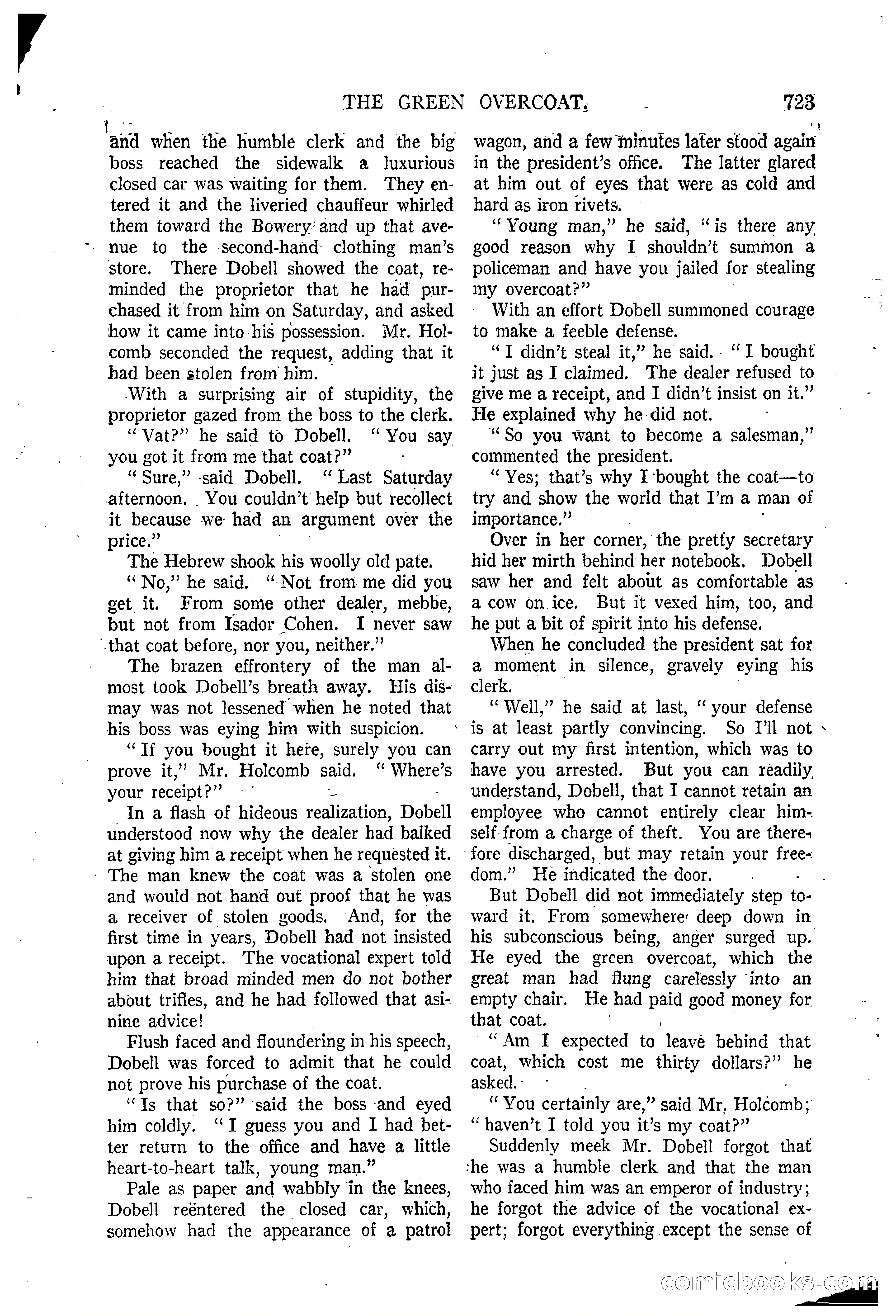
A restored page from Pulp Fiction, 1924. Page through the whole issue in the reader above.
📄 Transcribed text from this page (OCR, searchable)
Machine-transcribed from the original scan — historical spelling and the odd misread are preserved.
| THE GREEN OVERCOAT. and when the humble clerk and the big boss reached the sidewalk a luxurious closed car was waiting for them. They en- tered it and the liveried chauffeur whirled them toward the Bowery: and up that ave- - nue to the -second-hand clothing man’s store. There Dobell showed the coat, re- minded the proprietor that he had pur- chased it from him on Saturday, and asked how it came into-his possession. Mr. Hol- comb seconded the request, adding that it had been stolen from him. — With a surprising air of stupidity, the proprietor gazed from the boss to the clerk. ‘“Vate” he said to Dobell. ‘ You say you got it from me that coat?” “Sure,” -said Dobell. “Last Saturday afternoon. . You couldn’t help but recollect it because we had an argument over the price.” The Hebrew shook his woolly old pate. “No,” he said. ‘ Not from me did you get it. From some other dealer, mebbe, but not from Isador Cohen. I never saw that coat before, nor you, neither.” The brazen effrontery of the man al- most took Dobell’s breath away. His dis- may was not lessened when he noted that his boss was eying him with suspicion. “Tf you bought it here, surely you can prove it,” Mr, “Holcomb said. “* Where’s your receipt?” a _ In a flash of hideous realization, Dobell understood now why the dealer had balked at giving him a receipt when he requested it. - The man knew the coat was a stolen one and would not hand out proof that he was a receiver of stolen goods. And, for the first time in years, Dobell had not insisted upon a receipt. The vocational expert told him that broad minded men do not bother about trifles, and he had followed that asi- nine advice! | Flush faced and floundering in his speech, Dobell was forced to admit that he could not prove his purchase of the coat. ‘Ts that so?” said the boss and eyed him coldly. ‘I guess you and I had bet- ter return to the office and have a little heart-to-heart talk, young man.” | Pale as paper and wabbly in the knees, Dobell reéntered the closed car, which, somehow had the appearance of a patrol 123 . ‘4 wagon, and a few minutes later stood again in the president’s office. The latter glared at him out of eyes that were as cold and hard as iron rivets. ‘Young man,” he said, “is there any good reason why I shouldn’t summon a policeman and have you jailed for stealing my overcoat?” With an effort Dobell summoned courage to make a feeble defense. “T didn’t steal it,” he said. . “I bought it just as I claimed. The dealer refused to give me a receipt, and I didn’t insist on 1.” He explained why he did not. “So you want to become a salesman,” commented the president. “Yes; that’s why I ‘bought the coat—to try and ‘show the world that I’m a man of importance. - Over in her corner, the pretty secretary hid her mirth behind her notebook. Dobell saw her and felt about as comfortable as a cow on ice. But it vexed him, too, and he put a bit of spirit into his defense. When he concluded the president sat for a moment in silence, gravely eying his clerk. Well,” he said at last, “ your defense ‘ is at least partly convincing. So Ill not carry out my first intention, which was to have you arrested. But you can readily understand, Dobell, that I cannot retain an employee who cannot entirely clear him- self from a charge of theft. You are there. ‘fore discharged, but may retain your free- dom.” He indicated the door. ? But Dobell did not immediately step te } ward it. From somewhere deep down in his subconscious being, anger surged up. He eyed the green overcoat, which the great man had flung carelessly ‘into an empty chair. He had pad good money for. that coat. ~“ Am I expected to ‘Teavé behind that coat, which cost me thirty dollars?” he asked.- You certainly are,” said Mr. Holéomb: ‘“haven’t I told you it’s my coat?” Suddenly meek Mr. Dobell forgot that ‘he was a humble clerk and that the man who faced him was an emperor of industry; he forgot the advice of the vocational ex- pert; forgot everything except the sense of OS COMmicoo©