
Pulp Fiction, 1924 · page 109 of 186
Argosy All-Story Weekly, May 3, 1924 — page 109: what you’re looking at
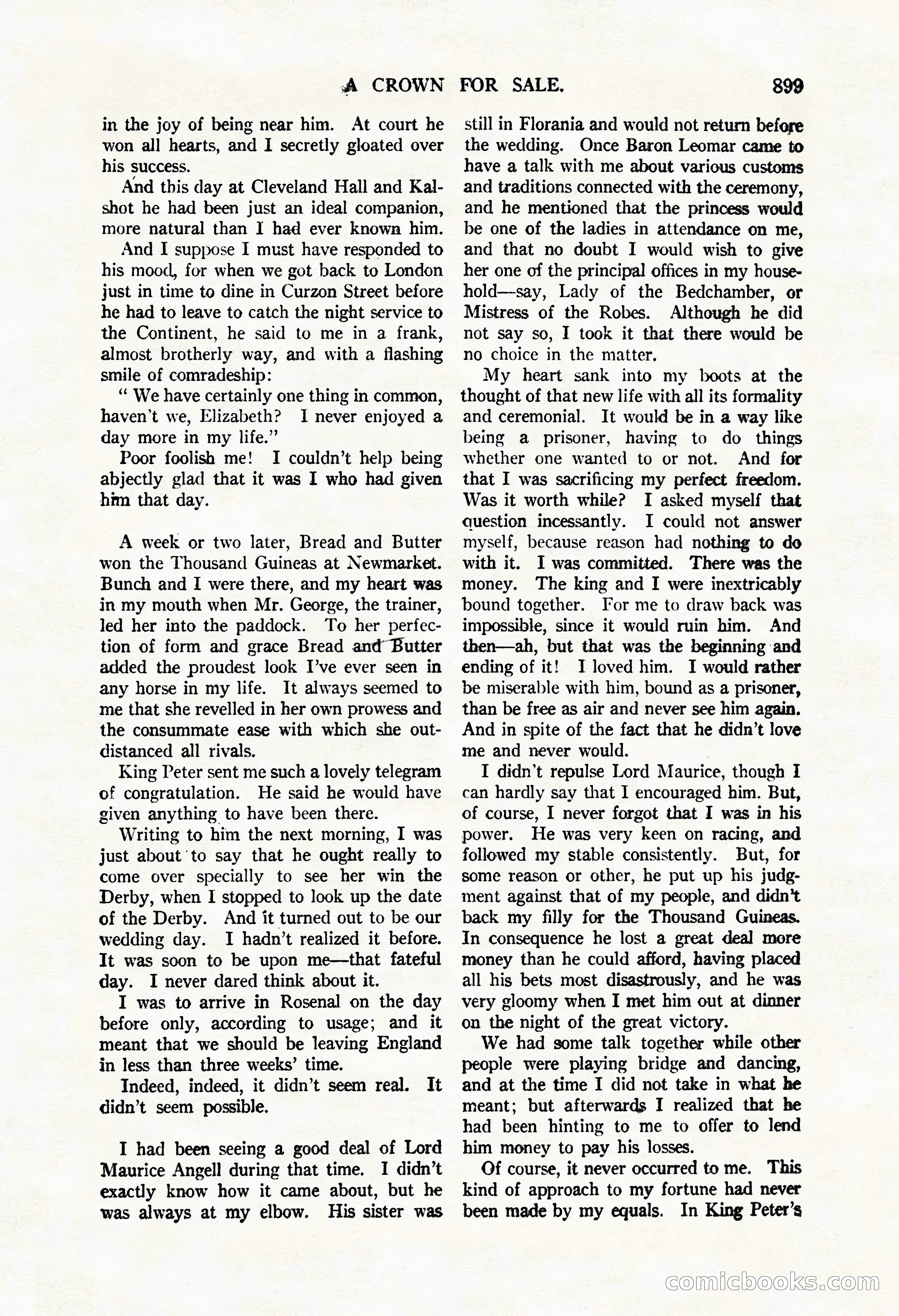
A restored page from Pulp Fiction, 1924. Page through the whole issue in the reader above.
📄 Transcribed text from this page (OCR, searchable)
Machine-transcribed from the original scan — historical spelling and the odd misread are preserved.
A CROWN in the joy of being near him. At court he won all hearts, and I secretly gloated over his success. And this day at Cleveland Hall and Kal- shot he had been just an ideal companion, more natural than I had ever known him. And I suppose I must have responded to his mood, for when we got back to London just in time to dine in Curzon Street before he had to leave to catch the night service to the Continent, he said to me in a frank, almost brotherly way, and with a flashing smile of comradeship: “We have certainly one thing in common, haven’t we, Elizabeth? I never enjoyed a day more in my life.” Poor foolish me! I couldn’t help being abjectly glad that it was I who had given hm that day. A week or two later, Bread and Butter won the Thousand Guineas at Newmarket. Bunch and I were there, and my heart was in my mouth when Mr. George, the trainer, led her into the paddock. To her perfec- tion of form and grace Bread and’ Butter added the proudest look I’ve ever seen in any horse in my life. It always seemed to me that she revelled in her own prowess and the consummate ease with which she out- distanced all rivals. King Peter sent me such a lovely telegram of congratulation. He said he would have given anything to have been there. Writing to him the next morning, I was just about to say that he ought really to come over specially to see her win the Derby, when I stopped to look up the date of the Derby. And it turned out to be our wedding day. I hadn’t realized it before. It was soon to be upon me—that fateful day. I never dared think about it. I was to arrive in Rosenal on the day before only, according to usage; and it meant that we should be leaving England in less than three weeks’ time. Indeed, indeed, it didn’t seem real. It didn’t seem possible. I had been seeing a good deal of Lord Maurice Angell during that time. I didn’t exactly know how it came about, but he was always at my elbow. His sister was FOR SALE. 899 still in Florania and would not return before the wedding. Once Baron Leomar came to have a talk with me about various customs and traditions connected with the ceremony, and he mentioned that the princess would be one of the ladies in attendance on me, and that no doubt I would wish to give her one of the principal offices in my house- hold—say, Lady of the Bedchamber, or Mistress of the Robes. Although he did not say so, I took it that there would be no choice in the matter. My heart sank into my boots at the thought of that new life with all its formality and ceremonial. It would be in a way like being a prisoner, having to do things whether one wanted to or not. And for that I was sacrificing my perfect freedom. Was it worth while? I asked myself that question incessantly. I could not answer myself, because reason had nothing to do with it. I was committed. There was the money. The king and I were inextricably bound together. Jor me to draw back was impossible, since it would ruin him. And then—ah, but that was the beginning and ending of it! I loved him. I would rather be miserable with him, bound as a prisoner, than be free as air and never see him again. And in spite of the fact that he didn’t love me and never would. I didn’t repulse Lord Maurice, though I can hardly say that I encouraged him. But, of course, I never forgot that I was in his power. He was very keen on racing, and followed my stable consistently. But, for some reason or other, he put up his judg- ment against that of my people, and didn’t back my filly for the Thousand Guineas. In consequence he lost a great deal more money than he could afford, having placed all his bets most disastrously, and he was very gloomy when I met him out at dinner on the night of the great victory. We had some talk together while other people were playing bridge and dancing, and at the time I did not take in what he meant; but afterwards I realized that he had been hinting to me to offer to lend him money to pay his losses. Of course, it never occurred to me. This kind of approach to my fortune had never been made by my equals. In King Peter’s comniiclsoo! (©