
Pulp Fiction, 1924 · page 128 of 186
Argosy All-Story Weekly, May 3, 1924 — page 128: what you’re looking at
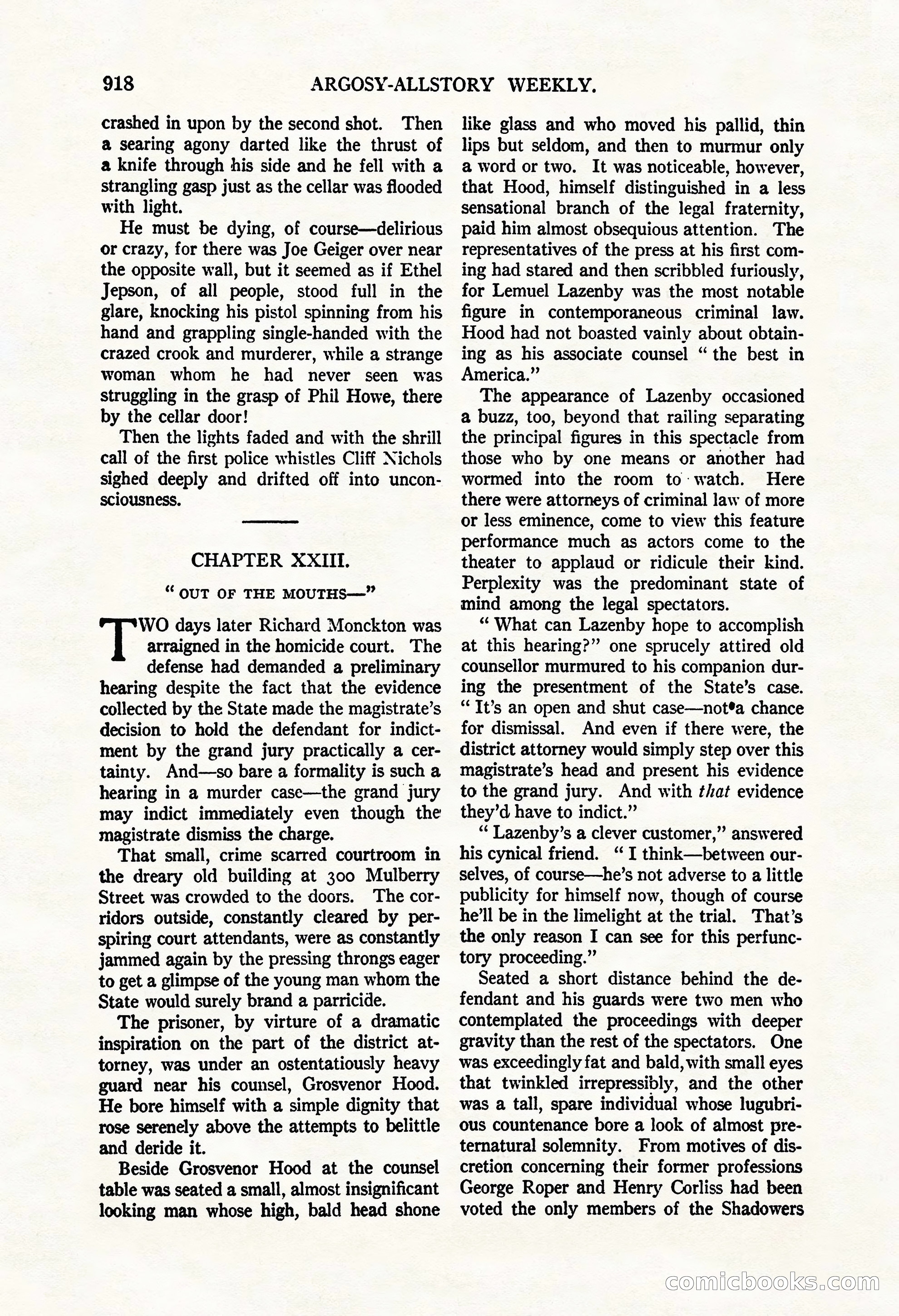
A restored page from Pulp Fiction, 1924. Page through the whole issue in the reader above.
📄 Transcribed text from this page (OCR, searchable)
Machine-transcribed from the original scan — historical spelling and the odd misread are preserved.
918 crashed in upon by the second shot. Then @ searing agony darted like the thrust of a knife through his side and he fell with a strangling gasp just as the cellar was flooded with light. He must be dying, of course—delirious or crazy, for there was Joe Geiger over near the opposite wall, but it seemed as if Ethel Jepson, of all people, stood full in the glare, knocking his pistol spinning from his hand and grappling single-handed with the crazed crook and murderer, while a strange woman whom he had never seen was struggling in the grasp of Phil Howe, there by the cellar door! Then the lights faded and with the shrill call of the first police whistles Cliff Nichols sighed deeply and drifted off into uncon- sciousness. CHAPTER XXIII. “ OUT OF THE MOUTHS—” WO days later Richard Monckton was arraigned in the homicide court. The defense had demanded a preliminary hearing despite the fact that the evidence collected by the State made the magistrate’s decision to hold the defendant for indict- ment by the grand jury practically a cer- tainty. And—so bare a formality is such a hearing in a murder case—the grand jury may indict immediately even though the magistrate dismiss the charge. That small, crime scarred courtroom in the dreary old building at 300 Mulberry Street was crowded to the doors. The cor- ridors outside, constantly cleared by per- spiring court attendants, were as constantly jammed again by the pressing throngs eager to get a glimpse of the young man whom the State would surely brand a parricide. The prisoner, by virture of a dramatic inspiration on the part of the district at- torney, was under an ostentatiously heavy guard near his counsel, Grosvenor Hood. He bore himself with a simple dignity that rose serenely above the attempts to belittle and deride it. Beside Grosvenor Hood at the counsel table was seated a small, almost insignificant looking man whose high, bald head shone ARGOSY-ALLSTORY WEEKLY. like glass and who moved his pallid, thin lips but seldom, and then to murmur only a word or two. It was noticeable, however, that Hood, himself distinguished in a less sensational branch of the legal fraternity, paid him almost obsequious attention. The representatives of the press at his first com- ing had stared and then scribbled furiously, for Lemuel Lazenby was the most notable figure in contemporaneous criminal law. Hood had not boasted vainly about obtain- ing as his associate counsel “the best in America.” The appearance of Lazenby occasioned a buzz, too, beyond that railing separating the principal figures in this spectacle from those who by one means or another had wormed into the room to-watch. Here there were attorneys of criminal law of more or less eminence, come to view this feature performance much as actors come to the theater to applaud or ridicule their kind. Perplexity was the predominant state of mind among the legal spectators. ‘What can Lazenby hope to accomplish at this hearing?” one sprucely attired old counsellor murmured to his companion dur- ing the presentment of the State’s case. ‘It’s an open and shut case—not®a chance for dismissal. And even if there were, the district attorney would simply step over this magistrate’s head and present his evidence to the grand jury. And with tat evidence they’d have to indict.” ‘“‘ Lazenby’s a clever customer,” answered his cynical friend. ‘ I think—between our- selves, of course—he’s not adverse to a little publicity for himself now, though of course he’ll be in the limelight at the trial. That’s the only reason I can see for this perfunc- tory proceeding.” Seated a short distance behind the de- fendant and his guards were two men who contemplated the proceedings with deeper gravity than the rest of the spectators. One was exceedingly fat and bald, with small eyes that twinkled irrepressibly, and the other was a tall, spare individual whose lugubri- ous countenance bore a look of almost pre- ternatural solemnity. From motives of dis- cretion concerning their former professions George Roper and Henry Corliss had been voted the only members of the Shadowers COMIG DOO! (©