
Pulp Fiction, 1924 · page 64 of 186
Argosy All-Story Weekly, May 3, 1924 — page 64: what you’re looking at
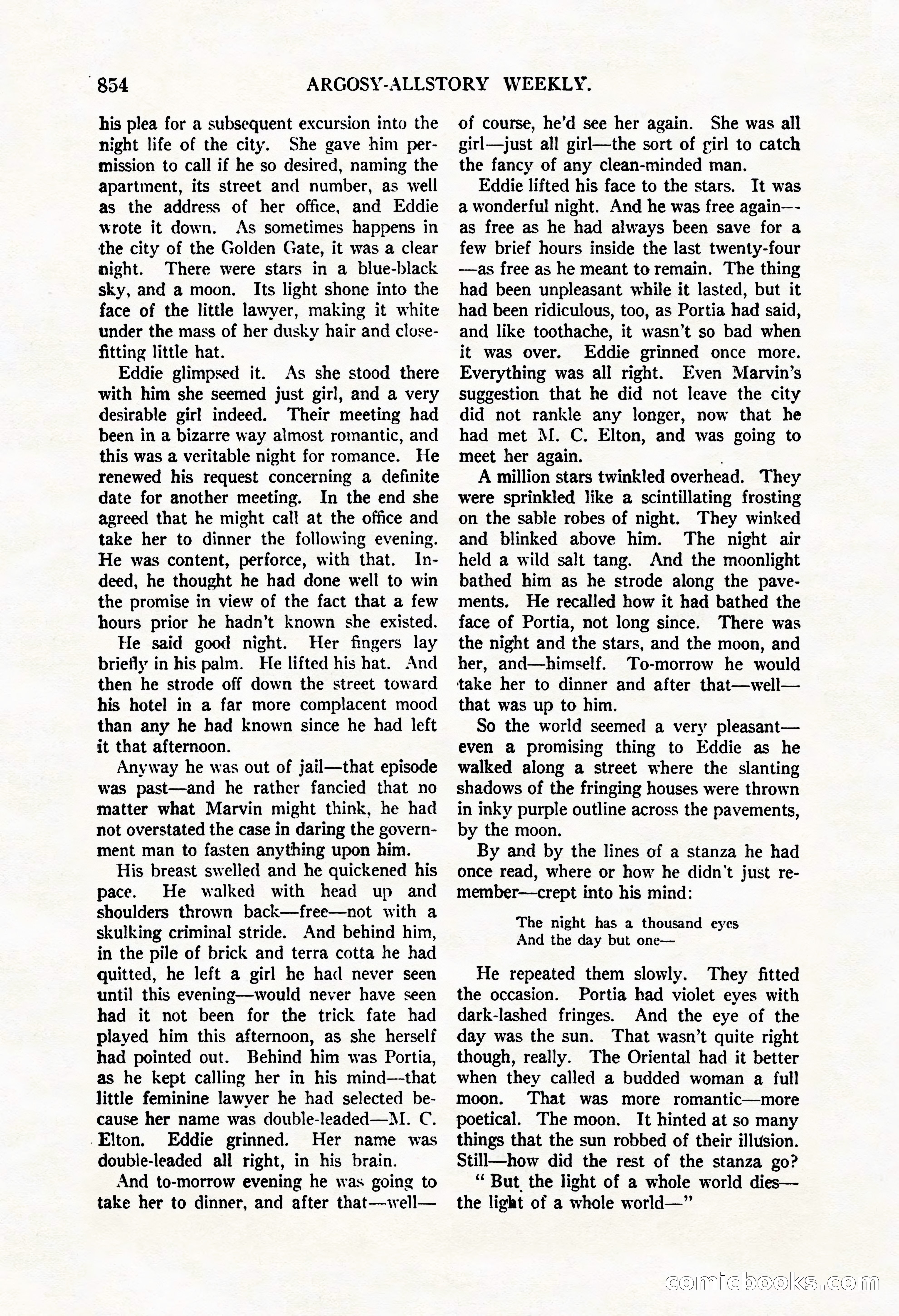
A restored page from Pulp Fiction, 1924. Page through the whole issue in the reader above.
📄 Transcribed text from this page (OCR, searchable)
Machine-transcribed from the original scan — historical spelling and the odd misread are preserved.
854 his plea for a subsequent excursion into the night life of the city. She gave him per- mission to call if he so desired, naming the apartment, its street and number, as well as the address of her office, and Eddie wrote it down. As sometimes happens in the city of the Golden Gate, it was a clear night. There were stars in a blue-black sky, and a moon. Its light shone into the face of the little lawyer, making it white under the mass of her dusky hair and close- fitting little hat. Eddie glimpsed it. As she stood there with him she seemed just girl, and a very desirable girl indeed. Their meeting had been in a bizarre way almost romantic, and this was a veritable night for romance. He renewed his request concerning a definite date for another meeting. In the end she agreed that he might call at the office and take her to dinner the following evening. He was content, perforce, with that. In- deed, he thought he had done well to win the promise in view of the fact that a few hours prior he hadn’t known she existed. He said good night. Her fingers lay briefly in his palm. He lifted his hat. And then he strode off down the street toward his hotel in a far more complacent mood than any he had known since he had left it that afternoon. Anyway he was out of jail—that episode was past—and he rather fancied that no matter what Marvin might think, he had not overstated the case in daring the govern- ment man to fasten anything upon him. His breast swelled and he quickened his pace. He walked with head up and shoulders thrown back—free—not with a skulking criminal stride. And behind him, in the pile of brick and terra cotta he had quitted, he left a girl he had never seen until this evening—would never have seen had it not been for the trick fate had plaved him this afternoon, as she herself had pointed out. Behind him was Portia, as he kept calling her in his mind—that little feminine lawyer he had selected be- cause her name was double-leaded—M. C. _Elton. Eddie grinned. Her name was double-leaded all right, in his brain. And to-morrow evening he was going to take her to dinner, and after that—well— ARGOSY-ALLSTORY WEEKLY. of course, he’d see her again. She was all girl—just all girl—the sort of girl to catch the fancy of any clean-minded man. Eddie lifted his face to the stars. It was a wonderful night. And he was free again—- as free as he had always been save for a few brief hours inside the last twenty-four ——as free as he meant to remain. The thing had been unpleasant while it lasted, but it had been ridiculous, too, as Portia had said, and like toothache, it wasn’t so bad when it was over. Eddie grinned once more. Everything was all right. Even Marvin’s suggestion that he did not leave the city did not rankle any longer, now that he had met M. C. Elton, and was going to meet her again. A million stars twinkled overhead. They were sprinkled like a scintillating frosting on the sable robes of night. They winked and blinked above him. The night air held a wild salt tang. And the moonlight bathed him as he strode along the pave- ments. He recalled how it had bathed the face of Portia, not long since. There was the night and the stars, and the moon, and her, and—himself. To-morrow he would take her to dinner and after that—well— that was up to him. So the world seemed a very pleasant— even a promising thing to Eddie as he walked along a street where the slanting shadows of the fringing houses were thrown in inky purple outline across the pavements, by the moon. By and by the lines of a stanza he had once read, where or how he didn't just re- member—crept into his mind: The night has a thousand eyes And the day but one— He repeated them slowly. They fitted the occasion. Portia had violet eyes with dark-lashed fringes. And the eye of the day was the sun. That wasn’t quite right though, really. The Oriental had it better when they called a budded woman a full moon. That was more romantic—more poetical. The moon. It hinted at so many things that the sun robbed of their illusion. Still—how did the rest of the stanza go? “ But. the light of a whole world dies— the light of a whole world—”’ COMIGDoOOo! (©