
Pulp Fiction, 1924 · page 80 of 186
Argosy All-Story Weekly, May 3, 1924 — page 80: what you’re looking at
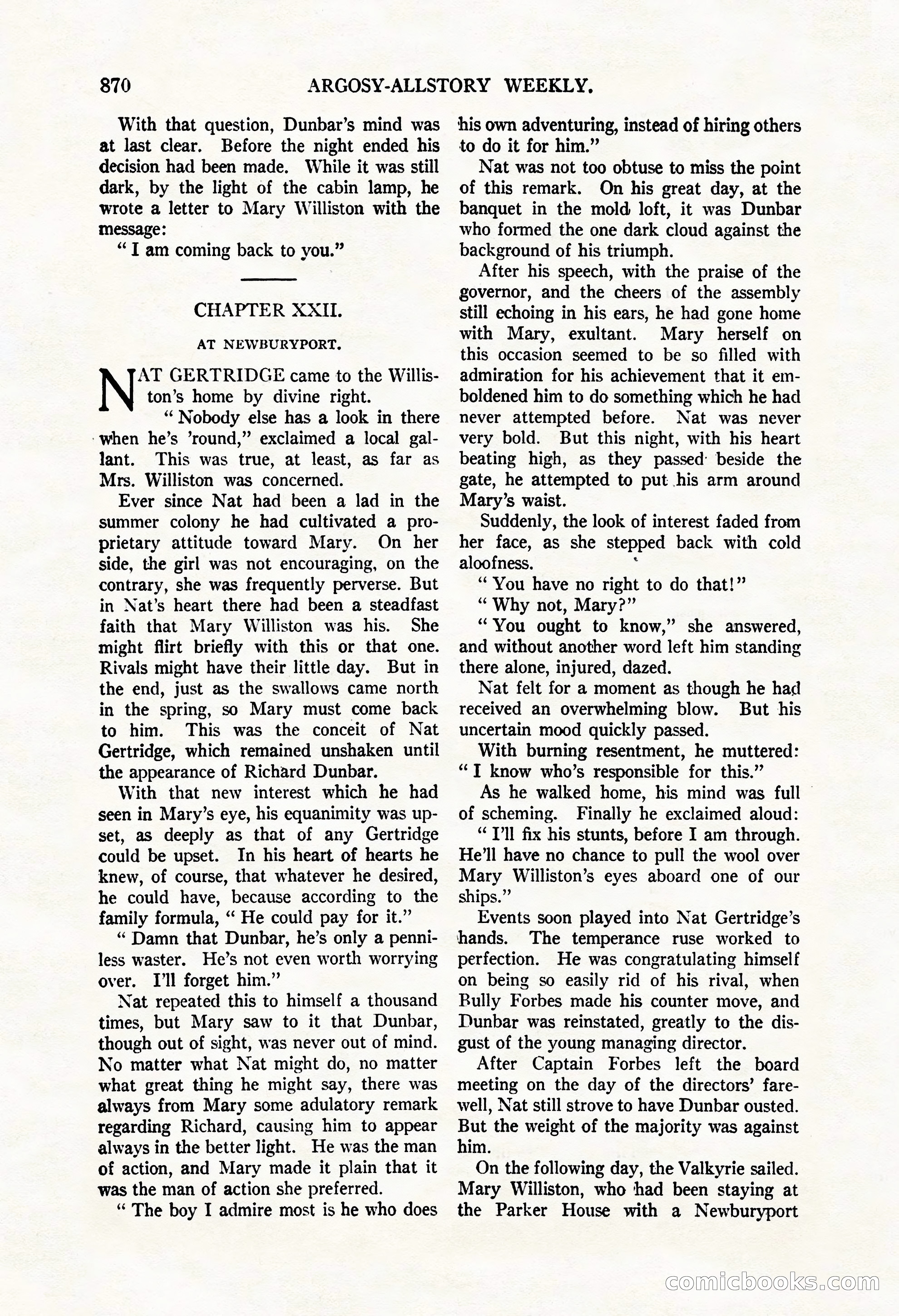
A restored page from Pulp Fiction, 1924. Page through the whole issue in the reader above.
📄 Transcribed text from this page (OCR, searchable)
Machine-transcribed from the original scan — historical spelling and the odd misread are preserved.
870 With that question, Dunbar’s mind was at last clear. Before the night ended his decision had been made. While it was still dark, by the light of the cabin lamp, he wrote a letter to Mary Williston with the message: “‘T am coming back to you.” CHAPTER XXII. AT NEWBURYPORT. AT GERTRIDGE came to the Willis- N ton’s home by divine right. ‘“* Nobody else has a look in there ‘when he’s ’round,” exclaimed a local gal- lant. This was true, at least, as far as Mrs. Williston was concerned. Ever since Nat had been a lad in the summer colony he had cultivated a pro- prietary attitude toward Mary. On her side, the girl was not encouraging, on the contrary, she was frequently perverse. But in Nat’s heart there had been a steadfast faith that Mary Williston was his. She might flirt briefly with this or that one. Rivals might have their little day. But in the end, just as the swallows came north in the spring, so Mary must come back to him. This was the conceit of Nat Gertridge, which remained unshaken until the appearance of Richard Dunbar. With that new interest which he had seen in Mary’s eye, his equanimity was up- set, as deeply as that of any Gertridge could be upset. In his heart of hearts he knew, of course, that whatever he desired, he could have, because according to the family formula, “‘ He could pay for it.” “Damn that Dunbar, he’s only a penni- less waster. He’s not even worth worrying over. I'll forget him.” Nat repeated this to himself a thousand times, but Mary saw to it that Dunbar, though out of sight, was never out of mind. No matter what Nat might do, no matter what great thing he might say, there was always from Mary some adulatory remark regarding Richard, causing him to appear always in the better light. He was the man of action, and Mary made it plain that it was the man of action she preferred. “The boy I admire most is he who does ARGOSY-ALLSTORY WEEKLY, his own adventuring, instead of hiring others to do it for him.” Nat was not too obtuse to miss the point of this remark. On his great day, at the banquet in the mold loft, it was Dunbar who formed the one dark cloud against the background of his triumph. After his speech, with the praise of the governor, and the cheers of the assembly still echoing in his ears, he had gone home with Mary, exultant. Mary herself on this occasion seemed to be so filled with admiration for his achievement that it em- boldened him to do something which he had never attempted before. Nat was never very bold. But this night, with his heart beating high, as they passed: beside the gate, he attempted to put his arm around Mary’s waist. Suddenly, the look of interest faded from her face, as she stepped back with cold aloofness. : “You have no right to do that!” “Why not, Mary?” “You ought to know,” she answered, and without another word left him standing there alone, injured, dazed. Nat felt for a moment as though he had received an overwhelming blow. But his uncertain mood quickly passed. With burning resentment, he muttered: ‘“‘T know who’s responsible for this.” As he walked home, his mind was full © of scheming. Finally he exclaimed aloud: “Tl fix his stunts, before I am through. He’ll have no chance to pull the wool over Mary Williston’s eyes aboard one of our ships.” Events soon played into Nat Gertridge’s hands. The temperance ruse worked to perfection. He was congratulating himself on being so easily rid of his rival, when Bully Forbes made his counter move, and Dunbar was reinstated, greatly to the dis- gust of the young managing director. After Captain Forbes left the board meeting on the day of the directors’ fare- well, Nat still strove to have Dunbar ousted. But the weight of the majority was against him. On the following day, the Valkyrie sailed. Mary Williston, who had been staying at the Parker House with a Newburyport COMmMiclool (©