
Pulp Fiction, 1924 · page 114 of 172
Argosy All-Story Weekly, May 17, 1924 — page 114: what you’re looking at
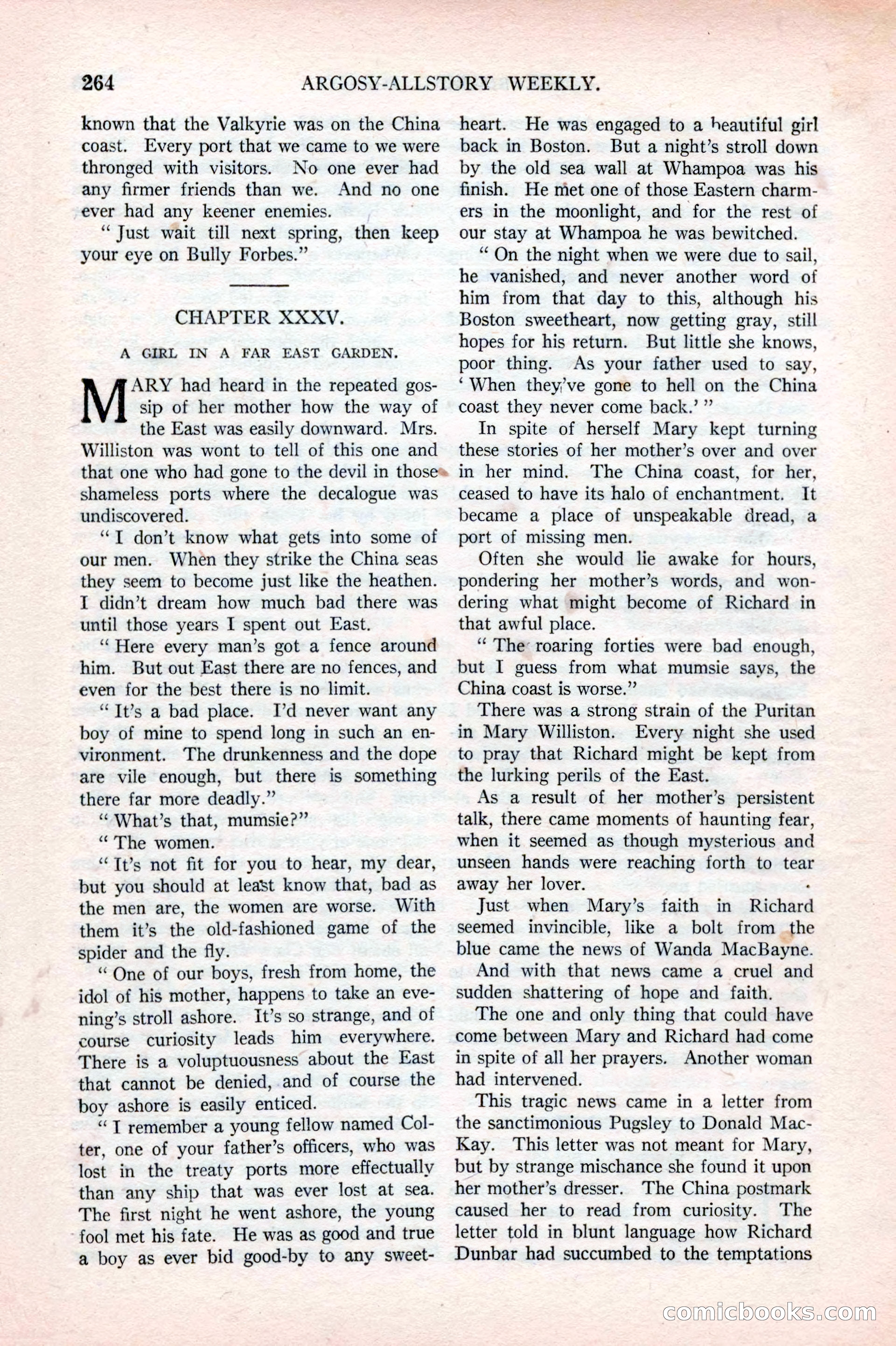
A restored page from Pulp Fiction, 1924. Page through the whole issue in the reader above.
📄 Transcribed text from this page (OCR, searchable)
Machine-transcribed from the original scan — historical spelling and the odd misread are preserved.
264 known that the Valkyrie was on the China coast. Every port that we came to we were thronged with visitors. No one ever had any firmer friends than we. And no one ever had any keener enemies. “Just wait till next spring, then keep your eye on Bully Forbes.” CHAPTER XXXV. A GIRL IN A FAR EAST GARDEN. ARY had heard in the repeated gos- sip of her mother how the way of the East was easily downward. Mrs. Williston was wont to tell of this one and that one who had gone to the devil in those® shameless ports where the decalogue was undiscovered. ‘“T don’t know what gets into some of our men. When they strike the China seas they seem to become just like the heathen. I didn’t dream how much bad there was until those years I spent out East. ‘Here every man’s got a fence around him. But out East there are no fences, and even for the best there is no limit. “Tt’s a bad place. I’d never want any boy of mine to spend long in such an en- vironment. The drunkenness and the dope are vile enough, but there is something there far more deadly.” “ What’s that, mumsie?” “The women. “Tt’s not fit for you to hear, my dear, but you should at least know that, bad as the men are, the women are worse. With them it’s the old-fashioned game of the spider and the fly. “ One of our boys, fresh from home, the idol of his mother, happens to take an eve- ning’s stroll ashore. It’s so strange, and of course curiosity leads him everywhere. There is a voluptuousness about the East that cannot be denied, and of course the boy ashore is easily enticed. “T remember a young fellow named Col- ter, one of your father’s officers, who was lost in the treaty ports more effectually than any ship that was ever lost at sea. The first night he went ashore, the young fool met his fate. He was as good and true a boy as ever bid good-by to any sweet- ARGOSY-ALLSTORY WEEKLY. heart. He was engaged to a heautiful girl back in Boston. But a night’s stroll down by the old sea wall at Whampoa was his finish. He met one of those Eastern charm- ers in the moonlight, and for the rest of our stay at Whampoa he was bewitched. “On the night when we were due to sail, he vanished, and never another word of him from that day to this, although his Boston sweetheart, now getting gray, still hopes for his return. But little she knows, poor thing. As your father used to say, ‘When they’ve gone to hell on the China coast they never come back.’ ” In spite of herself Mary kept turning these stories of her mother’s over and over in her mind. The China coast, for her, ceased to have its halo of enchantment. It became a place of unspeakable dread, a port of missing men. Often she would lie awake for hours, pondering her mother’s words, and won- dering what might become of Richard in that awful place. “The roaring forties were bad enough, but I guess from what mumsie says, the China coast is worse.” There was a strong strain of the Puritan in Mary Williston. Every night she used to pray that Richard might be kept from the lurking perils of the East. As a result of her mother’s persistent talk, there came moments of haunting fear, when it seemed as though mysterious and unseen hands were reaching forth to tear away her lover. . Just when Mary’s faith in Richard seemed invincible, like a bolt from the blue came the news of Wanda MacBayne. And with that news came a cruel and sudden shattering of hope and faith. The one and only thing that could have come between Mary and Richard had come in spite of all her prayers. Another woman had intervened. This tragic news came in a letter from the sanctimonious Pugsley to Donald Mac- Kay. This letter was not meant for Mary, but by strange mischance she found it upon her mother’s dresser. The China postmark caused her to read from curiosity. The letter told in blunt language how Richard Dunbar had succumbed to the temptations COMMICLOOOkKS (C@