
Pulp Fiction, 1924 · page 118 of 172
Argosy All-Story Weekly, May 17, 1924 — page 118: what you’re looking at
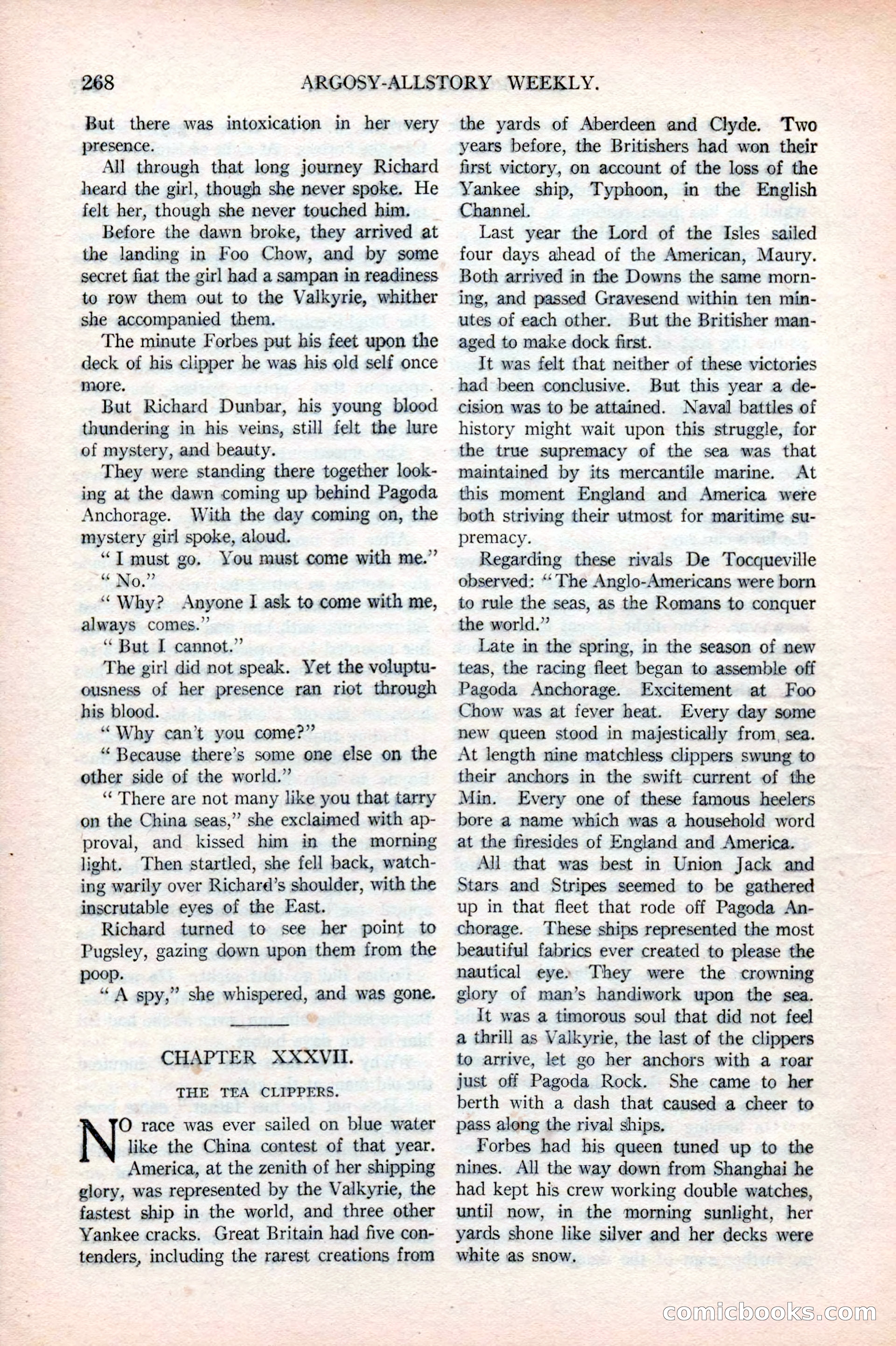
A restored page from Pulp Fiction, 1924. Page through the whole issue in the reader above.
📄 Transcribed text from this page (OCR, searchable)
Machine-transcribed from the original scan — historical spelling and the odd misread are preserved.
268 But there was intoxication in her very presence. All through that long journey Richard heard the girl, though she never spoke. He felt her, though she never touched him. Before the dawn broke, they arrived at the landing in Foo Chow, and by some secret fiat the girl had a sampan in readiness to row them out to the Valkyrie, whither she accompanied them. The minute Forbes put his feet upon the deck of his clipper he was his old self once more. 7 But Richard Dunbar, his young blood thundering in his veins, still felt the lure of mystery, and beauty. They were standing there together look- ing at the dawn coming up behind Pagoda Anchorage. With the day coming on, the mystery girl spoke, aloud. “T must go. You must come with me.” oe No.” ‘Why? Anyone I ask to come with me, always comes.” ‘“ But I cannot.” The girl did not speak. Yet the voluptu- ousness of her presence ran riot through his blood. “Why can’t you come?” “ Because there’s some one else on the other side of the world.” ‘“‘ There are not many like you that tarry on the China seas,” she exclaimed with ap- proval, and kissed him in the morning light. Then startled, she fell back, watch- ing warily over Richard’s shoulder, with the inscrutable eyes of the East. Richard turned to see her point to Pugsley, gazing down upon them from the p. “A spy,” she whispered, and was gone. CHAPTER XXXYVII. THE TEA CLIPPERS. : O race was ever sailed on blue water like the China contest of that year. America, at the zenith of her shipping glory, was represented by the Valkyrie, the fastest ship in the world, and three other Yankee cracks. Great Britain had five con- tenders, including the rarest creations from ARGOSY-ALLSTORY WEEKLY. the yards of Aberdeen and Clyde. Two years before, the Britishers had won their first victory, on account of the loss of the Yankee ship, Typhoon, in the English Channel. Last year the Lord of the Isles sailed four days ahead of the American, Maury. Both arrived in the Downs the same morn- ing, and passed Gravesend within ten min- utes of each other. But the Britisher man- aged to make dock first. It was felt that neither of these victories had been conclusive. But this year a de- cision was to be attained. Naval battles of history might wait upon this struggle, for the true supremacy of the sea was that maintained by its mercantile marine. At this moment England and America were both striving their utmost for maritime su- premacy. Regarding these rivals De Tocqueville observed: “The Anglo-Americans were born to rule the seas, as the Romans to conquer the world.” Late in the spring, in the season of new teas, the racing fleet began to assemble off Pagoda Anchorage. Excitement at Foo Chow was at fever heat. Every day some new queen stood in majestically from, sea. At length nine matchless clippers swung to their anchors in the swift current of the Min. Every one of these famous heelers bore a name which was a household word at the firesides of England and America. All that was best in Union Jack and Stars and Stripes seemed to be gathered up in that fleet that rode off Pagoda An- chorage. These ships represented the most beautiful fabrics ever created to please the nautical eye» They were the crowning glory of man’s handiwork upon the sea. It was a timorous soul that did not feel a thrill as Valkyrie, the last of the clippers to arrive, let go her anchors with a roar just off Pagoda Rock. She came to her berth with a dash that caused a cheer to pass along the rival ships. Forbes had his queen tuned up to the nines. All the way down from Shanghai he had kept his crew working double watches, until now, in the morning sunlight, her yards shone like silver and her decks were white as snow. COmmicloool< (C@