
Pulp Fiction, 1924 · page 130 of 172
Argosy All-Story Weekly, May 17, 1924 — page 130: what you’re looking at
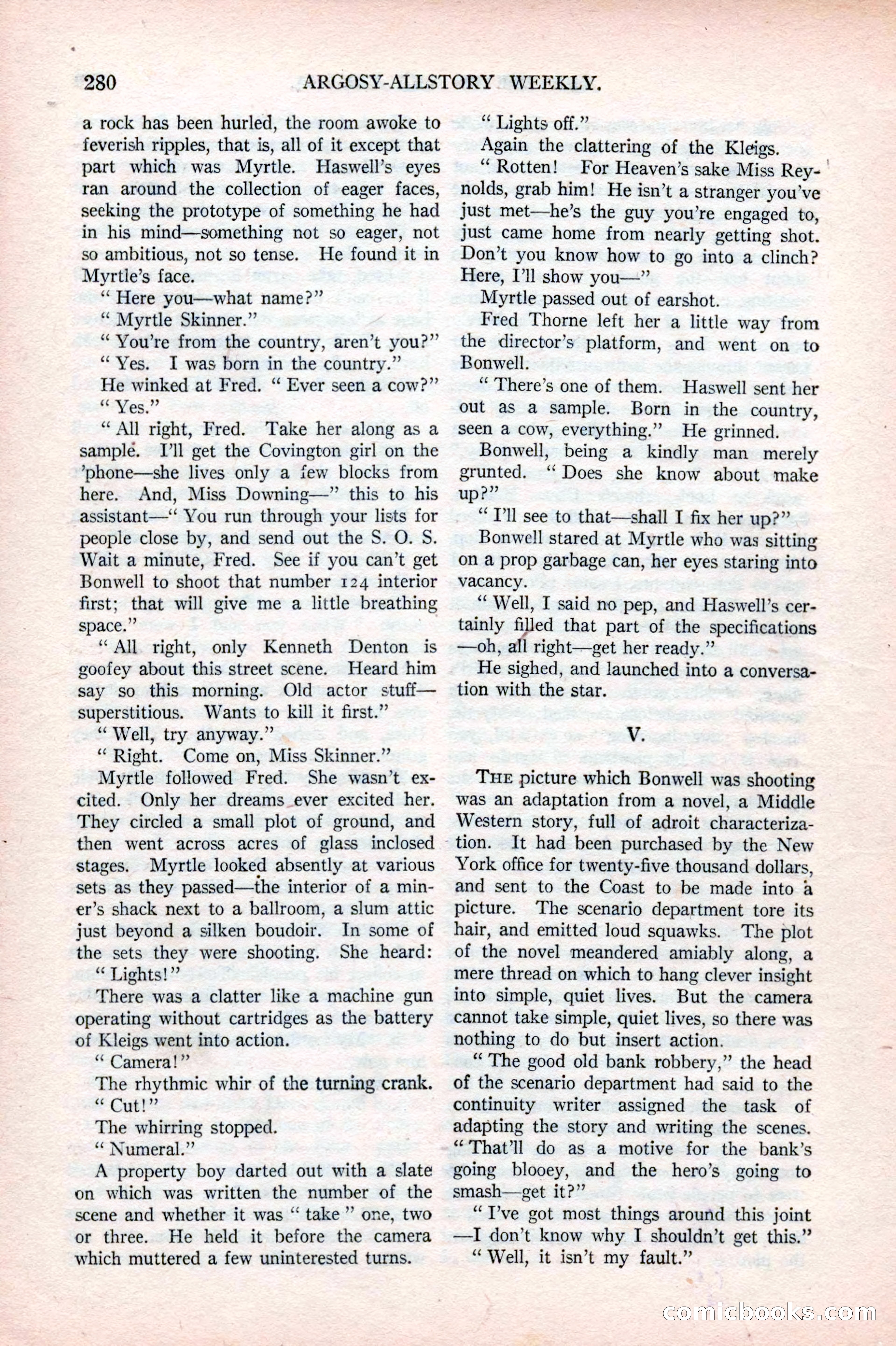
A restored page from Pulp Fiction, 1924. Page through the whole issue in the reader above.
📄 Transcribed text from this page (OCR, searchable)
Machine-transcribed from the original scan — historical spelling and the odd misread are preserved.
280 a rock has been hurled, the room awoke to feverish ripples, that is, all of it except that part which was Myrtle. Haswell’s eyes ran around the collection of eager faces, seeking the prototype of something he had in his mind—something not so eager, not so ambitious, not so tense. He found it in Myrtle’s face. ‘Here you—what name?” “ Myrtle Skinner.” “You're from the country, aren’t you?” “Yes. I was born in the country.” He winked at Fred. “ Ever seen a cow?” <4 Yes.” “All right, Fred. Take her along as a sample. Ill get the Covington girl on the ’phone—she lives only a few blocks from here. And, Miss Downing—” this to his assistant—‘‘ You run through your lists for people close by, and send out the S. O. S. Wait a minute, Fred. See if you can’t get Bonwell to shoot that number 124 interior first; that will give me a little breathing space.” “ All right, only Kenneth Denton is goofey about this street scene. Heard him say so this morning. Old actor stuff— superstitious. Wants to kill it first.” “Well, try anyway.” “ Right. Come on, Miss Skinner.” Myrtle followed Fred. She wasn’t ex- cited. Only her dreams_ever excited her. They circled a small plot of ground, and then went across acres of glass inclosed stages. Myrtle looked absently at various sets as they passed—the interior of a min- er’s shack next to a ballroom, a slum attic just beyond a silken boudoir. In some of the sets they were shooting. She heard: “ Lights!” There was a clatter like a machine gun operating without cartridges as the battery of Kleigs went into action. “* Camera!” The rhythmic whir of the turning crank. “ce Cut! ? The whirring stopped. “ Numeral.” A property boy darted out with a slate on which was written the number of the scene and whether it was “‘ take” one, two or three. He held it before the camera which muttered a few uninterested turns. ARGOSY-ALLSTORY. WEEKLY, “ Lights off.” Again the clattering of the Kleigs. “ Rotten! nolds, grab him! He isn’t a stranger you’ve just met—he’s the guy you’re engaged to, just came home from nearly getting shot. Don’t you know how to go into a clinch? Here, I'll show you—”’ Myrtle passed out of earshot. Fred Thorne left her a little way from the director’s platform, and went on to Bonwell. ‘‘ There’s one of them. Haswell sent her out as a sample. Born in the country, seen a cow, everything.” He grinned. Bonwell, being a kindly man merely grunted. ‘Does she know about make up?” “Tl see to that—shall I fix her up?” Bonwell stared at Myrtle who was sitting on a prop garbage can, her eyes staring into vacancy. “Well, I said no pep, and Haswell’s cer- tainly filled that part of the specifications —oh, all right—get her ready.” He sighed, and launched into a conversa- tion with the star. V. THE picture which Bonwell was shooting was an adaptation from a novel, a Middle Western story, full of adroit characteriza- tion. It had been purchased by the New York office for twenty-five thousand dollars, and sent to the Coast to be made into a picture. The scenario department tore its hair, and emitted loud squawks. The plot of the novel meandered amiably along, a mere thread on which to hang clever insight into simple, quiet lives. But the camera cannot take simple, quiet lives, so there was nothing to do but insert action. “The good old bank robbery,” the head of the scenario department had said to the continuity writer assigned the task of adapting the story and writing the scenes. “That'll do as a motive for the bank’s going blooey, and the hero’s going to smash—get it?” “T’ve got most things around this joint —I don’t know why I shouldn’t get this.” “Well, it isn’t my fault.” For Heaven’s sake Miss Rey-' COmiclboool< (C@