
Pulp Fiction, 1924 · page 132 of 172
Argosy All-Story Weekly, May 17, 1924 — page 132: what you’re looking at
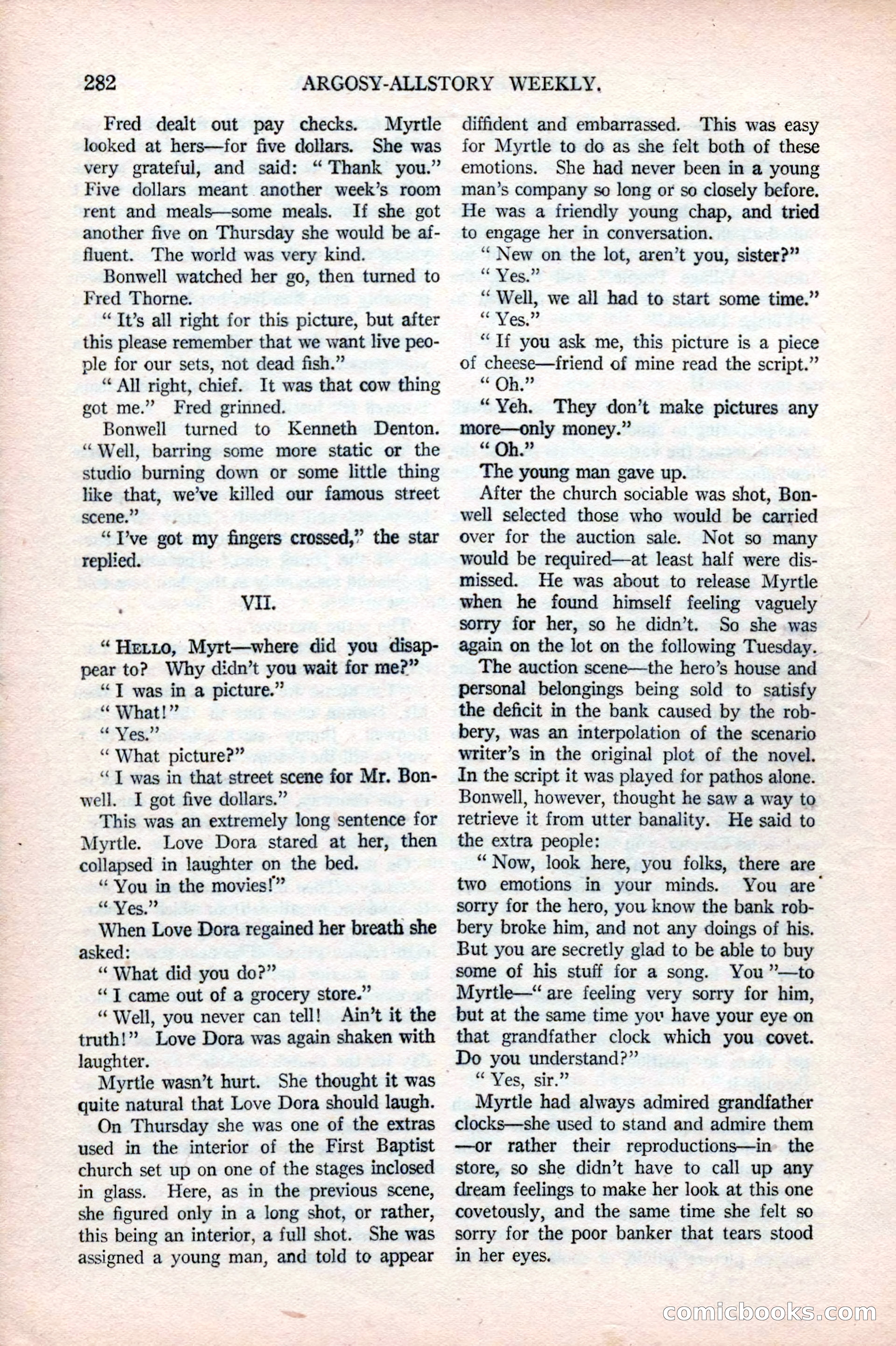
A restored page from Pulp Fiction, 1924. Page through the whole issue in the reader above.
📄 Transcribed text from this page (OCR, searchable)
Machine-transcribed from the original scan — historical spelling and the odd misread are preserved.
282 Fred dealt out pay checks. Myrtle looked at hers—for five dollars. She was very grateful, and said: “Thank you.” Five dollars meant another week’s room rent and meals—some meals. If she got another five on Thursday she would be af- fluent. The world was very kind. Bonwell watched her go, then turned to Fred Thorne. “It’s all right for this picture, but after this please remember that we want live peo- ple for our sets, not dead fish.” “ All right, chief. It was that cow thing got me.” Fred grinned. Bonwell turned to Kenneth Denton. “ Well, barring some more static or the studio burning down or some little thing like that, we’ve killed our famous street scene.” “T’ve got my fingers crossed,” the star replied. Vil. “ Hetto, Myrt—where did you disap- pear to? Why didn’t you wait for me?” “T was in a picture.” cc What! ”? << Ves.”’ “What picture?” “J was in that street scene for Mr. Bon- well. I got five dollars.” This was an extremely long sentence for Myrtle. Love Dora stared at her, then collapsed in laughter on the bed. “You in the movies!” <4 Yes.” When Love Dora regained her breath she asked: “ What did you do?” “J came out of a grocery store.” “ Well, you never can tell! Ain’t it the truth!” Love Dora was again shaken with laughter. Myrtle wasn’t hurt. She thought it was quite natural that Love Dora should laugh. On Thursday she was one of the extras used in the interior of the First Baptist church set up on one of the stages inclosed in glass. Here, as in the previous scene, she figured only in a long shot, or rather, this being an interior, a full shot. She was assigned a young man, and told to appear ARGOSY-ALLSTORY WEEKLY. diffident and embarrassed. This was easy for Myrtle to do as she felt both of these emotions. She had never been in a young man’s company so long or so closely before. He was a friendly young chap, and tried to engage her in conversation. ‘““ New on the lot, aren’t you, sister?” ce Yes.” “Well, we all had to start some time.” «¢ Yes.” “If you ask me, this picture is a piece of cheese—friend of mine read the script.” 74 On.” “Yeh. They don’t make pictures any more—only money.” “cc Oh.” The young man gave up. After the church sociable was shot, Bon- well selected those who would be carried over for the auction sale. Not so many would be required—at least half were dis- missed. He was about to release Myrtle when he found himself feeling vaguely sorry for her, so he didn’t. So she was again on the lot on the following Tuesday. The auction scene—the hero’s house and personal belongings being sold to satisfy the deficit in the bank caused by the rob- bery, was an interpolation of the scenario writer’s in the original plot of the novel. In the script it was played for pathos alone. Bonwell, however, thought he saw a way to retrieve it from utter banality. He said to the extra people: “Now, look here, you folks, there are two emotions in your minds. You are sorry for the hero, you know the bank rob- bery broke him, and not any doings of his. But you are secretly glad to be able to buy some of his stuff for a song. You ”—to Myrtle—“ are feeling very sorry for him, but at the same time you have your eye on that grandfather clock which you covet. Do you understand?” eyes, sir.” Myrtle had always admired grandfather clocks—she used to stand and admire them —or rather their reproductions—in the store, so she didn’t have to call up any dream feelings to make her look at this one covetously, and the same time she felt so sorry for the poor banker that tears stood in her eyes. COmiclboool< (C@