
Pulp Fiction, 1924 · page 135 of 172
Argosy All-Story Weekly, May 17, 1924 — page 135: what you’re looking at
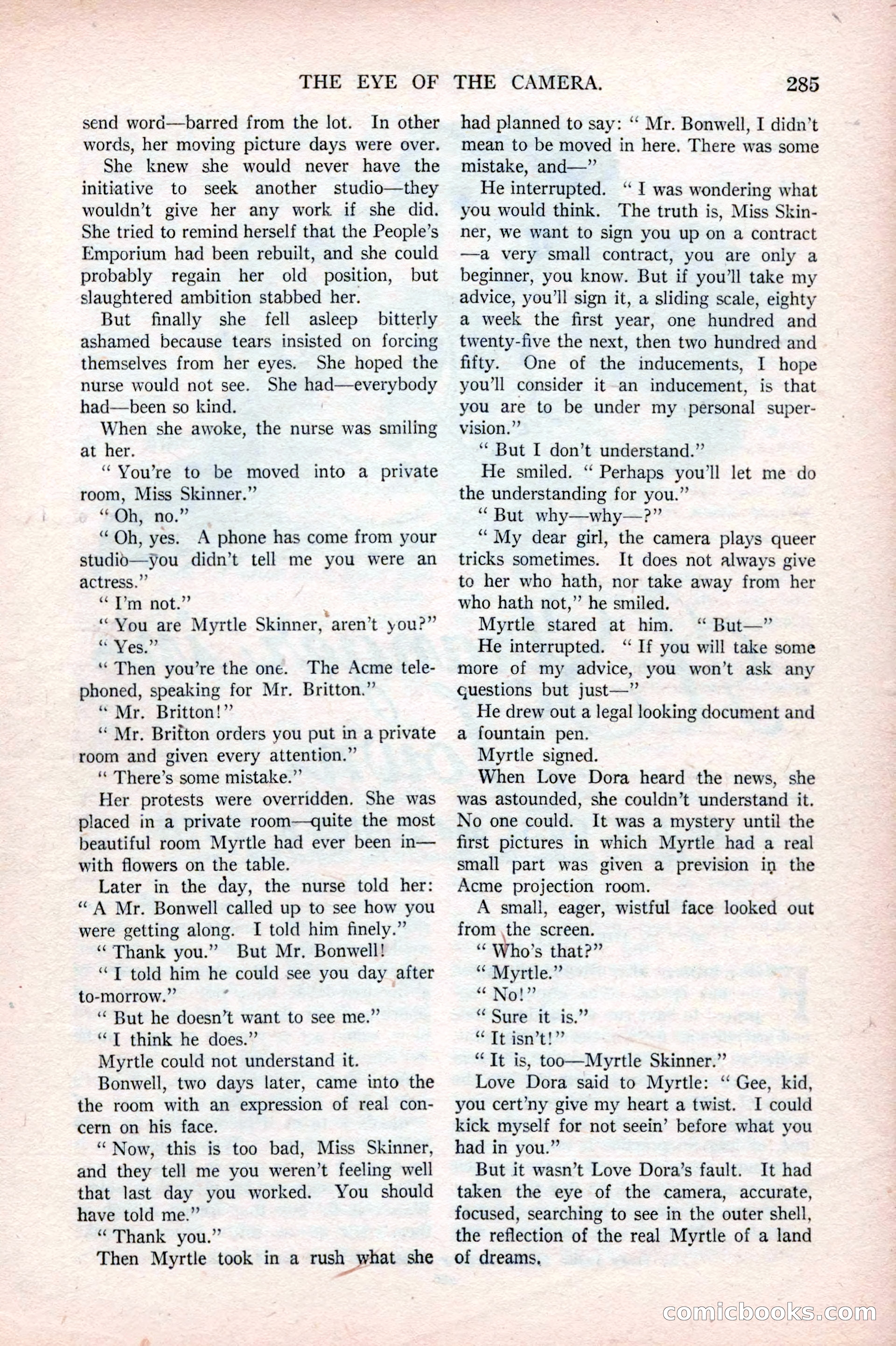
A restored page from Pulp Fiction, 1924. Page through the whole issue in the reader above.
📄 Transcribed text from this page (OCR, searchable)
Machine-transcribed from the original scan — historical spelling and the odd misread are preserved.
THE EYE OF send word—barred from the lot. In other words, her moving picture days were over. She knew she would never have the initiative to seek another studio—they wouldn’t give her any work if she did. She tried to remind herself that the People’s Emporium had been rebuilt, and she could probably regain her old position, but slaughtered ambition stabbed her. But finally she fell asleep _ bitterly ashamed because tears insisted on forcing themselves from her eyes. She hoped the nurse would not see. She had—everybody had—been so kind. When she awoke, the nurse was smiling at her. “You’re to be moved into a private room, Miss Skinner.” $Oh- 20.” “Oh, yes. A phone has come from your studis—you didn’t tell me you were an actress.” “ 1’m not.” : “You are Myrtle Skinner, aren’t you?” “Yes,” ‘‘ Then you’re the one. The Acme tele- phoned, speaking for Mr. Britton.” “Mr. Britton!” “ Mr. Britton orders you put in a private room and given every attention.” ‘‘ There’s some mistake.” Her protests were overridden, She was placed in a private room—quite the most beautiful room Myrtle had ever been in— with flowers on the table. Later in the day, the nurse told her: “A Mr. Bonwell called up to see how you were getting along. I told him finely.” “ Thank you.” But Mr. Bonwell! “T told him he could see you day after to-morrow.” : ‘“ But he doesn’t want to see me.” “{ think he does.” Myrtle could not understand it. Bonwell, two days later, came into the the room with an expression of real con- cern on his face. “Now, this is too bad, Miss Skinner, and they tell me you weren’t feeling well that last day you worked. You should have told me.” “Thank you.” Then Myrtle took in a rush what she THE CAMERA. 285 had planned to say: ‘“‘ Mr. Bonwell, I didn’t mean to be moved in here. There was some mistake, and—”’ He interrupted. ‘“ I was wondering what you would think. The truth is, Miss Skin- ner, we want to sign you up on a contract —a very small contract, you are only a beginner, you know. But if you’ll take my advice, you'll sign it, a sliding scale, eighty a week the first year, one hundred and twenty-five the next, then two hundred and fifty. One of the inducements, I hope you'll consider it an inducement, is that you are to be under my personal super- vision.” “But I don’t understand.” He smiled. “ Perhaps you'll let me do the understanding for you.” “But why—why—?” “My dear girl, the camera plays queer tricks sometimes. It does not always give to her who hath, nor take away from her who hath not,” he smiled. Myrtle stared at him. “ But—” He interrupted. ‘“ If you will take some more of my advice, you won’t ask any Guestions but just—” He drew out a legal looking document and a fountain pen. Myrtle signed. When Love Dora heard the news, she was astounded, she couldn’t understand it. No one could. It was a mystery until the first pictures in which Myrtle had a real small part was given a prevision in the Acme projection room. A small, eager, wistful face looked out from the screen. ‘“* Who’s that?” * Myrtle.” “¢ No! ) Sure it-is.” “Feast!” “Tt is, too—Myrtle Skinner.” Love Dora said to Myrtle: ‘ Gee, kid, you cert’ny give my heart a twist. I could kick myself for not seein’ before what you had in you.” But it wasn’t Love Dora’s fault. It had taken the eye of the camera, accurate, focused, searching to see in the outer shell, the reflection of the real Myrtle of a land of dreams, CoOmicloool< (C@