
Pulp Fiction, 1924 · page 162 of 172
Argosy All-Story Weekly, May 17, 1924 — page 162: what you’re looking at
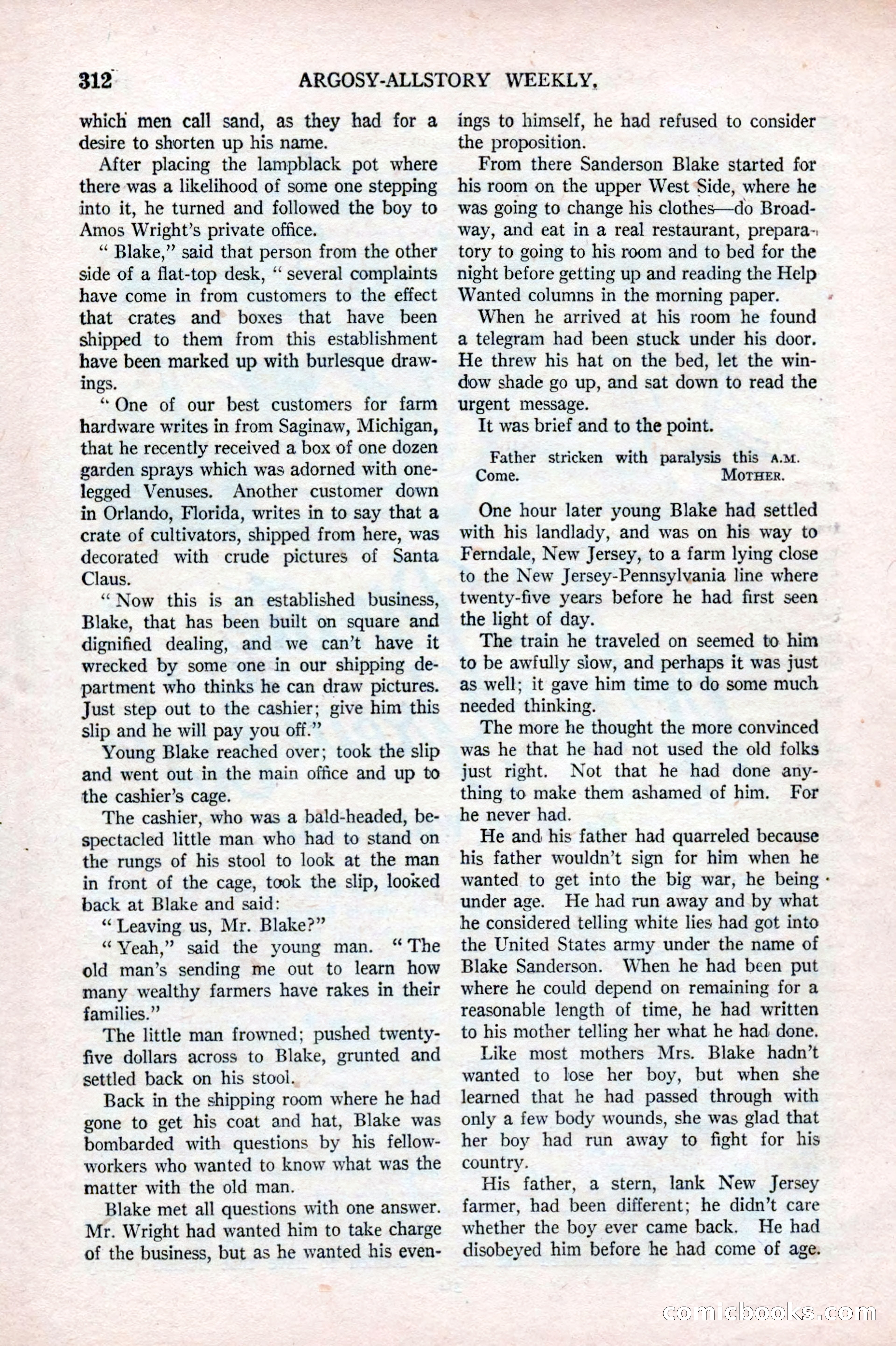
A restored page from Pulp Fiction, 1924. Page through the whole issue in the reader above.
📄 Transcribed text from this page (OCR, searchable)
Machine-transcribed from the original scan — historical spelling and the odd misread are preserved.
312 which men call sand, as they had for a desire to shorten up his name. After placing the lampblack pot where there was a likelihood of some one stepping into it, he turned and followed the boy to Amos Wright’s private office. “ Blake,” said that person from the other side of a flat-top desk, “‘ several complaints have come in from customers to the effect that crates and boxes that have been shipped to them from this establishment have been marked up with burlesque draw- ings. “One of our best customers for farm hardware writes in from Saginaw, Michigan, that he recently received a box of one dozen garden sprays which was adorned with one- legged Venuses. Another customer down in Orlando, Florida, writes in to say that a crate of cultivators, shipped from here, was decorated with crude pictures of Santa Claus. ‘“ Now this is an established business, Blake, that has been built on square and dignified dealing, and we can’t have it wrecked by some one in our shipping de- partment who thinks he can draw pictures. Just step out to the cashier; give him this slip and he will pay you off.” Young Blake reached over; took the slip and went out in the main office and up to the cashier’s cage. The cashier, who was a bald-headed, be- spectacled little man who had to stand on the rungs of his stool to look at the man in front of the cage, took the slip, looxed back at Blake and said: “Leaving us, Mr. Blake?” “Veah,” said the young man. “ The old man’s sending me out to learn how many wealthy farmers have rakes in their families.” The little man frowned; pushed twenty- five dollars across to Blake, grunted and settled back on his stool. Back in the shipping room where he had gone to get his coat and hat, Blake was bombarded with questions by his fellow- workers who wanted to know what was the matter with the old man. Blake met all questions with one answer. Mr. Wright had wanted him to take charge of the business, but as he wanted his even- ARGOSY-ALLSTORY WEEKLY, ings to himself, he had refused to consider the proposition. From there Sanderson Blake started for his room on the upper West Side, where he was going to change his clothes—do Broad- way, and eat in a real restaurant, prepara- tory to going to his room and to bed for the night before getting up and reading the Help Wanted columns in the morning paper. When he arrived at his room he found a telegram had been stuck under his door. He threw his hat on the bed, let the win- dow shade go up, and sat down to read the urgent message. It was brief and to the point. Father stricken with paralysis this a.m. Come. MorTHser. One hour later young Blake had settled with his landlady, and was on his way to Ferndale, New Jersey, to a farm lying close to the New Jersey-Pennsylvania line where twenty-five years before he had first seen the light of day. The train he traveled on seemed to him to be awfully siow, and perhaps it was just as well; it gave him time to do some much needed thinking. The more he thought the more convinced was he that he had not used the old folks just right. Not that he had done any- thing to make them ashamed of him. For he never had. He and his father had quarreled because his father wouldn’t sign for him when he wanted to get into the big war, he being - under age. He had run away and by what he considered telling white lies had got into the United States army under the name of Blake Sanderson. When he had been put where he could depend on remaining for a reasonable length of time, he had written to his mother telling her what he had done. Like most mothers Mrs. Blake hadn’t wanted to lose her boy, but when she learned that he had passed through with only a few body wounds, she was glad that her boy had run away to fight for his country. His father, a stern, lank New Jersey farmer, had been different; he didn’t care whether the boy ever came back. He had disobeyed him before he had come of age. GO DOO AMUG SS (C@