
Pulp Fiction, 1924 · page 18 of 172
Argosy All-Story Weekly, May 17, 1924 — page 18: what you’re looking at
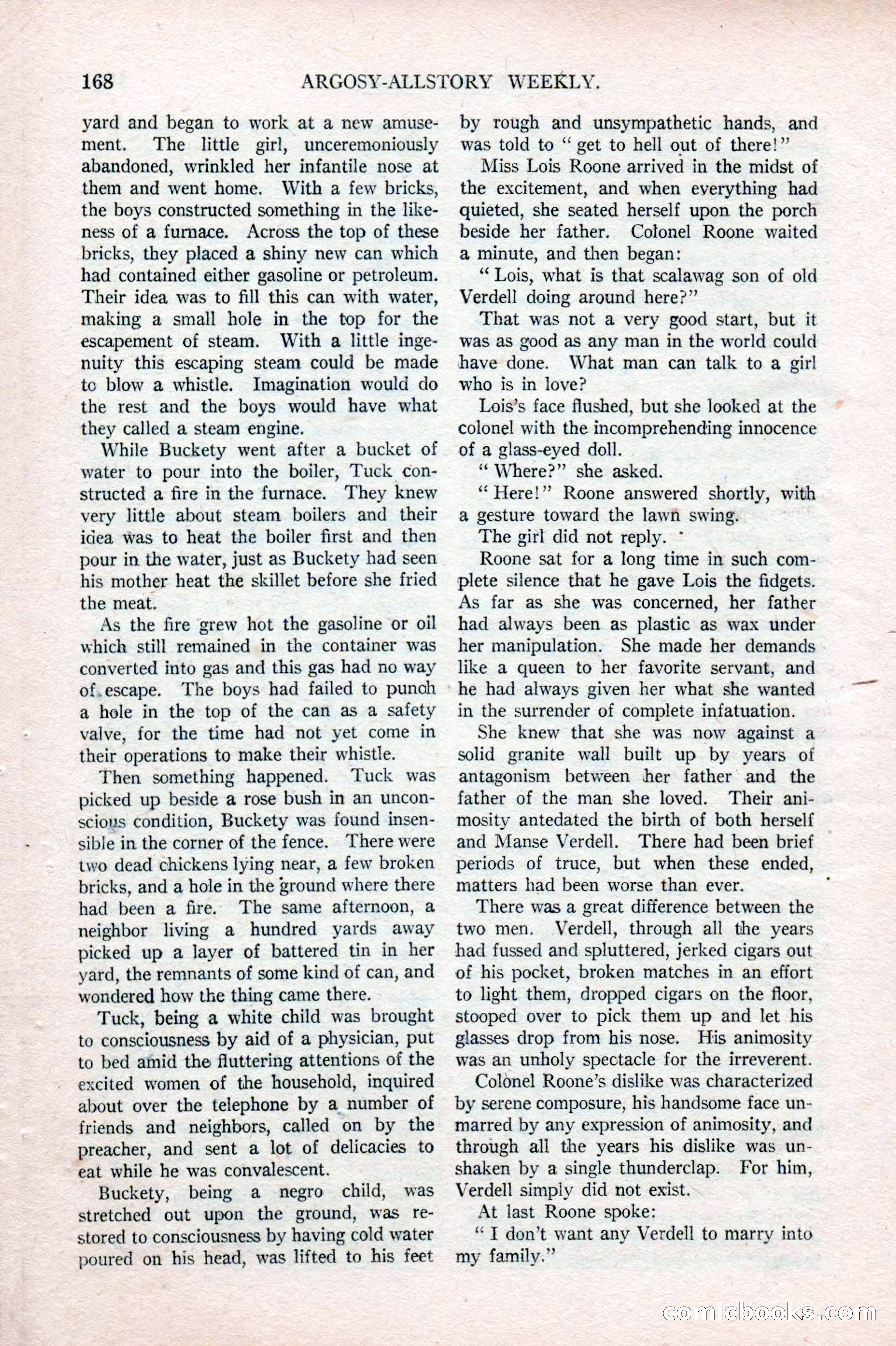
A restored page from Pulp Fiction, 1924. Page through the whole issue in the reader above.
📄 Transcribed text from this page (OCR, searchable)
Machine-transcribed from the original scan — historical spelling and the odd misread are preserved.
168 yard and began to work at a new amuse- ment. The little girl, unceremoniously abandoned, wrinkled her infantile nose at them and went home, With a few bricks, the boys constructed something in the like- ness of a furnace. Across the top of these bricks, they placed a shiny new can which had contained either gasoline or petroleum. Their idea was to fill this can with water, making a small hole in the top for the escapement of steam. With a little inge- nuity this escaping steam could be made tc blow a whistle. Imagination would do the rest and the boys would have what they called a steam engine. While Buckety went after a bucket of water to pour into the boiler, Tuck con- structed a fire in the furnace. They knew very little about steam boilers and their idea was to heat the boiler first and then pour in the water, just as Buckety had seen his mother heat the skillet before she fried the meat. As the fire grew hot the gasoline or oil which still remained in the container was converted into gas and this gas had no way of.escape. The boys had failed to punch a hole in the top of the can as a safety valve, for the time had not yet come in their operations to make their whistle. Then something happened. Tuck was picked up beside a rose bush in an uncon- scious condition, Buckety was found insen- sible in the corner of the fence. There were two dead chickens lying near, a few broken bricks, and a hole in the ground where there had been a fire. The same afternoon, a neighbor living a hundred yards away picked up a layer of battered tin in her yard, the remnants of some kind of can, and wondered how the thing came there. Tuck, being a white child was brought to consciousness by aid of a physician, put to bed amid the fluttering attentions of the excited women of the household, inquired about over the telephone by a number of friends and neighbors, called on by the preacher, and sent a lot of delicacies to eat while he was convalescent. Buckety, being a negro child, was stretched out upon the ground, was re- stored to consciousness by having cold water poured on his head, was lifted to his feet ARGOSY-ALLSTORY WEEKLY. by rough and unsympathetic hands, and was told to “ get to hell out of there!”’ Miss Lois Roone arrived in the midst of the excitement, and when everything had quieted, she seated herself upon the porch beside her father. Colonel Roone waited a minute, and then began: ‘Lois, what is that scalawag son of old Verdell doing around here?” That was not a very good start, but it was as good as any man in the world could have done. What man can talk to a girl who is in love? Lois’s face flushed, but she looked at the colonel with the incomprehending innocence of a glass-eyed doll. ‘‘ Where?” she asked. ‘“‘ Here!”’ Roone answered shortly, with a gesture toward the lawn swing. The girl did not reply. ~ Roone sat for a long time in such com- plete silence that he gave Lois the fidgets. As far as she was concerned, her father had always been as plastic as wax under her manipulation. She made her demands like a queen to her favorite servant, and he had always given her what she wanted in the surrender of complete infatuation. She knew that she was now against a solid granite wall built up by years of antagonism between her father and the father of the man she loved. Their ani- mosity antedated the birth of both herself and Manse Verdell. There had been brief periods of truce, but when these ended, matters had been worse than ever. There was a great difference between the two men. Verdell, through all the years had fussed and spluttered, jerked cigars out of his pocket, broken matches in an effort to light them, dropped cigars on the floor, stooped over to pick them up and let his glasses drop from his nose. His animosity was an unholy spectacle for the irreverent. Colonel Roone’s dislike was characterized by serene composure, his handsome face un- marred by any expression of animosity, and through all the years his dislike was un- shaken by a single thunderclap. For him, Verdell simply did not exist. At last Roone spoke: “ T don’t want any Verdell to marry into my family.” COnmiclbool< (C@