
Pulp Fiction, 1924 · page 34 of 172
Argosy All-Story Weekly, May 17, 1924 — page 34: what you’re looking at
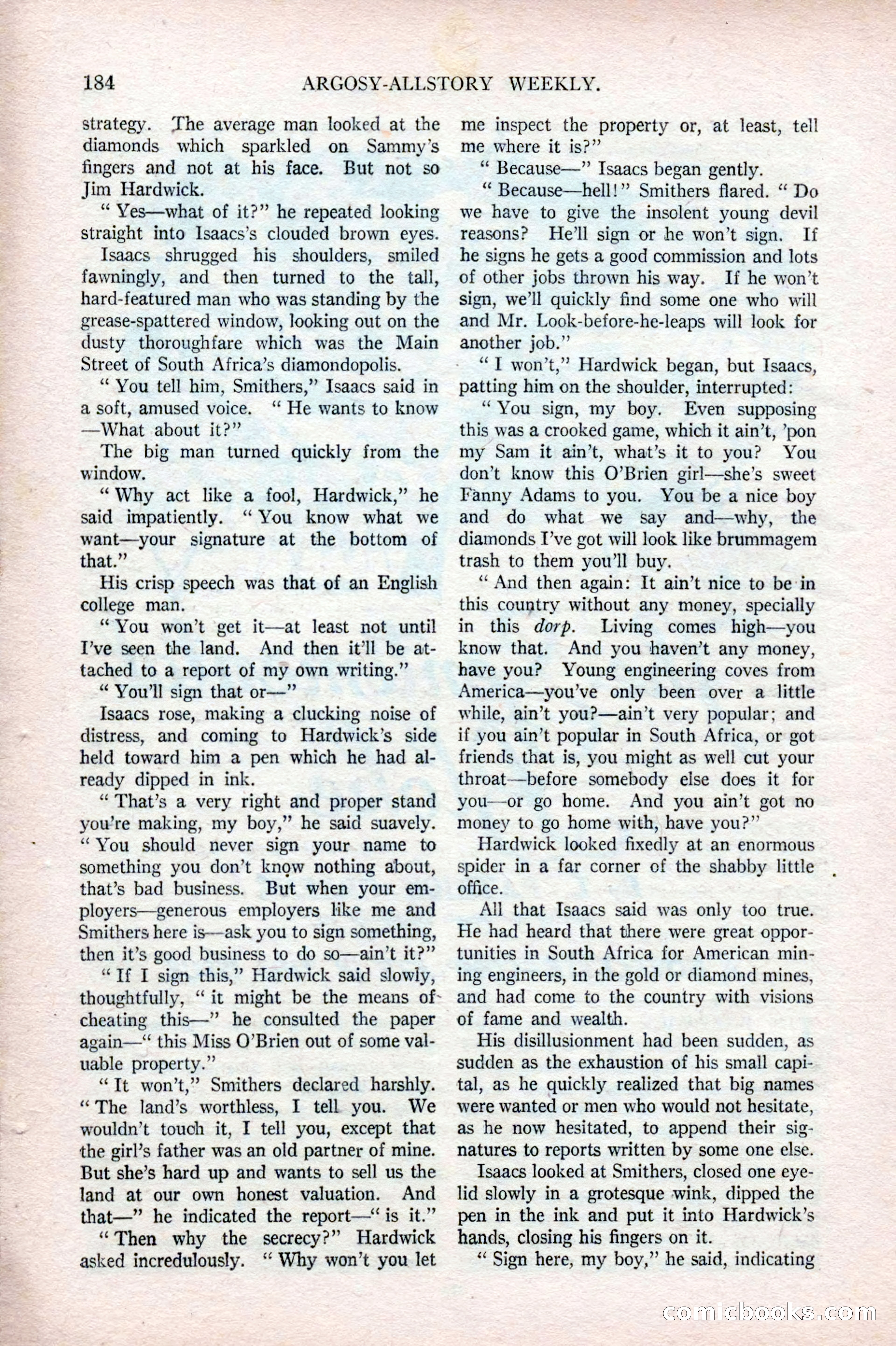
A restored page from Pulp Fiction, 1924. Page through the whole issue in the reader above.
📄 Transcribed text from this page (OCR, searchable)
Machine-transcribed from the original scan — historical spelling and the odd misread are preserved.
184 strategy. ‘The average man looked at the diamonds which sparkled on Sammy’s fingers and not at his face. But not so Jim Hardwick. ‘“ Yes—what of it?” he repeated looking straight into Isaacs’s clouded brown eyes. Isaacs shrugged his shoulders, smiled fawningly, and then turned to the tall, hard-featured man who was standing by the grease-spattered window, looking out on the dusty thoroughfare which was the Main Street of South Africa’s diamondopolis. ‘“‘ You tell him, Smithers,” Isaacs said in a soft, amused voice. ‘“ He wants to know —What about it?” The big man turned quickly from the window. “Why act like a fool, Hardwick,” he said impatiently. ‘“ You know what we want—your signature at the bottom of that.” His crisp speech was that of an English college man. “You won’t get it—at least not until I’ve seen the land. And then it'll be at- tached to a report of my own writing.” “ You'll sign that or—”’ Isaacs rose, making a clucking noise of distress, and coming to Hardwick’s side held toward him a pen which he had al- ready dipped in ink. “ That’s a very right and proper stand yowre making, my boy,” he said suavely. “You should never sign your name to something you don’t know nothing about, that’s bad business. But when your em- ployers—generous employers like me and Smithers here is—ask you to sign something, then it’s good business to do so—ain’t it?” “Tf I sign this,” Hardwick said slowly, thoughtfully, “it might be the means of- cheating this—” he consulted the paper again—“ this Miss O’Brien out of some val- uable property.” “Tt won't,” Smithers declared harshly. “The land’s worthless, I tell you. We wouldn’t touch it, I tell you, except that the girl’s father was an old partner of mine. But she’s hard up and wants to sell us the land at our own honest valuation. And that—” he indicated the report—“ is it.” ““Then why the secrecy?” Hardwick asked incredulously. ‘“ Why won’t you let ARGOSY-ALLSTORY WEEKLY. me inspect the property or, at least, tell me where it is?” “* Because—” Isaacs began gently. “* Because—hell!”’ Smithers flared. “ Do we have to give the insolent young devil reasons? He'll sign or he won’t sign. If he signs he gets a good commission and lots of other jobs thrown his way. If he won’t sign, we’ll quickly find some one who will and Mr. Look-before-he-leaps will look for another job.” “I won’t,” Hardwick began, but Isaacs, patting him on the shoulder, interrupted: “You sign, my boy. Even supposing this was a crooked game, which it ain’t, ’pon my Sam it ain’t, what’s it to you? You don’t know this O’Brien girl—she’s sweet Fanny Adams to you. You be a nice boy and do what we say and—why, the diamonds I’ve got will look like brummagem trash to them you'll buy. “And then again: It ain’t nice to be in this country without any money, specially in this dorp. Living comes high—you know that. And you haven’t any money, have you? Young engineering coves from America—you’ve only been over a little while, ain’t you?—ain’t very popular; and if you ain’t popular in South Africa, or got friends that is, you might as well cut your throat—before somebody else does it for you—or go home. And you ain’t got no money to go home with, have you?”’ Hardwick looked fixedly at an enormous spider in a far corner of the shabby little office. All that Isaacs said was only too true. He had heard that there were great oppor- tunities in South Africa for American min- ing engineers, in the gold or diamond mines, and had come to the country with visions of fame and wealth. His disillusionment had been sudden, as sudden as the exhaustion of his small capi- tal, as he quickly realized that big names were wanted or men who would not hesitate, as he now hesitated, to append their sig- natures to reports written by some one else. Isaacs looked at Smithers, closed one eye- lid slowly in a grotesque wink, dipped the pen in the ink and put it into Hardwick’s hands, closing his fingers on it. “‘ Sign here, my boy,” he said, indicating CORmmicloooks (C@