
Pulp Fiction, 1924 · page 90 of 172
Argosy All-Story Weekly, May 17, 1924 — page 90: what you’re looking at
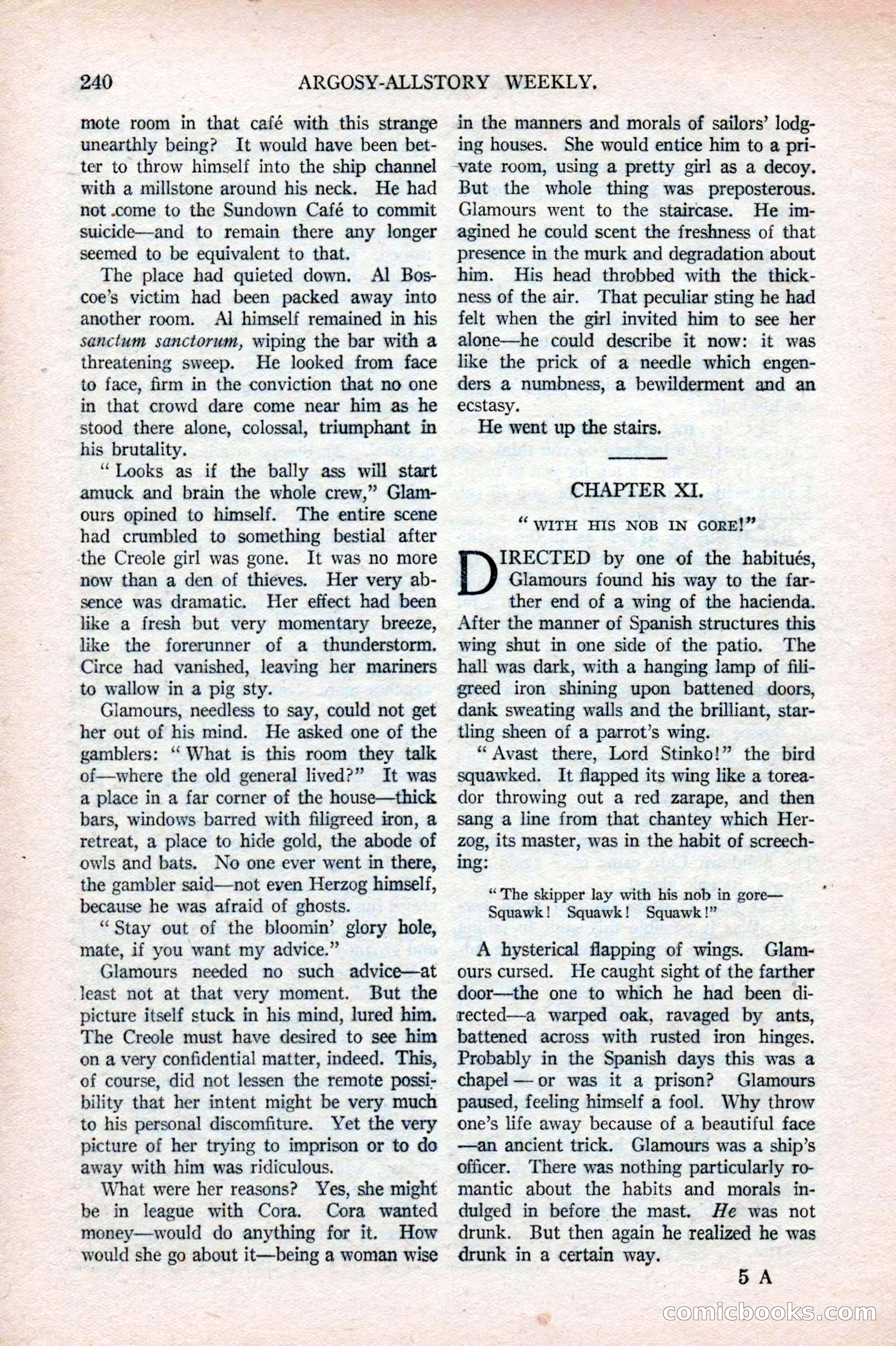
A restored page from Pulp Fiction, 1924. Page through the whole issue in the reader above.
📄 Transcribed text from this page (OCR, searchable)
Machine-transcribed from the original scan — historical spelling and the odd misread are preserved.
240 mote room in that café with this strange unearthly being? It would have been bet- ter to throw himself into the ship channel with a millstone around his neck. He had not .come to the Sundown Café to commit suicide—and to remain there any longer seemed to be equivalent to that. The place had quieted down. Al Bos- coe’s victim had been packed away into another room. Al himself remained in his sanctum sanctorum, wiping the bar with a threatening sweep. He looked from face to face, firm in the conviction that no one in that crowd dare come near him as he stood there alone, colossal, triumphant in his brutality. “Looks as if the bally ass will start amuck and brain the whole crew,” Glam- ours opined to himself. The entire scene had crumbled to something bestial after the Creole girl was gone. It was no more now than a den of thieves. Her very ab- sence was dramatic. Her effect had been like a fresh but very momentary breeze, like the forerunner of a thunderstorm. Circe had vanished, leaving her mariners to wallow in a pig sty. Glamours, needless to say, could not get her out of his mind. He asked one of the gamblers: “‘ What is this room they talk of—where the old general lived?” It was a place in a far corner of the house—thick bars, windows barred with filigreed iron, a retreat, a place to hide gold, the abode of owls and bats. No one ever went in there, the gambler said—not even Herzog himself, because he was afraid of ghosts. “Stay out of the bloomin’ glory hole, mate, if you want my advice.” Glamours needed no such advice—at least not at that very moment. But the picture itself stuck in his mind, lured him. The Creole must have desired to see him on a very confidential matter, indeed. This, of course, did not lessen the remote possi- bility that her intent might be very much to his personal discomfiture. Yet the very picture of her trying to imprison or to do away with him was ridiculous. What were her reasons? Yes, she might be in league with Cora. Cora wanted money—would do anything for it. How would she go about it—being a woman wise ARGOSY-ALLSTORY WEEKLY, in the manners and morals of sailors’ lodg- ing houses. She would entice him to a pri- ‘vate room, using a pretty girl as a decoy. But the whole thing was preposterous. Glamours went to the staircase. He im- agined he could scent the freshness of that presence in the murk and degradation about him. His head throbbed with the thick- ness of the air. That peculiar sting he had felt when the girl invited him to see her alone—he could describe it now: it was like the prick of a needle which engen- ders a numbness, a bewilderment and an ecstasy. He went up the stairs. CHAPTER XI, ‘WITH HIS NOB IN GORE!” IRECTED by one of the habitués, Glamours found his way to the far- ther end of a wing of the hacienda. After the manner of Spanish structures this wing shut in one side of the patio. The hall was dark, with a hanging lamp of fili- greed iron shining upon battened doors, dank sweating walls and the brilliant, star- tling sheen of a parrot’s wing. “Avast there, Lord Stinko!” the bird squawked. It flapped its wing like a torea- dor throwing out a red zarape, and then sang a line from that chantey which Her- zog, its master, was in the habit of screech- ing: “The skipper lay with his nob in gore— Squawk! Squawk! Squawk!” A hysterical flapping of wings. Glam- ours cursed. He caught sight of the farther door—the one to which he had been di- rected—a warped oak, ravaged by ants, battened across with rusted iron hinges. Probably in the Spanish days this was a chapel — or was it a prison? Glamours paused, feeling himself a fool. Why throw one’s life away because of a beautiful face —an ancient trick. Glamours was a ship’s officer. There was nothing particularly ro- mantic about the habits and morals in- dulged in before the mast. He was not drunk. But then again he realized he was drunk in a certain way. 5 A NOOK (C@ AUG (C@