
Pulp Fiction, 1924 · page 136 of 172
Argosy All-Story Weekly, August 9, 1924 — page 136: what you’re looking at
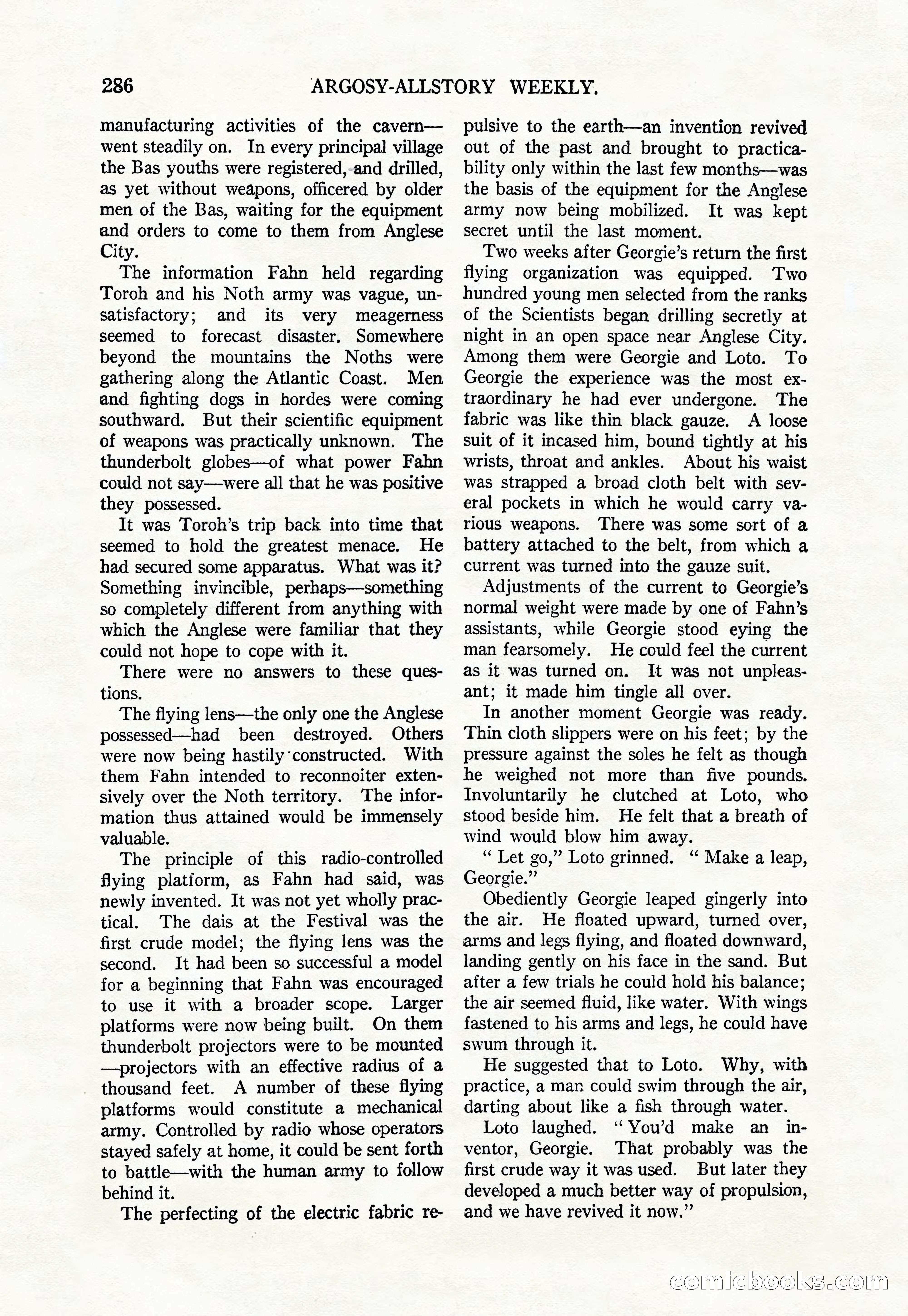
A restored page from Pulp Fiction, 1924. Page through the whole issue in the reader above.
📄 Transcribed text from this page (OCR, searchable)
Machine-transcribed from the original scan — historical spelling and the odd misread are preserved.
286 manufacturing activities of the cavern— went steadily on. In every principal village the Bas youths were registered, -and drilled, as yet without weapons, officered by older men of the Bas, waiting for the equipment and orders to come to them from Anglese City. The information Fahn held regarding Toroh and his Noth army was vague, un- satisfactory; and its very meagerness seemed to forecast disaster. Somewhere beyond the mountains the Noths were gathering along the Atlantic Coast. Men and fighting dogs in hordes were coming southward. But their scientific equipment of weapons was practically unknown. The thunderbolt globes—of what power Fahn could not say—were all that he was positive they possessed. It was Toroh’s trip back into time that seemed to hold the greatest menace. He had secured some apparatus. What was it? Something invincible, perhaps—something so completely different from anything with which the Anglese were familiar that they could not hope to cope with it. There were no answers to these ques- tions. The flying lens—the only one the Anglese possessed—had been destroyed. Others were now being hastily constructed. With them Fahn intended to reconnoiter exten- sively over the Noth territory. The infor- mation thus attained would be immensely valuable. The principle of this radio-controlled flying platform, as Fahn had said, was newly invented. It was not yet wholly prac- tical. The dais at the Festival was the first crude model; the flying lens was the second. It had been so successful a model for a beginning that Fahn was encouraged to use it with a broader scope. Larger platforms were now being built. On them thunderbolt projectors were to be mounted —projectors with an effective radius of a thousand feet. A number of these flying platforms would constitute a mechanical army. Controlled by radio whose operators stayed safely at home, it could be sent forth to battle—with the human army to follow behind it. The perfecting of the electric fabric re- ARGOSY-ALLSTORY WEEKLY. pulsive to the earth—an invention revived out of the past and brought to practica- bility only within the last few months—was the basis of the equipment for the Anglese army now being mobilized. It was kept secret until the last moment. Two weeks after Georgie’s return the first flying organization was equipped. Two hundred young men selected from the ranks of the Scientists began drilling secretly at night in an open space near Anglese City. Among them were Georgie and Loto. To Georgie the experience was the most ex- traordinary he had ever undergone. The fabric was like thin black gauze. <A loose suit of it incased him, bound tightly at his wrists, throat and ankles. About his waist was strapped a broad cloth belt with sev- eral pockets in which he would carry va- rious weapons. There was some sort of a battery attached to the belt, from which a current was turned into the gauze suit. Adjustments of the current to Georgie’s normal weight were made by one of Fahn’s assistants, while Georgie stood eying the man fearsomely. He could feel the current as it was turned on. It was not unpleas- ant; it made him tingle all over. In another moment Georgie was ready. Thin cloth slippers were on his feet; by the pressure against the soles he felt as though he weighed not more than five pounds. Involuntarily he clutched at Loto, who stood beside him. He felt that a breath of wind would blow him away. “Let go,” Loto grinned. ‘‘ Make a leap, Georgie.” Obediently Georgie leaped gingerly into the air. He floated upward, turned over, arms and legs flying, and floated downward, landing gently on his face in the sand. But after a few trials he could hold his balance; the air seemed fluid, like water. With wings fastened to his arms and legs, he could have swum through it. He suggested that to Loto. Why, with practice, a man could swim through the air, darting about like a fish through water. Loto laughed. ‘‘You’d make an in- ventor, Georgie. That probably was the first crude way it was used. But later they developed a much better way of propulsion, and we have revived it now.” GOMIIGIOO S (©