
Pulp Fiction, 1924 · page 15 of 172
Argosy All-Story Weekly, August 9, 1924 — page 15: what you’re looking at
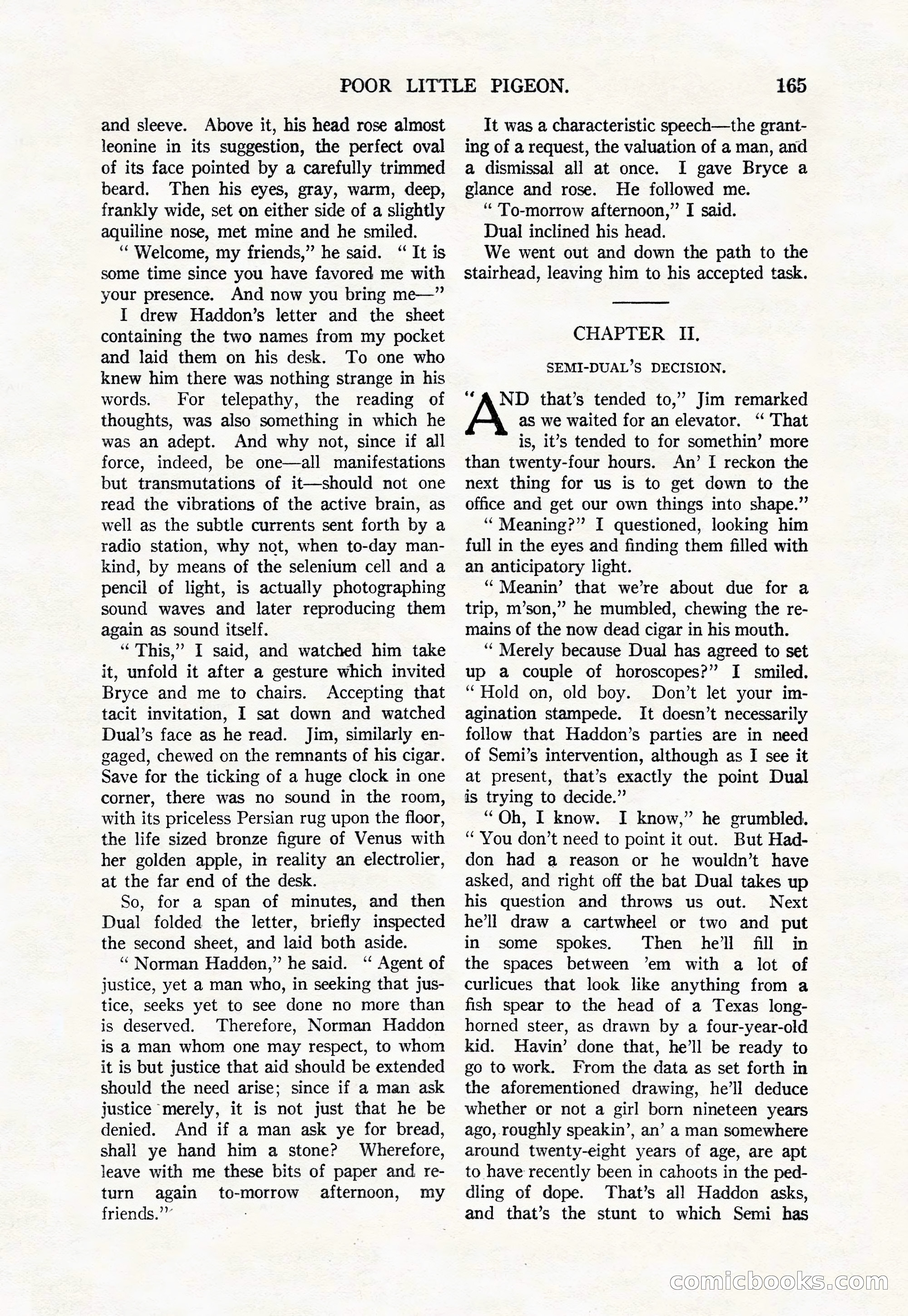
A restored page from Pulp Fiction, 1924. Page through the whole issue in the reader above.
📄 Transcribed text from this page (OCR, searchable)
Machine-transcribed from the original scan — historical spelling and the odd misread are preserved.
POOR LITTLE PIGEON. and sleeve. Above it, his head rose almost leonine in its suggestion, the perfect oval of its face pointed by a carefully trimmed beard. Then his eyes, gray, warm, deep, frankly wide, set on either side of a slightly aquiline nose, met mine and he smiled. ‘“‘ Welcome, my friends,” he said. “ It is some time since you have favored me with your presence. And now you bring me—” I drew Haddon’s letter and the sheet containing the two names from my pocket and laid them on his desk. To one who knew him there was nothing strange in his words. For telepathy, the reading of thoughts, was also something in which he was an adept. And why not, since if all force, indeed, be one—all manifestations but transmutations of it—should not one read the vibrations of the active brain, as well as the subtle currents sent forth by a radio station, why not, when to-day man- kind, by means of the selenium cell and a pencil of light, is actually photographing sound waves and later reproducing them again as sound itself. “This,” I said, and watched him take it, unfold it after a gesture which invited Bryce and me to chairs. Accepting that tacit invitation, I sat down and watched Dual’s face as he read. Jim, similarly en- gaged, chewed on the remnants of his cigar. Save for the ticking of a huge clock in one corner, there was no sound in the room, with its priceless Persian rug upon the floor, the life sized bronze figure of Venus with her golden apple, in reality an electrolier, at the far end of the desk. So, for a span of minutes, and then Dual folded the letter, briefly inspected the second sheet, and laid both aside. ‘Norman Haddon,” he said. ‘‘ Agent of justice, yet a man who, in seeking that jus- tice, seeks yet to see done no more than is deserved. Therefore, Norman Haddon is a man whom one may respect, to whom it is but justice that aid should be extended should the need arise; since if a man ask justice merely, it is not just that he be denied. And if a man ask ye for bread, shall ye hand him a stone? Wherefore, leave with me these bits of paper and re- turn again to-morrow afternoon, my friends.’”’ 165 It was a characteristic speech—the grant- ing of a request, the valuation of a man, and a dismissal all at once. I gave Bryce a glance and rose. He followed me. “To-morrow afternoon,” I said. Dual inclined his head. We went out and down the path to the stairhead, leaving him to his accepted task. CHAPTER II, SEMI-DUAL’S DECISION. ‘““A ND that’s tended to,”’ Jim remarked as we waited for an elevator. ‘“ That is, it’s tended to for somethin’ more than twenty-four hours. An’ I reckon the next thing for us is to get down to the office and get our own things into shape.” ‘“ Meaning?” I questioned, looking him full in the eyes and finding them filled with an anticipatory light. ‘“‘Meanin’ that we’re about due for a trip, m’son,”’ he mumbled, chewing the re- mains of the now dead cigar in his mouth. “Merely because Dual has agreed to set up a couple of horoscopes?” I smiled. “Hold on, old boy. Don’t let your im- agination stampede. It doesn’t necessarily follow that Haddon’s parties are in need of Semi’s intervention, although as I see it at present, that’s exactly the point Dual is trying to decide.” “Oh, I know. I know,” he grumbled. ‘You don’t need to point it out. But Had- don had a reason or he wouldn’t have asked, and right off the bat Dual takes up his question and throws us out. Next he’ll draw a cartwheel or two and put in some spokes. Then he'll fill in the spaces between ’em with a lot of curlicues that look like anything from a fish spear to the head of a Texas long- horned steer, as drawn by a four-year-old kid. Havin’ done that, he’ll be ready to go to work. From the data as set forth in the aforementioned drawing, he’ll deduce whether or not a girl born nineteen years ago, roughly speakin’, an’ a man somewhere around twenty-eight years of age, are apt to have recently been in cahoots in the ped- dling of dope. That’s all Haddon asks, and that’s the stunt to which Semi has LOO a © > S (C@)