
Pulp Fiction, 1924 · page 27 of 172
Argosy All-Story Weekly, August 9, 1924 — page 27: what you’re looking at
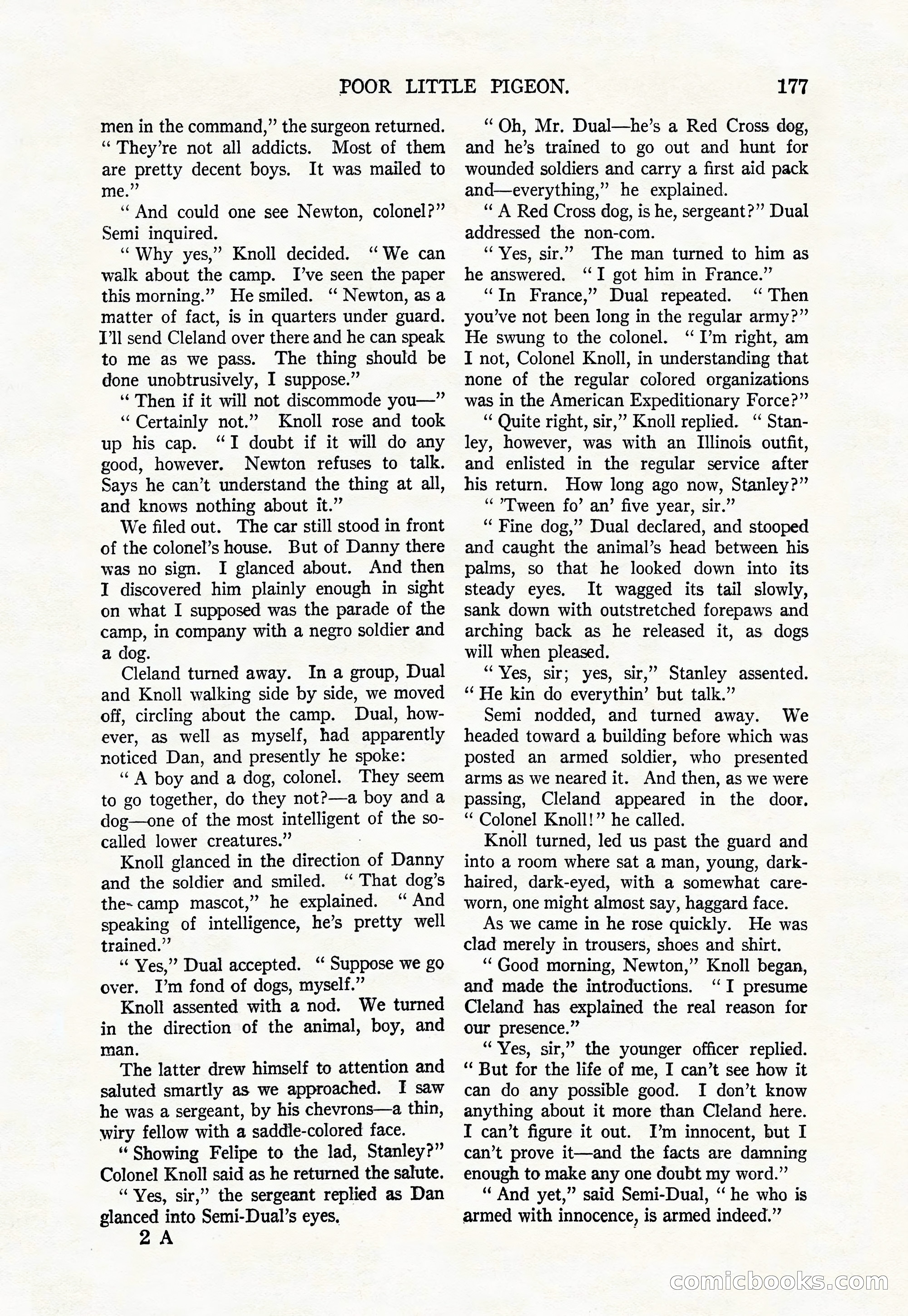
A restored page from Pulp Fiction, 1924. Page through the whole issue in the reader above.
📄 Transcribed text from this page (OCR, searchable)
Machine-transcribed from the original scan — historical spelling and the odd misread are preserved.
POOR LITTLE PIGEON. men in the command,” the surgeon returned. ‘“'They’re not all addicts. Most of them are pretty decent boys. It was mailed to me.” ‘“And could one see Newton, colonel?” Semi inquired. ‘Why yes,” Knoll decided. ‘“ We can walk about the camp. I’ve seen the paper this morning.” Hesmiled. ‘‘ Newton, as a matter of fact, is in quarters under guard. I'll send Cleland over there and he can speak to me as we pass. The thing should be done unobtrusively, I suppose.” “Then if it will not discommode you—” “Certainly not.” Knoll rose and took up his cap. “I doubt if it will do any good, however. Newton refuses to talk. Says he can’t understand the thing at all, and knows nothing about it.” We filed out. The car still stood in front of the colonel’s house. But of Danny there was no sign. I glanced about. And then I discovered him plainly enough in sight on what I supposed was the parade of the camp, in company with a negro soldier and a dog. Cleland turned away. In a group, Dual and Knoll walking side by side, we moved off, circling about the camp. Dual, how- ever, as well as myself, had apparently noticed Dan, and presently he spoke: ‘A boy and a dog, colonel. They seem to go together, do they not?—a boy and a dog—one of the most apeuteent of the so- called lower creatures.” Knoll glanced in the direction of Danny and the soldier and smiled. ‘“‘ That dog’s the- camp mascot,” he explained. “ And speaking of intelligence, he’s pretty well trained.” “Ves,” Dual accepted. ‘“‘ Suppose we go over. I’m fond of dogs, myself.” Knoll assented with a nod. We turned in the direction of the animal, boy, and man. The latter drew himself to attention and saluted smartly as we approached. I saw he was a sergeant, by his chevrons—a thin, wiry fellow with a saddle-colored face. “ Showing Felipe to the lad, Stanley?” Colonel Knoll said as he returned the salute. “Ves, sir,” the sergeant replied as Dan glanced into Semi-Dual’s eyes, ZA L177 “ Oh, Mr. Dual—he’s a Red Cross dog, and he’s trained to go out and hunt for wounded soldiers and carry a first aid pack and—everything,” he explained. ‘‘ A Red Cross dog, is he, sergeant?” Dual addressed the non-com. “Yes, sir.” The man turned to him as he answered. ‘I got him in France.” ‘In France,” Dual repeated. ‘ Then you’ve not been long in the regular army?”’ He swung to the colonel. “I’m right, am I not, Colonel Knoll, in understanding that none of the regular colored organizations was in the American Expeditionary Force?”’ “ Quite right, sir,”’ Knoll replied. ‘‘ Stan- ley, however, was with an Illinois outfit, and enlisted in the regular service after his return. How long ago now, Stanley?” ‘Tween fo’ an’ five year, sir.” “Fine dog,” Dual declared, and stooped and caught the animal’s head between his palms, so that he looked down into its Steady eyes. It wagged its tail slowly, sank down with outstretched forepaws and arching back as he released it, as dogs will when pleased. “Yes, sir; yes, sir,” Stanley assented. ‘“‘ He kin do everythin’ but talk.” Semi nodded, and turned away. We headed toward a building before which was posted an armed soldier, who presented arms as we neared it. And then, as we were passing, Cleland appeared in the door. ‘““ Colonel Knoll!” he called. Knoll turned, led us past the guard and into a room where sat a man, young, dark- haired, dark-eyed, with a somewhat care- worn, one might almost say, haggard face. As we came in he rose quickly. He was clad merely in trousers, shoes and shirt. “Good morning, Newton,” Knoll began, and made the introductions. ‘I presume Cleland has explained the real reason for our presence.” “Yes, sir,” the younger officer replied. *“‘ But for the life of me, I can’t see how it can do any possible good. I don’t know anything about it more than Cleland here. I can’t figure it out. I’m innocent, but I can’t prove it—and the facts are damning enough to make any one doubt my word.” “‘ And yet,” said Semi-Dual, ‘‘ he who is armed with innocence, is armed indeed.” GoMmilGebsoo @) SS CO nn