
Pulp Fiction, 1924 · page 41 of 172
Argosy All-Story Weekly, August 9, 1924 — page 41: what you’re looking at
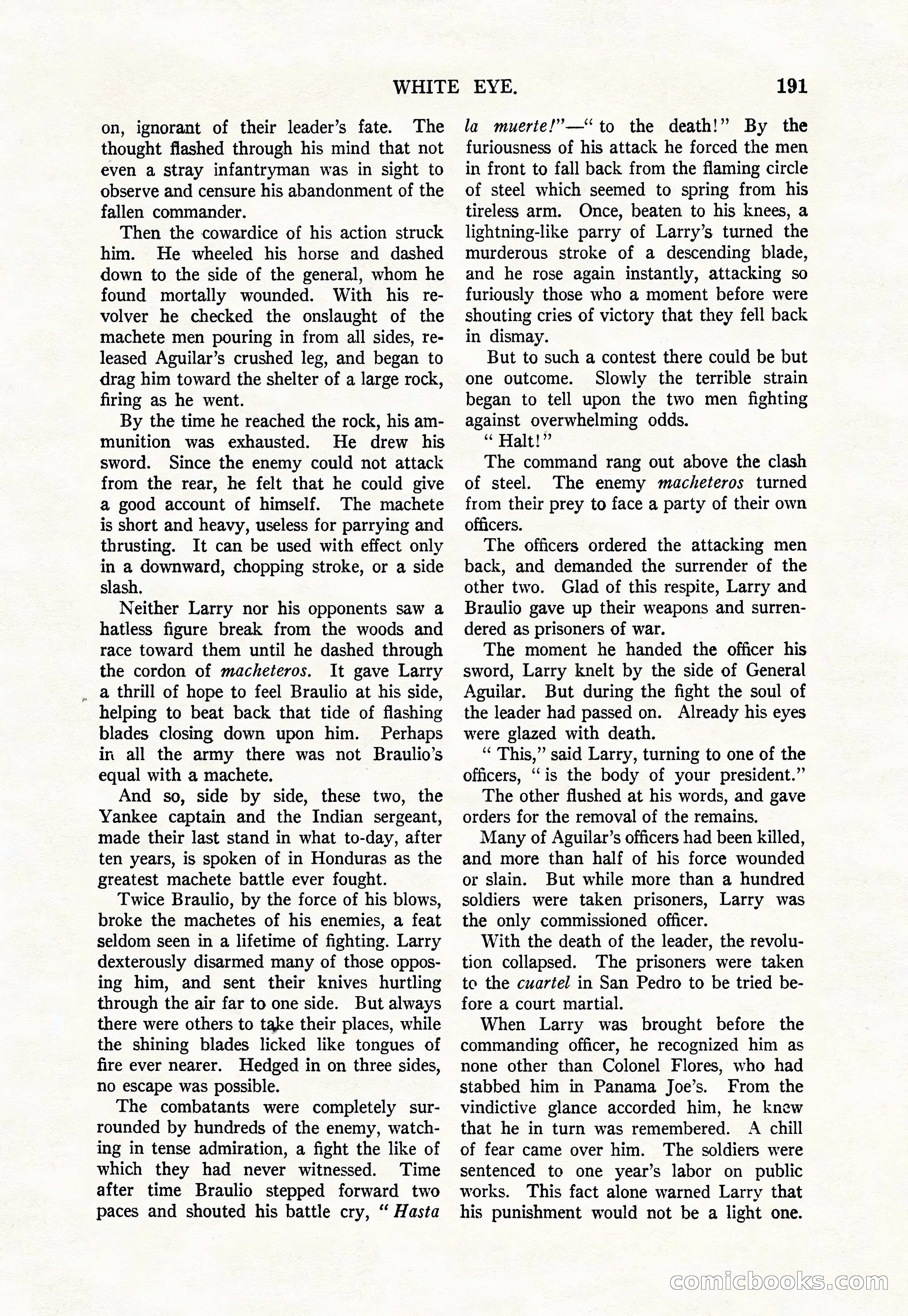
A restored page from Pulp Fiction, 1924. Page through the whole issue in the reader above.
📄 Transcribed text from this page (OCR, searchable)
Machine-transcribed from the original scan — historical spelling and the odd misread are preserved.
WHITE EYE. on, ignorant of their leader’s fate. The thought flashed through his mind that not even a stray infantryman was in sight to observe and censure his abandonment of the fallen commander. Then the cowardice of his action struck him. He wheeled his horse and dashed down to the side of the general, whom he found mortally wounded. With his re- volver he checked the onslaught of the machete men pouring in from all sides, re- leased Aguilar’s crushed leg, and began to drag him toward the shelter of a large rock, firing as he went. By the time he reached the rock, his am- munition was exhausted. He drew his sword. Since the enemy could not attack from the rear, he felt that he could give a good account of himself. The machete is short and heavy, useless for parrying and thrusting. It can be used with effect only in a downward, chopping stroke, or a side slash. Neither Larry nor his opponents saw a hatless figure break from the woods and race toward them until he dashed through the cordon of macheteros. It gave Larry _ a thrill of hope to feel Braulio at his side, helping to beat back that tide of flashing blades closmg down upon him. Perhaps in all the army there was not Braulio’s equal with a machete. | And so, side by side, these two, the Yankee captain and the Indian sergeant, made their last stand in what to-day, after ten years, is spoken of in Honduras as the greatest machete battle ever fought. Twice Braulio, by the force of his blows, broke the machetes of his enemies, a feat seldom seen in a lifetime of fighting. Larry dexterously disarmed many of those oppos- ing him, and sent their knives hurtling through the air far to one side. But always there were others to take their places, while the shining blades licked like tongues of fire ever nearer. Hedged in on three sides, no escape was possible. The combatants were completely sur- rounded by hundreds of the enemy, watch- ing in tense admiration, a fight the like of which they had never witnessed. Time after time Braulio stepped forward two paces and shouted his battle cry, “ Hasta 191 la muerie!’—“to the death!” By the furiousness of his attack he forced the men in front to fall back from the flaming circle of steel which seemed to spring from his tireless arm. Once, beaten to his knees, a lightning-like parry of Larry’s turned the murderous stroke of a descending blade, and he rose again instantly, attacking so furiously those who a moment before were shouting cries of victory that they fell back in dismay. But to such a contest there could be but one outcome. Slowly the terrible strain began to tell upon the two men fighting against overwhelming odds. (7 Halt! ) The command rang out above the clash of steel. The enemy macheteros turned from their prey to face a party of their own officers. The officers ordered the attacking men back, and demanded the surrender of the other two. Glad of this respite, Larry and Braulio gave up their weapons and surren- dered as prisoners of war. The moment he handed the officer his sword, Larry knelt by the side of General Aguilar. But during the fight the soul of the leader had passed on. Already his eyes were glazed with death. “ This,” said Larry, turning to one of the officers, ‘‘is the body of your president.” The other flushed at his words, and gave orders for the removal of the remains. Many of Aguilar’s officers had been killed, and more than half of his force wounded or slain. But while more than a hundred soldiers were taken prisoners, Larry was the only commissioned officer. With the death of the leader, the revolu- tion collapsed. The prisoners were taken toe the cuartel in San Pedro to be tried be- fore a court martial. When Larry was brought before the commanding officer, he recognized him as none other than Colonel Flores, who had stabbed him in Panama Joe’s. From the vindictive glance accorded him, he knew that he in turn was remembered. A chill of fear came over him. The soldiers were sentenced to one year’s labor on public works. This fact alone warned Larry that his punishment would not be a light one. ECOMmiclooo S (C@) nn