
Pulp Fiction, 1924 · page 52 of 172
Argosy All-Story Weekly, August 9, 1924 — page 52: what you’re looking at
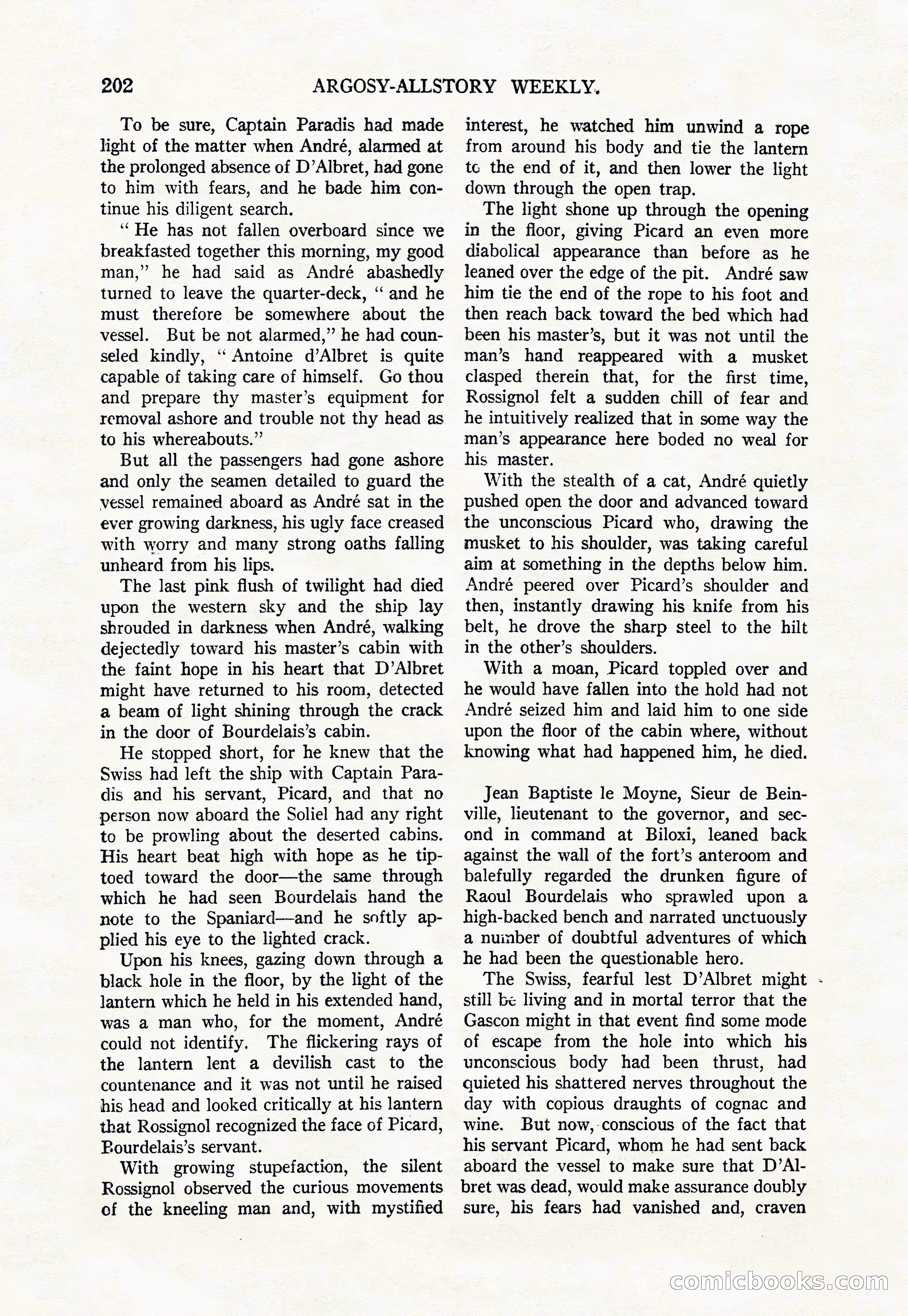
A restored page from Pulp Fiction, 1924. Page through the whole issue in the reader above.
📄 Transcribed text from this page (OCR, searchable)
Machine-transcribed from the original scan — historical spelling and the odd misread are preserved.
202 To be sure, Captain Paradis had made light of the matter when André, alarmed at the prolonged absence of D’Albret, had gone to him with fears, and he bade him con- tinue his diligent search. ‘““He has not fallen overboard since we breakfasted together this morning, my good man,” he had said as André abashedly turned to leave the quarter-deck, ‘“‘ and he must therefore be somewhere about the vessel. But be not alarmed,” he had coun- seled kindly, ‘‘ Antoine d’Albret is quite capable of taking care of himself. Go thou and prepare thy master’s equipment for removal ashore and trouble not thy head as to his whereabouts.” But all the passengers had gone ashore and only the seamen detailed to guard the vessel remained aboard as André sat in the ever growing darkness, his ugly face creased with worry and many strong oaths falling unheard from his lips. The last pink flush of twilight had died upon the western sky and the ship lay shrouded in darkness when André, walking dejectedly toward his master’s cabin with the faint hope in his heart that D’Albret might have returned to his room, detected a beam of light shining through the crack in the door of Bourdelais’s cabin. He stopped short, for he knew that the Swiss had left the ship with Captain Para- dis and his servant, Picard, and that no person now aboard the Soliel had any right to be prowling about the deserted cabins. His heart beat high with hope as he tip- toed toward the door—the same through which he had seen Bourdelais hand the note to the Spaniard—and he softly ap- plied his eye to the lighted crack. Upon his knees, gazing down through a black hole in the floor, by the light of the lantern which he held in his extended hand, was a man who, for the moment, André could not identify. The flickering rays of the lantern lent a devilish cast to the countenance and it was not until he raised his head and looked critically at his lantern that Rossignol recognized the face of Picard, Bourdelais’s servant. With growing stupefaction, the silent Rossignol observed the curious movements of the kneeling man and, with mystified ARGOSY-ALLSTORY WEEKLY. interest, he watched him unwind a rope from around his body and tie the lantern tc the end of it, and then lower the light down through the open trap. The light shone up through the opening in the floor, giving Picard an even more diabolical appearance than before as he leaned over the edge of the pit. André saw him tie the end of the rope to his foot and then reach back toward the bed which had been his master’s, but it was not until the man’s hand reappeared with a musket clasped therein that, for the first time, Rossignol felt a sudden chill of fear and he intuitively realized that in some way the man’s appearance here boded no weal for his master. With the stealth of a cat, André quietly pushed open the door and advanced toward the unconscious Picard who, drawing the musket to his shoulder, was taking careful aim at something in the depths below him. André peered over Picard’s shoulder and then, instantly drawing his knife from his belt, he drove the sharp steel to the hilt in the other’s shoulders. With a moan, Picard toppled over and he would have fallen into the hold had not André seized him and laid him to one side upon the floor of the cabin where, without knowing what had happened him, he died. Jean Baptiste le Moyne, Sieur de Bein- ville, lieutenant to the governor, and sec- ond in command at Biloxi, leaned back against the wall of the fort’s anteroom and balefully regarded the drunken figure of Raoul Bourdelais who sprawled upon a high-backed bench and narrated unctuously a nuinber of doubtful adventures of which he had been the questionable hero. The Swiss, fearful lest D’Albret might - still be living and in mortal terror that the Gascon might in that event find some mode of escape from the hole into which his unconscious body had been thrust, had quieted his shattered nerves throughout the day with copious draughts of cognac and wine. But now,-conscious of the fact that his servant Picard, whom he had sent back aboard the vessel to make sure that D’Al- bret was dead, would make assurance doubly sure, his fears had vanished and, craven COMmicloo A S CO)