
Pulp Fiction, 1924 · page 69 of 172
Argosy All-Story Weekly, August 9, 1924 — page 69: what you’re looking at
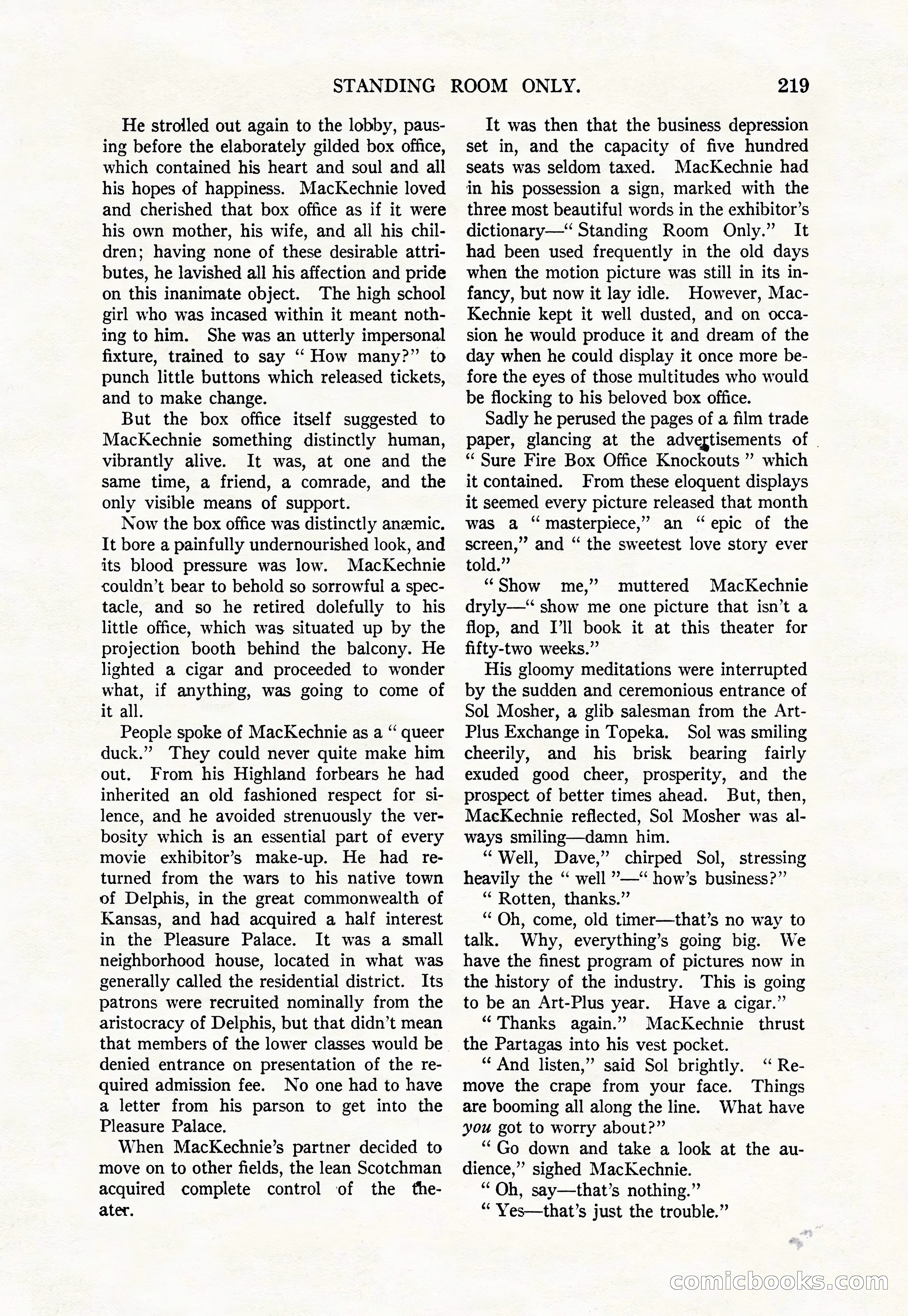
A restored page from Pulp Fiction, 1924. Page through the whole issue in the reader above.
📄 Transcribed text from this page (OCR, searchable)
Machine-transcribed from the original scan — historical spelling and the odd misread are preserved.
STANDING ROOM ONLY. He stroiled out again to the lobby, paus- ing before the elaborately gilded box office, which contained his heart and soul and all his hopes of happiness. MacKechnie loved and cherished that box office as if it were his own mother, his wife, and all his chil- dren; having none of these desirable attri- butes, he lavished all his affection and pride on this inanimate object. The high school girl who was incased within it meant noth- ing to him. She was an utterly impersonal fixture, trained to say “‘ How many?” to punch little buttons which released tickets, and to make change. But the box office itself suggested to MackKechnie something distinctly human, vibrantly alive. It was, at one and the same time, a friend, a comrade, and the only visible means of support. Now the box office was distinctly anemic. It bore a painfully undernourished look, and its blood pressure was low. MacKechnie couldn’t bear to behold so sorrowful a spec- tacle, and so he retired dolefully to his little office, which was situated up by the projection booth behind the balcony. He lighted a cigar and proceeded to wonder what, if anything, was going to come of it all. People spoke of MacKechnie as a ‘“‘ queer duck.” They could never quite make him out. From his Highland forbears he had inherited an old fashioned respect for si- lence, and he avoided strenuously the ver- bosity which is an essential part of every movie exhibitor’; make-up. He had re- turned from the wars to his native town of Delphis, in the great commonwealth of Kansas, and had acquired a half interest in the Pleasure Palace. It was a small neighborhood house, located in what was generally called the residential district. Its patrons were recruited nominally from the aristocracy of Delphis, but that didn’t mean that members of the lower classes would be denied entrance on presentation of the re- quired admission fee. No one had to have a letter from his parson to get into the Pleasure Palace. When MacKechnie’s partner decided to move on to other fields, the lean Scotchman acquired complete control of the the- ater. 219 It was then that the business depression set in, and the capacity of five hundred seats was seldom taxed. MacKechnie had in his possession a sign, marked with the three most beautiful words in the exhibitor’s dictionary—‘ Standing Room Only.” It had been used frequently in the old days when the motion picture was still in its in- fancy, but now it lay idle. However, Mac- Kechnie kept it well dusted, and on occa- sion he would produce it and dream of the day when he could display it once more be- fore the eyes of those multitudes who would be flocking to his beloved box office. Sadly he perused the pages of a film trade paper, glancing at the advegtisements of | “Sure Fire Box Office Knockouts ” which it contained. From these eloquent displays it seemed every picture released that month was a ‘“‘ masterpiece,” an “epic of the screen,” and “ the sweetest love story ever told.” ‘Show me,” muttered MacKechnie dryly—“ show me one picture that isn’t a flop, and I’ll book it at this theater for fifty-two weeks.” His gloomy meditations were interrupted by the sudden and ceremonious entrance of Sol Mosher, a glib salesman from the Art- Plus Exchange in Topeka. Sol was smiling cheerily, and his brisk bearing fairly exuded good cheer, prosperity, and the prospect of better times ahead. But, then, MacKechnie reflected, Sol Mosher was al- ways smiling—damn him. “Well, Dave,” chirped Sol, stressing heavily the “‘ well ”—‘‘ how’s business?” “ Rotten, thanks.” ‘“‘ Oh, come, old timer—that’s no way to talk. Why, everything’s going big. We have the finest program of pictures now in the history of the industry. This is going to be an Art-Plus year. Have a cigar.” “Thanks again.” MacKechnie thrust the Partagas into his vest pocket. ‘* And listen,” said Sol brightly. ‘“‘ Re- move the crape from your face. Things are booming all along the line. What have you got to worry about?” ‘““Go down and take a look at the au- dience,”’ sighed MacKechnie. “Oh, say—that’s nothing.” “ Yes—that’s just the trouble.” COMmICLO® O S (C@) im