
Pulp Fiction, 1924 · page 74 of 172
Argosy All-Story Weekly, August 9, 1924 — page 74: what you’re looking at
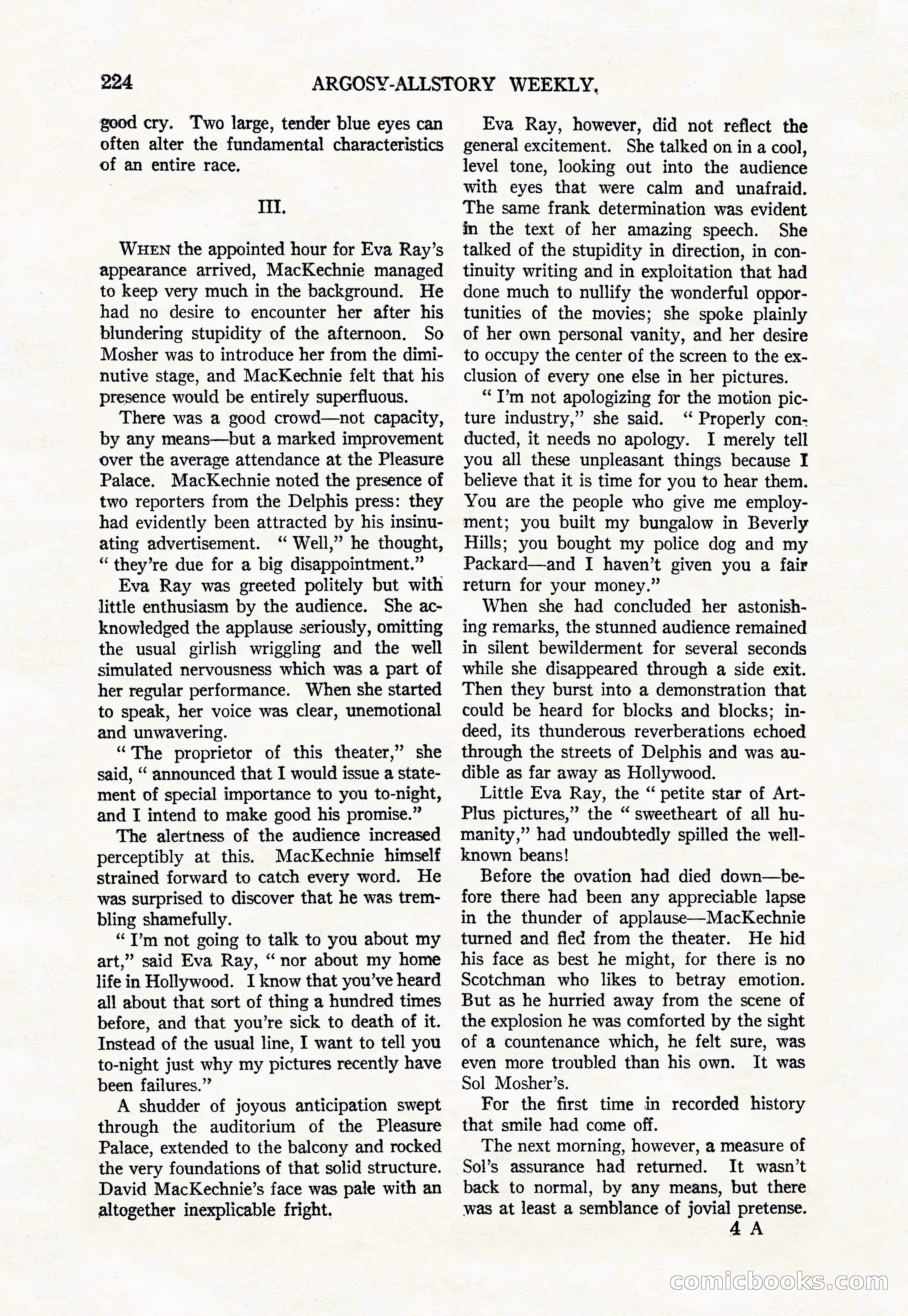
A restored page from Pulp Fiction, 1924. Page through the whole issue in the reader above.
📄 Transcribed text from this page (OCR, searchable)
Machine-transcribed from the original scan — historical spelling and the odd misread are preserved.
224 good cry. Two large, tender blue eyes can often alter the fundamental characteristics of an entire race. Til. WHEN the appointed hour for Eva Ray’s appearance arrived, MacKechnie managed to keep very much in the background. He had no desire to encounter her after his blundering stupidity of the afternoon. So Mosher was to introduce her from the dimi- nutive stage, and MacKechnie felt that his presence would be entirely superfluous. There was a good crowd—not capacity, by any means—but a marked improvement over the average attendance at the Pleasure Palace. MacKechnie noted the presence of two reporters from the Delphis press: they had evidently been attracted by his insinu- ating advertisement. ‘“ Well,” he thought, “ they’re due for a big disappointment.” Eva Ray was greeted politely but with little enthusiasm by the audience. She ac- knowledged the applause seriously, omitting the usual girlish wriggling and the well simulated nervousness which was a part of her regular performance. When she started to speak, her voice was clear, unemotional and unwavering. “The proprietor of this theater,” she said, ‘“‘ announced that I would issue a state- ment of special importance to you to-night, and I intend to make good his promise.” The alertness of the audience increased perceptibly at this. MacKechnie himself strained forward to catch every word. He was surprised to discover that he was trem- bling shamefully. “T’m not going to talk to you about my art,” said Eva Ray, “nor about my home life in Hollywood. I know that you’ve heard all about that sort of thing a hundred times before, and that you’re sick to death of it. Instead of the usual line, I want to tell you to-night just why my pictures recently have been failures.” A shudder of joyous anticipation swept through the auditorium of the Pleasure Palace, extended to the balcony and rocked the very foundations of that solid structure. David MacKechnie’s face was pale with an altogether inexplicable fright. ARGOSY-ALLSTORY WEEKLY. Eva Ray, however, did not reflect the general excitement. She talked on in a cool, level tone, looking out into the audience with eyes that were calm and unafraid. The same frank determination was evident in the text of her amazing speech. She talked of the stupidity in direction, in con- tinuity writing and in exploitation that had done much to nullify the wonderful oppor- tunities of the movies; she spoke plainly of her own personal vanity, and her desire to occupy the center of the screen to the ex- clusion of every one else in her pictures. “Tm not apologizing for the motion pic- ture industry,” she said. ‘“‘ Properly con- ducted, it needs no apology. I merely tell you all these unpleasant things because I believe that it is time for you to hear them. You are the people who give me employ- ment; you built my bungalow in Beverly Hills; you bought my police dog and my Packard—and I haven’t given you a fair return for your money.” When she had concluded her astonish- ing remarks, the stunned audience remained in silent bewilderment for several seconds while she disappeared through a side exit. Then they burst into a demonstration that could be heard for blocks and blocks; in- deed, its thunderous reverberations echoed through the streets of Delphis and was au- dible as far away as Hollywood. Little Eva Ray, the “ petite star of Art- Plus pictures,” the “ sweetheart of all hu- manity,” had undoubtedly spilled the well- known beans! Before the ovation had died down—be- fore there had been any appreciable lapse in the thunder of applause—MacKechnie turned and fled from the theater. He hid his face as best he might, for there is no Scotchman who likes to betray emotion. But as he hurried away from the scene of the explosion he was comforted by the sight of a countenance which, he felt sure, was even more troubled than his own. It was Sol Mosher’s. For the first time in recorded history that smile had come off. The next morning, however, a measure of Sol’s assurance had returned. It wasn’t back to normal, by any means, but there was at least a semblance of jovial pretense. LN@OO S} A CO SS (C@) nn