
Pulp Fiction, 1924 · page 80 of 172
Argosy All-Story Weekly, August 9, 1924 — page 80: what you’re looking at
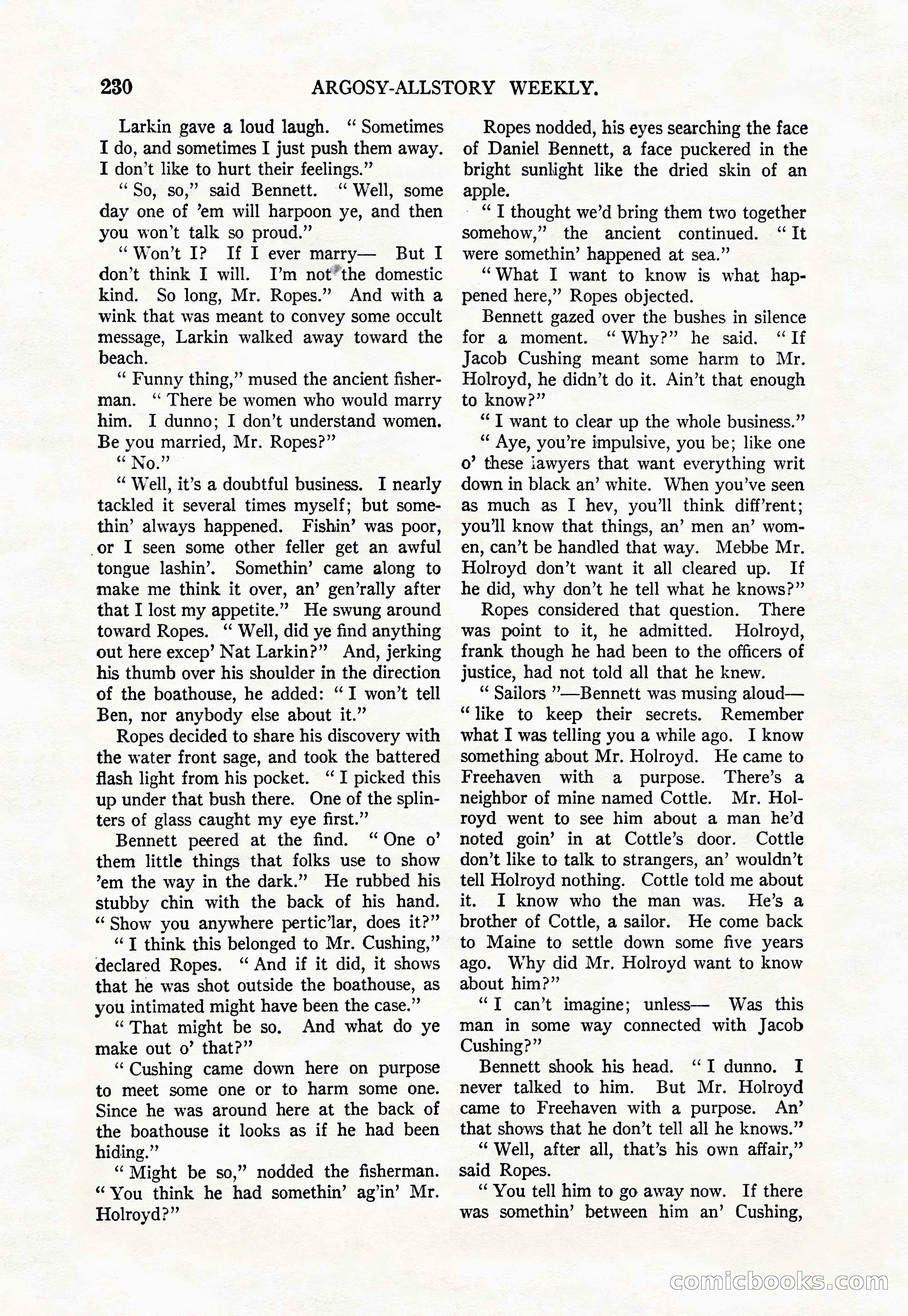
A restored page from Pulp Fiction, 1924. Page through the whole issue in the reader above.
📄 Transcribed text from this page (OCR, searchable)
Machine-transcribed from the original scan — historical spelling and the odd misread are preserved.
230 Larkin gave a loud laugh. ‘“ Sometimes I do, and sometimes I just push them away. I don’t like to hurt their feelings.” ‘““So, so,” said Bennett. ‘ Well, some day one of ’em will harpoon ye, and then you won’t talk so proud.” ‘“Won’t Ip If I ever marry— But I don’t think I will. I’m not*the domestic kind. So long, Mr. Ropes.” And with a wink that was meant to convey some occult message, Larkin walked away toward the beach. ‘“‘ Funny thing,” mused the ancient fisher- man. ‘“ There be women who would marry him. I dunno; I don’t understand women. Be you married, Mr. Ropes?” c¢ No.” “Well, it’s a doubtful business. I nearly tackled it several times myself; but some- thin’ always happened. Fishin’ was poor, or I seen some other feller get an awful tongue lashin’. Somethin’ came along to make me think it over, an’ gen’rally after that I lost my appetite.”” He swung around toward Ropes. ‘“ Well, did ye find anything out here excep’ Nat Larkin?” And, jerking his thumb over his shoulder in the direction of the boathouse, he added: ‘I won’t tell Ben, nor anybody else about it.” Ropes decided to share his discovery with the water front sage, and took the battered flash light from his pocket. “I picked this up under that bush there. One of the splin- ters of glass caught my eye first.” Bennett peered at the find. “One o’ them little things that folks use to show ’em the way in the dark.” He rubbed his stubby chin with the back of his hand. ‘¢ Show you anywhere pertic’lar, does it?” “ T think this belonged to Mr. Cushing,” declared Ropes. “And if it did, it shows that he was shot outside the boathouse, as you intimated might have been the case.” “That might be so. And what do ye make out o’ that?” ‘“‘ Cushing came down here on purpose to meet some one or to harm some one. Since he was around here at the back of the boathouse it looks as if he had been hiding.” “ Might be so,” nodded the fisherman. “Vou think he had somethin’ ag’in’ Mr. Holroyd?” ARGOSY-ALLSTORY WEEKLY. Ropes nodded, his eyes searching the face of Daniel Bennett, a face puckered in the bright sunlight like the dried skin of an apple. ~ “T thought we’d bring them two together somehow,” the ancient continued. “ It were somethin’ happened at sea.” ‘What I want to know is what hap- pened here,”’ Ropes objected. Bennett gazed over the bushes in silence for a moment. ‘“ Why?” he said. ‘If Jacob Cushing meant some harm to Mr. Holroyd, he didn’t do it. Ain’t that enough to know?” *¢ I want to clear up the whole business.” “ Aye, you’re impulsive, you be; like one o’ these iawyers that want everything writ down in black an’ white. When you’ve seen as much as I hev, you’ll think diff’rent; you'll know that things, an’ men an’ wom- en, can’t be handled that way. Mebbe Mr. Holroyd don’t want it all cleared up. If he did, why don’t he tell what he knows?” Ropes considered that question. There was point to it, he admitted. Holroyd, frank though he had been to the officers of justice, had not told all that he knew. *¢ Sailors ”—Bennett was musing aloud— “like to keep their secrets. Remember what I was telling you a while ago. I know something about Mr. Holroyd. He came to Freehaven with a purpose. There’s a neighbor of mine named Cottle. Mr. Hol- royd went to see him about a man he’d noted goin’ in at Cottle’s door. Cottle don’t like to talk to strangers, an’ wouldn’t tell Holroyd nothing. Cottle told me about it. I know who the man was. He’s a brother of Cottle, a sailor. He come back to Maine to settle down some five years ago. Why did Mr. Holroyd want to know about him?” “TI can’t imagine; unless— Was this man in some way connected with Jacob Cushing?” Bennett shook his head. “I dunno. I never talked to him. But Mr. Holroyd came to Freehaven with a purpose. An’ that shows that he don’t tell all he knows.” “Well, after all, that’s his own affair,” said Ropes. “You tell him to go away now. If there was somethin’ between him an’ Cushing, CoOMmiclooo S co nn