
Pulp Fiction, 1924 · page 95 of 172
Argosy All-Story Weekly, August 9, 1924 — page 95: what you’re looking at
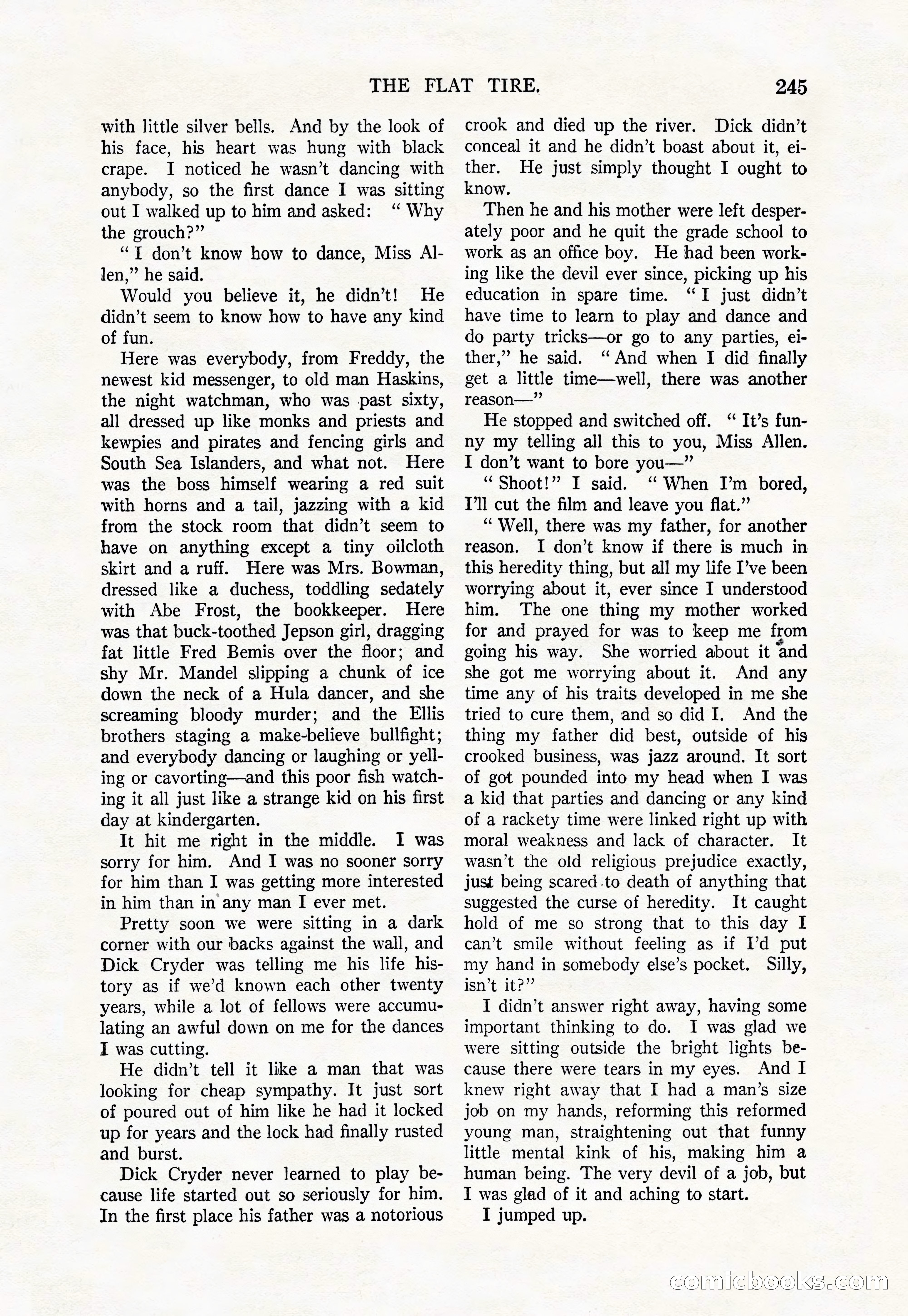
A restored page from Pulp Fiction, 1924. Page through the whole issue in the reader above.
📄 Transcribed text from this page (OCR, searchable)
Machine-transcribed from the original scan — historical spelling and the odd misread are preserved.
THE FLAT TIRE. with little silver bells. And by the look of his face, his heart was hung with black crape. I noticed he wasn’t dancing with anybody, so the first dance I was sitting out I walked up to him and asked: ‘‘ Why the grouch?” “T don’t know how to dance, Miss Al- len,” he said. Would you believe it, he didn’t! He didn’t seem to know how to have any kind of fun. Here was everybody, from Freddy, the newest kid messenger, to old man Haskins, the night watchman, who was past sixty, all dressed up like monks and priests and kewpies and pirates and fencing girls and South Sea Islanders, and what not. Here was the boss himself wearing a red suit with horns and a tail, jazzing with a kid from the stock room that didn’t seem to have on anything except a tiny oilcloth skirt and a ruff. Here was Mrs. Bowman, dressed like a duchess, toddling sedately with Abe Frost, the bookkeeper. Here was that buck-toothed Jepson girl, dragging fat little Fred Bemis over the floor; and shy Mr. Mandel slipping a chunk of ice down the neck of a Hula dancer, and she screaming bloody murder; and the Ellis brothers staging a make-believe bullfight; and everybody dancing or laughing or yell- ing or cavorting—and this poor fish watch- ing it all just like a strange kid on his first day at kindergarten. It hit me right in the middle. I was sorry for him. And I was no sooner sorry for him than I was getting more interested in him than in any man I ever met. Pretty soon we were sitting in a dark corner with our backs against the wall, and Dick Cryder was telling me his life his- tory as if we’d known each other twenty years, while a lot of fellows were accumu- lating an awful down on me for the dances I was cutting. He didn’t tell it like a man that was looking for cheap sympathy. It just sort of poured out of him like he had it locked up for years and the lock had finally rusted and burst. Dick Cryder never learned to play be- cause life started out so seriously for him. In the first place his father was a notorious 245 crook and died up the river. Dick didn’t conceal it and he didn’t boast about it, ei- ther. He just simply thought I ought to know. Then he and his mother were left desper- ately poor and he quit the grade school to work as an office boy. He had been work- ing like the devil ever since, picking up his education in spare time. ‘‘I just didn’t have time to learn to play and dance and do party tricks—or go to any parties, ei- ther,” he said. ‘And when I did finally get a little time—well, there was another reason—”’ He stopped and switched off. ‘“ It’s fun- ny my telling all this to you, Miss Allen. I don’t want to bore you—” “Shoot!”? I said. ‘‘ When I’m bored, T’ll cut the film and leave you flat.” ‘Well, there was my father, for another reason. I don’t know if there is much in this heredity thing, but all my life I’ve been worrying about it, ever since I understood him. The one thing my mother worked for and prayed for was to keep me from going his way. She worried about it and she got me worrying about it. And any time any of his traits developed in me she tried to cure them, and so did I. And the thing my father did best, outside of his crooked business, was jazz around. It sort of got pounded into my head when I was a kid that parties and dancing or any kind of a rackety time were linked right up with moral weakness and lack of character. It wasn’t the old religious prejudice exactly, just being scared.to death of anything that suggested the curse of heredity. It caught hold of me so strong that to this day I can’t smile without feeling as if I’d put my hand in somebody else’s pocket. Silly, ish’ t ite?’ I didn’t answer right away, having some important thinking to do. I was glad we were sitting outside the bright lights be- cause there were tears in my eyes. And lI knew right away that I had a man’s size job on my hands, reforming this reformed young man, straightening out that funny little mental kink of his, making him a human being. The very devil of a job, but I was glad of it and aching to start. IT jumped up. GoIMnilGeboo @) S GO)