
Pulp Fiction, 1924 · page 102 of 172
Argosy All-Story Weekly, October 25, 1924 — page 102: what you’re looking at
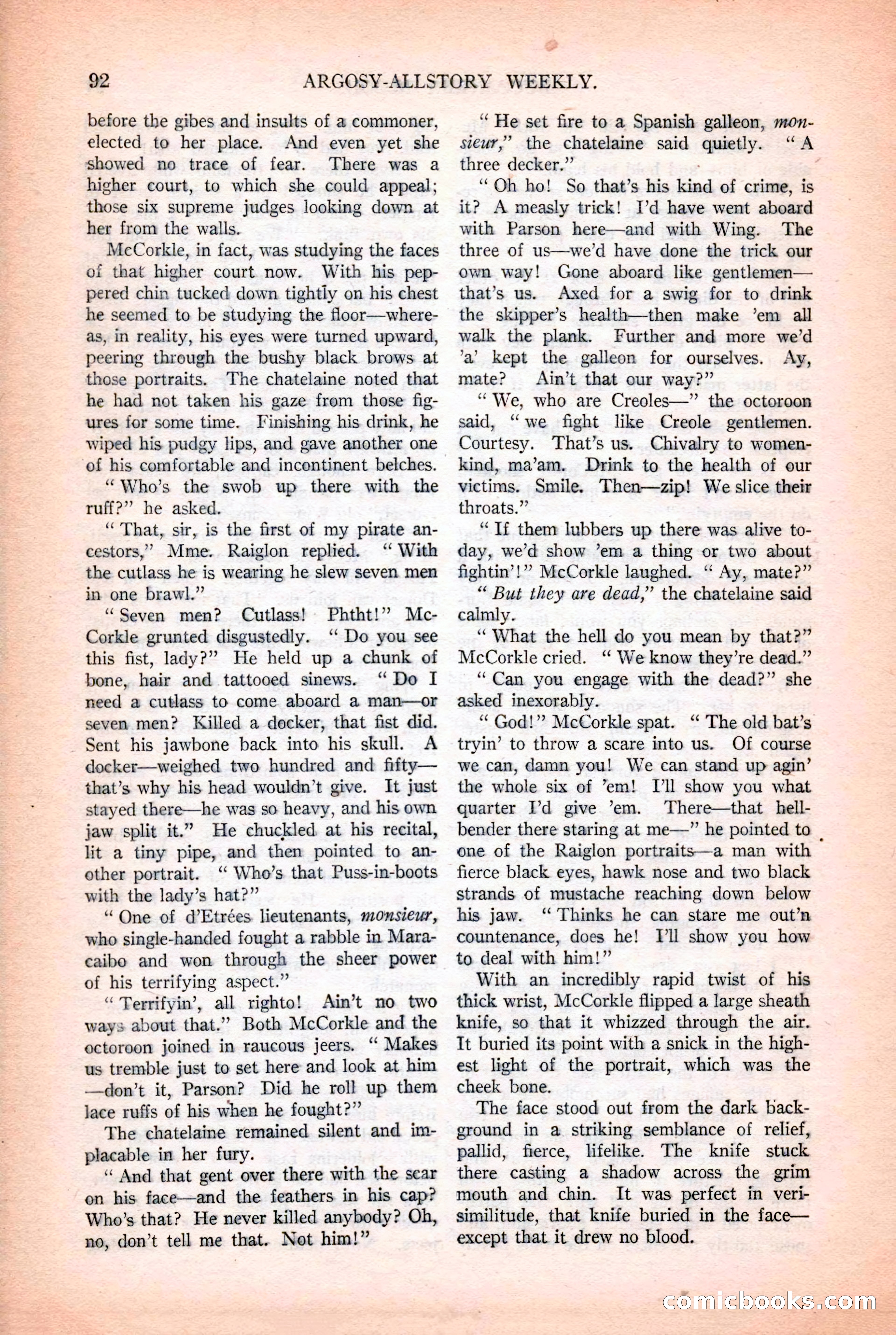
A restored page from Pulp Fiction, 1924. Page through the whole issue in the reader above.
📄 Transcribed text from this page (OCR, searchable)
Machine-transcribed from the original scan — historical spelling and the odd misread are preserved.
Bi i Mats ng ~ 92 ARGOSY-ALLSTORY WEEKLY. before the gibes and insults of a commoner, elected to her place. And even yet she showed no trace of fear. There was a higher court, to which she could appeal; those six supreme judges looking down at her from the walls. McCorkle, in fact, was studying the faces oi that higher court now. With his pep- pered chin tucked down tightly on his chest he seemed to be studying the floor—where- as, in reality, his eyes were turned upward, peering through the bushy black brows at those portraits. The chatelaine noted that he had not taken his gaze from those fig- ures for some time. Finishing his drink, he wiped his pudgy lips, and gave another one of his comfortable and incontinent belches. ““Who’s the swob up there with the ruff?” he asked. “ That, sir, is the first of my pirate an- cestors,” Mme. Raiglon replied. ‘ With the cutlass he is wearing he slew seven men in one brawl.” “Seven men? Cutlass! Phtht!” Mc- Corkle grunted disgustedly. ‘‘ Do you see this fist, lady?” He held up a chunk of bone, hair and tattooed sinews. “ Do I need a cutlass to come aboard a man—or seven men? Killed a docker, that fist did. Sent his jawbone back into his skull. A docker—weighed two hundred and fifity— that’s why his head wouldn’t give. It just stayed there—he was so heavy, and his own jaw split it.” He chuckled at his recital, lit a tiny pipe, and then pointed to an- other portrait. ‘ Who’s that Puss-in-boots with the lady’s hat?” “One of d’Etrées. lieutenants, monsieur, who single-handed fought a rabble in Mara- caibo and won through the sheer power of his terrifying aspect.” “ Terrifyin’, all righto! Ain’t no two ways about that.” Both McCorkle and the octoroon joined in raucous jeers. “ Makes us tremble just to set here and look at him —don’t it, Parson? Did he roll up them lace ruffs of his when he fought?” The chatelaine remained silent and im- placable in her fury. ‘“ And that gent over there with the sear on his face—and the feathers in his cap? Who’s that? He never killed anybody? Oh, no, don’t tell me that. Not him!” ‘“ He set fire to a Spanish galleon, mon- sieur,’ the chatelaine said quietly. “A three decker.”’ ‘Oh ho! So that’s his kind of crime, is it? A measly trick! I’d have went aboard with Parson here—and with Wing. The three of us—we’d have done the trick our own way! Gone aboard like gentlemen— that’s us. Axed for a swig for to drink the skipper’s health—then make ’em all walk the plank. Further and more we’d ‘a’ kept the galleon for ourselves. Ay, mate? Ain’t that our way?” “We, who are Creoles—” the octoroon said, “we fight like Creole gentlemen. Courtesy. That’s us. Chivalry to women- kind, ma’am. Drink to the health of our victims. Smile. Then—zip! We slice their throats.” “Tf them lubbers up there was alive to- day, we’d show ’em a thing or two about fightin’!”” McCorkle laughed. “ Ay, mate?” “ But they are dead,” the chatelaine said calmly. ‘What the hell do you mean by that?” McCorkle cried. “‘ We know they’re dead.” “Can you engage with the dead?” she asked inexorably. “God!” McCorkle spat. ‘“ The old bat’s tryin’ to throw a scare into us. Of course we can, damn you! We can stand up agin’ the whole six of ’em! Ill show you what quarter I’d give ’em. There—that hell- bender there staring at me—” he pointed to | one of the Raiglon portraits—a man with fierce black eyes, hawk nose and two black strands of mustache reaching down below his jaw. “ Thinks he can stare me out’n countenance, does he! Jl show you how to deal with him!” With an incredibly rapid twist of his thick wrist, McCorkle flipped a large sheath knife, so that it whizzed through the air. It buried its point with a snick in the high- est light of the portrait, which was the cheek bone. The face stood out from the dark back- ground in a striking semblance of relief, pallid, fierce, lifelike. The knife stuck there casting a shadow across the grim mouth and chin. It was perfect in veri- similitude, that knife buried in the face— except that it drew no blood. » COMMICOOOKS