
Pulp Fiction, 1924 · page 133 of 172
Argosy All-Story Weekly, October 25, 1924 — page 133: what you’re looking at
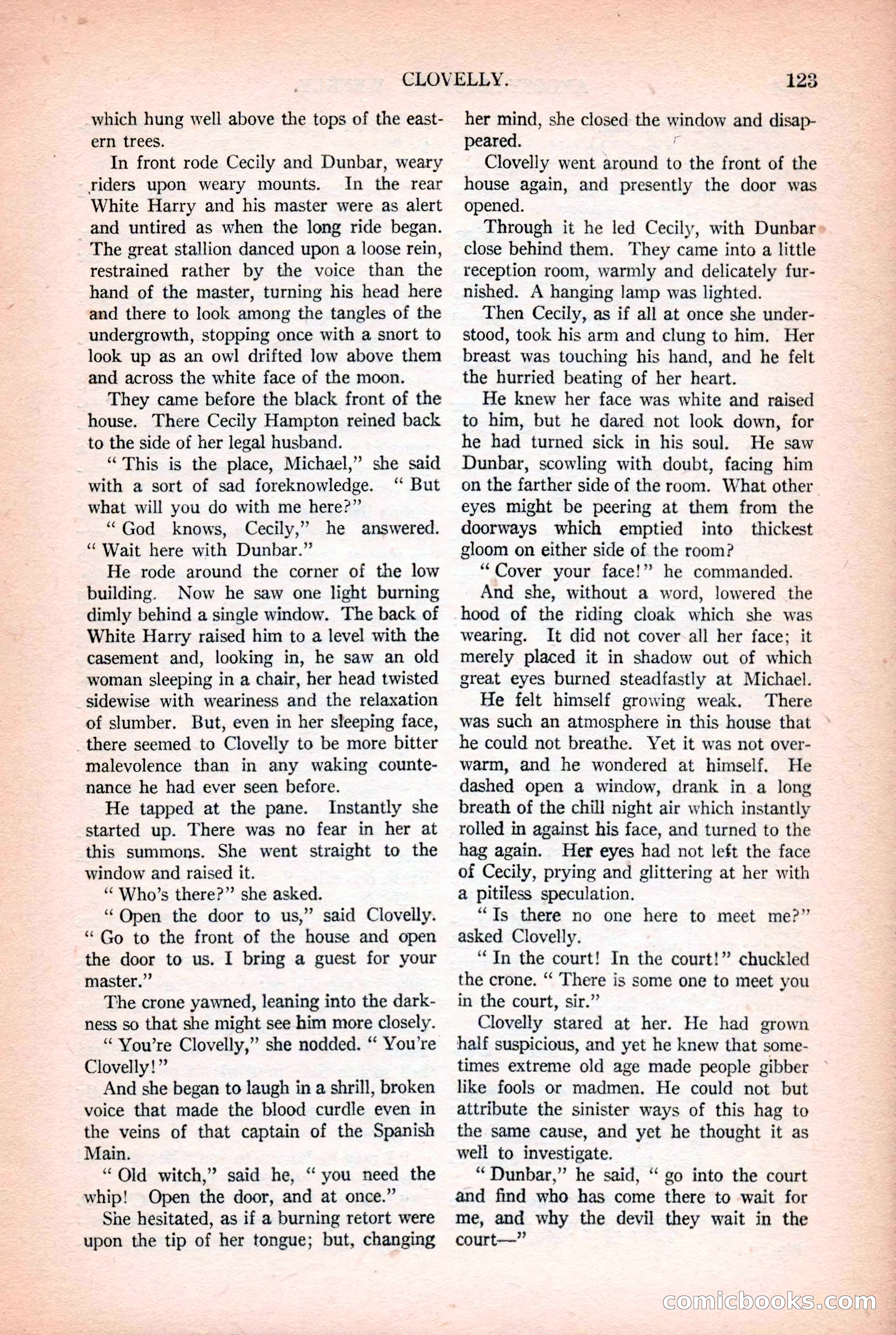
A restored page from Pulp Fiction, 1924. Page through the whole issue in the reader above.
📄 Transcribed text from this page (OCR, searchable)
Machine-transcribed from the original scan — historical spelling and the odd misread are preserved.
CLOVELLY. which hung well above the tops of the east- ern trees. In front rode Cecily and Dunbar, weary riders upon weary mounts. In the rear White Harry and his master were as alert and untired as when the long ride began. The great stallion danced upon a loose rein, restrained rather by the voice than the hand of the master, turning his head here and there to look among the tangles of the undergrowth, stopping once with a snort to look up as an owl drifted low above them and across the white face of the moon. They came before the black front of the house. There Cecily Hampton reined back to the side of her legal husband. “This is the place, Michael,” she said with a sort of sad foreknowledge. “ But what will you do with me here?” “God knows, Cecily,” he answered. “ Wait here with Dunbar.” He rode around the corner of the low building. Now he saw one light burning dimly behind a single window. The back of White Harry raised him to a level with the casement and, looking in, he saw an old woman sleeping in a chair, her head twisted sidewise with weariness and the relaxation of slumber. But, even in her sleeping face, there seemed to Clovelly to be more bitter malevolence than in any waking counte- nance he had ever seen before. He tapped at the pane. Instantly she started up. There was no fear in her at this summons. She went straight to the window and raised it. ‘“'Who’s there?” she asked. “Open the door to us,” said Clovelly. “ Go to the front of the house and open the door to us. I bring a guest for your master.” The crone yawned, leaning into the dark- ness so that she might see him more closely. “ You’re Clovelly,” she nodded. “ You’re Clovelly!” And she began to laugh in a shrill, broken voice that made the blood curdle even in the veins of that captain of the Spanish Main. “Old witch,” said he, “ you need the whip! Open the door, and at once.” She hesitated, as if a burning retort were upon the tip of her tongue; but, changing 125 her mind, she closed the window and disap- peared. , Clovelly went around to the front of the house again, and presently the door was opened. Through it he led Cecily, with Dunbar» close behind them. They came into a little reception room, warmly and delicately fur- nished. A hanging lamp was lighted. Then Cecily, as if all at once she under- stood, took his arm and clung to him. Her breast was touching his hand, and he felt the hurried beating of her heart. He knew her face was white and raised to him, but he dared not look down, for he had turned sick in his soul. He saw Dunbar, scowling with doubt, facing him on the farther side of the room. What other eyes might be peering at them from the doorways which emptied into thickest gloom on either side of the room? “Cover your face!” he commanded. And she, without a word, lowered the hood of the riding cloak which she was wearing. It did not cover all her face; it merely placed it in shadow out of which great eyes burned steadfastly at Michael. He felt himself growing weak. There was such an atmosphere in this house that he could not breathe. Yet it was not over- warm, and he wondered at himself. He dashed open a window, drank in a long breath of the chill night air which instantly rolled in against his face, and turned to the hag again. Her eyes had not left the face of Cecily, prying and glittering at her with a pitiless speculation. “Ts there no one here to meet me?”’ asked Clovelly. ‘In the court! In the court!” chuckled the crone. “ There is some one to meet you in the court, sir.” Clovelly stared at her. He had grown half suspicious, and yet he knew that some- times extreme old age made people gibber ~ like fools or madmen. He could not but attribute the sinister ways of this hag to the same cause, and yet he thought it as well to investigate. “Dunbar,” he said, “ go into the court and find who has come there to wait for me, and why the devil they wait in the court—” COnmmiclbooks (E@