
Pulp Fiction, 1924 · page 137 of 172
Argosy All-Story Weekly, October 25, 1924 — page 137: what you’re looking at
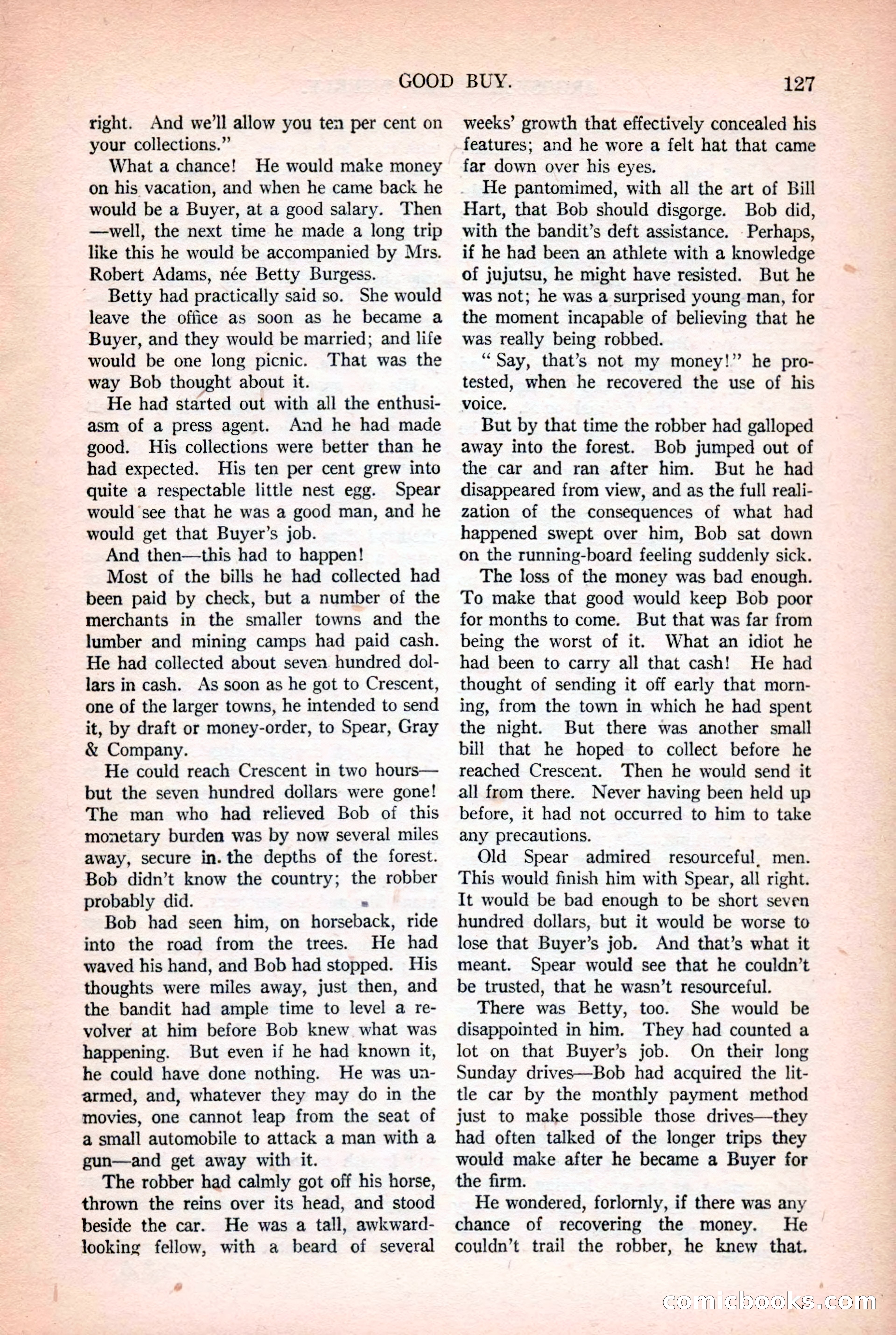
A restored page from Pulp Fiction, 1924. Page through the whole issue in the reader above.
📄 Transcribed text from this page (OCR, searchable)
Machine-transcribed from the original scan — historical spelling and the odd misread are preserved.
GOOD BUY. right. And we’ll allow you ten per cent on your collections.” What a chance! He would make money on his vacation, and when he came back he would be a Buyer, at a good salary. Then —well, the next time he made a long trip like this he would be accompanied by Mrs. Robert Adams, née Betty Burgess. Betty had practically said so. She would leave the office as soon as he became a Buyer, and they would be married; and life would be one long picnic. That was the way Bob thought about it. He had started out with all the enthusi- asm of a press agent. And he had made good. His collections were better than he had expected. His ten per cent grew into quite a respectable little nest egg. Spear would see that he was a good man, and he would get that Buyer’s job. And then—this had to happen! Most of the bills he had collected had been paid by check, but a number of the merchants in the smaller towns and the lumber and mining camps had paid cash. He had collected about seven hundred dol- lars in cash. As soon as he got to Crescent, one of the larger towns, he intended to send it, by draft or money-order, to Spear, Gray & Company. He could reach Crescent in two hours— but the seven hundred dollars were gone! The man who had relieved Bob of this monetary burden was by now several miles away, secure in. the depths of the forest. Bob didn’t know the country; the robber probably did. ° Bob had seen him, on horseback, ride into the road from the trees. He had waved his hand, and Bob had stopped. His thoughts were miles away, just then, and the bandit had ample time to level a re- volver at him before Bob knew what was happening. But even if he had known it, he could have done nothing. He was un- armed, and, whatever they may do in the movies, one cannot leap from the seat of a small automobile to attack a man with a gun—and get away with it. The robber had calmly got off his horse, thrown the reins over its head, and stood beside the car. He was a tall, awkward- looking fellow, with a beard of several oe 127 weeks’ growth that effectively concealed his features; and he wore a felt hat that came far down over his eyes. He pantomimed, with all the art of Bill Hart, that Bob should disgorge. Bob did, with the bandit’s deft assistance. - Perhaps, if he had been an athlete with a knowledge of jujutsu, he might have resisted. But he was not; he was a surprised young man, for the moment incapable of believing that he was really being robbed. “Say, that’s not my money!” he pro- tested, when he recovered the use of his voice. But by that time the robber had galloped away into the forest. Bob jumped out of the car and ran after him. But he had disappeared from view, and as the full reali- zation of the consequences of what had happened swept over him, Bob sat down on the running-board feeling suddenly sick. The loss of the money was bad enough. To make that good would keep Bob poor for months to come. But that was far from being the worst of it. What an idiot he had been to carry all that cash! He had thought of sending it off early that morn- ing, from the town in which he had spent the night. But there was another small bill that he hoped to collect before he reached Crescent. Then he would send it all from there. Never having been held up before, it had not occurred to him to take any precautions. Old Spear admired resourceful. men. This would finish him with Spear, all right. It would be bad enough to be short seven hundred dollars, but it would be worse to lose that Buyer’s job. And that’s what it meant. Spear would see that he couldn’t be trusted, that he wasn’t resourceful. There was Betty, too. She would be disappointed in him. They had counted a lot on that Buyer’s job. On their long Sunday drives—Bob had acquired the lit- tle car by the monthly payment method just to make possible those drives—they had often talked of the longer trips they would make after he became a Buyer for the firm. He wondered, forlornly, if there was any chance of recovering the money. He couldn’t trail the robber, he knew that. CORIICLOO© S (C@