
Pulp Fiction, 1924 · page 140 of 172
Argosy All-Story Weekly, October 25, 1924 — page 140: what you’re looking at
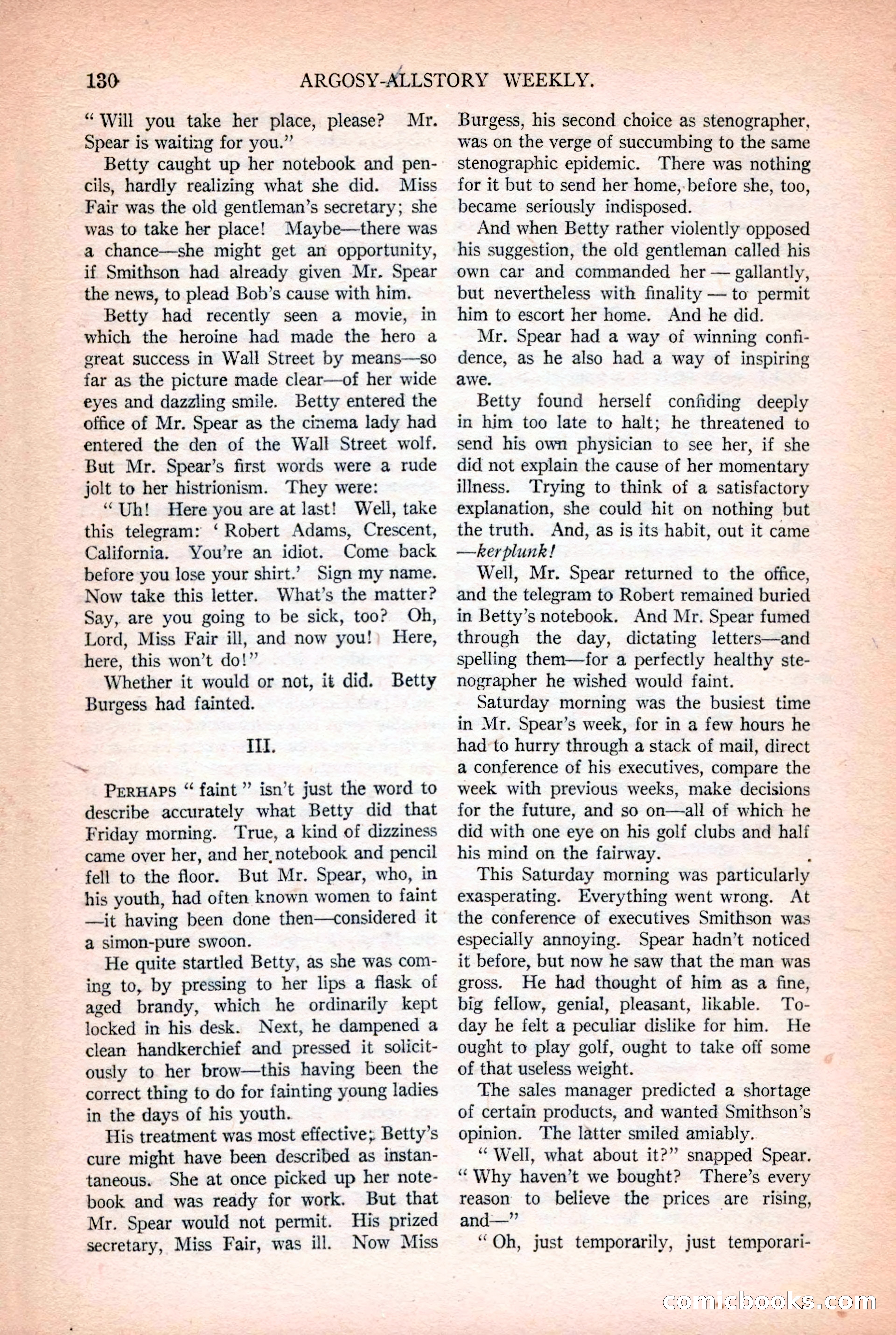
A restored page from Pulp Fiction, 1924. Page through the whole issue in the reader above.
📄 Transcribed text from this page (OCR, searchable)
Machine-transcribed from the original scan — historical spelling and the odd misread are preserved.
130 “Will you take her place, please? Mr. Spear is waiting for you.” Betty caught up her notebook and pen- cils, hardly realizing what she did. Miss Fair was the old gentleman’s secretary; she was to take her place! Maybe—there was a chance—she might get an opportunity, if Smithson had already given Mr. Spear the news, to plead Bob’s cause with him. Betty had recently seen a movie, in which the heroine had made the hero a great success in Wall Street by means—so far as the picture made clear—of her wide eyes and dazzling smile. Betty entered the office of Mr. Spear as the cinema lady had entered the den of the Wall Street wolf. But Mr. Spear’s first words were a rude jolt to her histrionism. They were: “Uh! Here you are at last! Well, take this telegram: ‘ Robert Adams, Crescent, California. You’re an idiot. Come back before you lose your shirt.’ Sign my name. Now take this letter. What’s the matter? Say, are you going to be sick, too? Oh, Lord, Miss Fair ill, and now you!) Here, here, this won’t do!”’ Whether it would or not, it did. Betty Burgess had fainted. Tit. ~~ Preruaps “ faint ” isn’t just the word to describe accurately what Betty did that Friday morning. True, a kind of dizziness came over her, and her, notebook and pencil fell to the floor. But Mr. Spear, who, in his youth, had often known women to faint —it having been done then—considered it a simon-pure swoon. He quite startled Betty, as she was com- ing to, by pressing to her lips a flask of aged brandy, which he ordinarily kept locked in his desk. Next, he dampened a clean handkerchief and pressed it solicit- ously to her brow—this having been the correct thing to do for fainting young ladies in the days of his youth. His treatment was most effective; Betty’s cure might have been described as instan- taneous. She at once picked up her note- book and was ready for work. But that Mr. Spear would not permit. His prized secretary, Miss Fair, was ill. Now Miss ARGOSY-ALLSTORY WEEKLY. Burgess, his second choice as stenographer, was on the verge of succumbing to the same stenographic epidemic. There was nothing for it but to send her home,-before she, too, became seriously indisposed. And when Betty rather violently opposed his suggestion, the old gentleman called his own car and commanded her — gallantly, but nevertheless with finality — to permit him to escort her home. And he did. Mr. Spear had a way of winning confi- dence, as he also had a way of inspiring awe. Betty found herself confiding deeply in him too late to halt; he threatened to send his own physician to see her, if she did not explain the cause of her momentary illness. Trying to think of a satisfactory explanation, she could hit on nothing but the truth. And, as is its habit, out it came —kerplunk! Well, Mr. Spear returned to the office, and the telegram to Robert remained buried in Betty’s notebook. And Mr. Spear fumed through the day, dictating letters—and spelling them—for a perfectly healthy ste- nographer he wished would faint. Saturday morning was the busiest time in Mr. Spear’s week, for in a few hours he had to hurry through a stack of mail, direct a conference of his executives, compare the week with previous weeks, make decisions for the future, and so on—all of which he did with one eye on his golf clubs and half his mind on the fairway. This Saturday morning was particularly exasperating. Everything went wrong. At the conference of executives Smithson was especially annoying. Spear hadn’t noticed it before, but now he saw that the man was gross. He had thought of him as a fine, big fellow, genial, pleasant, likable. To- day he felt a peculiar dislike for him. He ought to play golf, ought to take off some of that useless weight. The sales manager predicted a shortage of certain products, and wanted Smithson’s opinion. The latter smiled amiably. “Well, what about it?” snapped Spear. ““ Why haven’t we bought? There’s every reason to believe the prices are rising, and—”’ “Oh, just temporarily, just temporari- COmMclboooks